

Andere Kunden interessierten sich auch für
 How to Read Human Nature27,99 €
 How to Read Your Own Character25,99 €
 Proof Read20,99 €
 A Review of Aristotle's System of Ethics: A Prelection Read Feb. 16, 186727,99 €
 An Enquiry Into the Nature of the Human Soul: Its Origin, Properties, and Faculties; Considered Both in Regard to Itself, and Its Union With the Body27,99 €
 Human Immortality15,99 €
 An Introduction to the Science of Metaphysics46,99 €







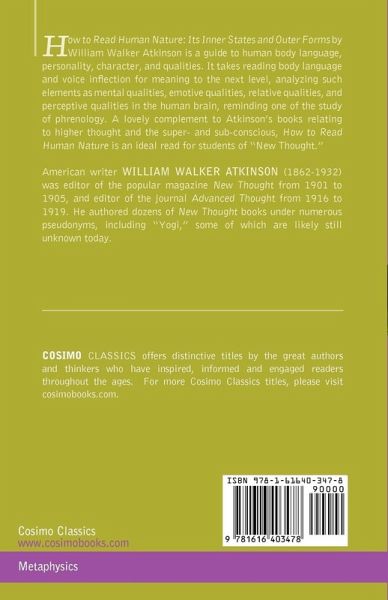
How to Read Human Nature: Its Inner States and Outer Forms by William Walker Atkinson is a guide to human body language, personality, character, and qualities. It takes reading body language and voice inflection for meaning to the next level, analyzing such elements as mental qualities, emotive qualities, relative qualities, and perceptive qualities in the human brain, reminding one of the study of phrenology. A lovely complement to Atkinson's books relating to higher thought and the super- and sub-conscious, How to Read Human Nature is an ideal read for students of "New Thought." American writer WILLIAM WALKER ATKINSON (1862-1932) was editor of the popular magazine New Thought from 1901 to 1905, and editor of the journal Advanced Thought from 1916 to 1919. He authored dozens of New Thought books under numerous pseudonyms, including "Yogi," some of which are likely still unknown today.