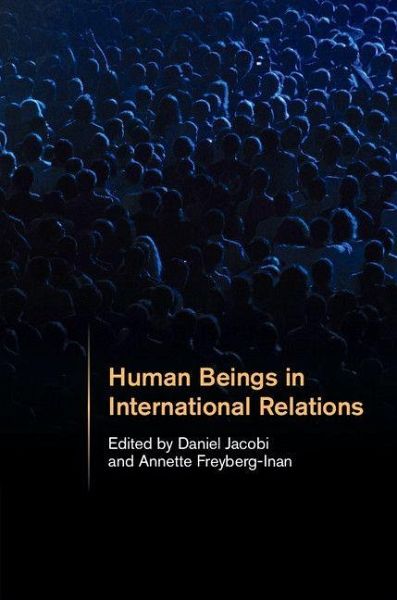
Since the 1980s, the discipline of International Relations has seen a series of disputes over its foundations. However, there has been one core concept that, although addressed in various guises, had never been explicitly and systematically engaged with in these debates: the human. This volume is the first to address comprehensively the topic of the human in world politics. It comprises cutting-edge accounts by leading scholars of how the human is (or is not) theorized across the entire range of IR theories, old and new. The authors provide a solid foundation for future debates about how, why,…mehr
Since the 1980s, the discipline of International Relations has seen a series of disputes over its foundations. However, there has been one core concept that, although addressed in various guises, had never been explicitly and systematically engaged with in these debates: the human. This volume is the first to address comprehensively the topic of the human in world politics. It comprises cutting-edge accounts by leading scholars of how the human is (or is not) theorized across the entire range of IR theories, old and new. The authors provide a solid foundation for future debates about how, why, and to which ends the human has been or must (not) be built into our theories, and systematically lay out the implications of such moves for how we come to see world politics and humanity's role within it.
Introduction: human being(s) in international relations Daniel Jacobi and Annette Freyberg-Inan; Part I. International Political Anthropology: 1. Between fear and despair: human nature in realism Annette Freyberg-Inan; 2. 'Human nature' and the paradoxical order of liberalism Stephen J. Rosow; 3. Disciplining human nature: the evolution of American social scientific theorizing Jennifer Sterling-Folker and Jason F. Charrette; 4. The Marxist perspective from 'species-being' to natural justice Chris Brown; 5. In biology we trust: biopolitical science and the elusive self Duncan Bell; 6. Greeks, neuroscience, and international relations Richard Ned Lebow; 7. Constructivism, realism, and the variety of human natures Samuel Barkin; 8. Feminism and the figure of Man Elisabeth Prügl; Part II. International Political Post-Anthropology: 9. Realism, agency, and the politics of nature Colin Wight; 10. A global human condition Mauro J. Caraccioli; 11. Imagining man - forgetting society? Benjamin Herborth; 12. On the social (re)construction of the human in world politics Daniel Jacobi; 13. Observing visions of man Oliver Kessler; 14. Who is acting in international relations? Jan-Hendrik Passoth and Nicholas J. Rowland; Conclusion: toward an International Political (Post-)Anthropology Annette Freyberg-Inan and Daniel Jacobi.
Introduction: human being(s) in international relations Daniel Jacobi and Annette Freyberg-Inan; Part I. International Political Anthropology: 1. Between fear and despair: human nature in realism Annette Freyberg-Inan; 2. 'Human nature' and the paradoxical order of liberalism Stephen J. Rosow; 3. Disciplining human nature: the evolution of American social scientific theorizing Jennifer Sterling-Folker and Jason F. Charrette; 4. The Marxist perspective from 'species-being' to natural justice Chris Brown; 5. In biology we trust: biopolitical science and the elusive self Duncan Bell; 6. Greeks, neuroscience, and international relations Richard Ned Lebow; 7. Constructivism, realism, and the variety of human natures Samuel Barkin; 8. Feminism and the figure of Man Elisabeth Prügl; Part II. International Political Post-Anthropology: 9. Realism, agency, and the politics of nature Colin Wight; 10. A global human condition Mauro J. Caraccioli; 11. Imagining man - forgetting society? Benjamin Herborth; 12. On the social (re)construction of the human in world politics Daniel Jacobi; 13. Observing visions of man Oliver Kessler; 14. Who is acting in international relations? Jan-Hendrik Passoth and Nicholas J. Rowland; Conclusion: toward an International Political (Post-)Anthropology Annette Freyberg-Inan and Daniel Jacobi.
Es gelten unsere Allgemeinen Geschäftsbedingungen: www.buecher.de/agb
Impressum
www.buecher.de ist ein Internetauftritt der buecher.de internetstores GmbH
Geschäftsführung: Monica Sawhney | Roland Kölbl | Günter Hilger
Sitz der Gesellschaft: Batheyer Straße 115 - 117, 58099 Hagen
Postanschrift: Bürgermeister-Wegele-Str. 12, 86167 Augsburg
Amtsgericht Hagen HRB 13257
Steuernummer: 321/5800/1497
USt-IdNr: DE450055826