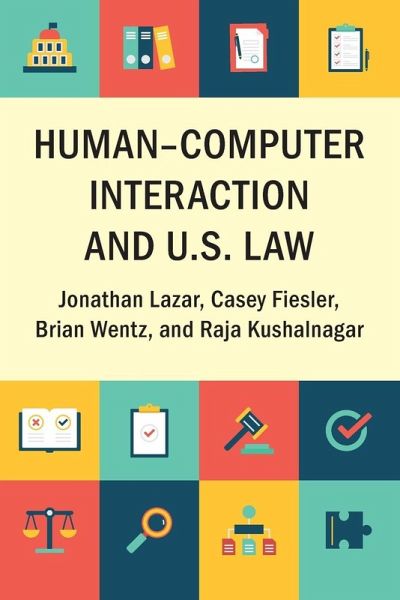
The core topics at the intersection of human-computer interaction (HCI) and US law -- privacy, accessibility, telecommunications, intellectual property, artificial intelligence (AI), dark patterns, human subjects research, and voting -- can be hard to understand without a deep foundation in both law and computing. Every member of the author team of this unique book brings expertise in both law and HCI to provide an in-depth yet understandable treatment of each topic area for professionals, researchers, and graduate students in computing and/or law. Two introductory chapters explaining the core…mehr
The core topics at the intersection of human-computer interaction (HCI) and US law -- privacy, accessibility, telecommunications, intellectual property, artificial intelligence (AI), dark patterns, human subjects research, and voting -- can be hard to understand without a deep foundation in both law and computing. Every member of the author team of this unique book brings expertise in both law and HCI to provide an in-depth yet understandable treatment of each topic area for professionals, researchers, and graduate students in computing and/or law. Two introductory chapters explaining the core concepts of HCI (for readers with a legal background) and U.S. law (for readers with an HCI background) are followed by in-depth discussions of each topic.
Jonathan Lazar, PhD, LLM, is Professor in the College of Information at the University of Maryland, where he is the executive director of the Maryland Initiative for Digital Accessibility (MIDA) and a faculty member in the Human-Computer Interaction Lab (HCIL). He has been teaching and researching about human-computer interaction (HCI), accessibility, and the intersections between law, policy, and HCI, for over 25 years. He has previously authored or edited 18 books and published over 200 refereed articles in journals, conference proceedings, edited books, and magazines. He has received research funding from the U.S. National Science Foundation, the U.S. National Institute on Disability, Independent Living, and Rehabilitation Research (NIDILRR), Google, and Adobe. He has served as an expert witness in many legal cases, has given legislative testimony at the state and federal level over 20 times, regularly teaches legal research methods to nonlawyers, and is a member of the Disability Rights Bar Association.
Inhaltsangabe
Foreword by Lorrie Cranor Preface 1. Introduction to Law for Human Computer Interaction 2. Introduction to Human Computer Interaction for Law 3. Accessibility 4. Privacy 5. Human Subjects Research Regulation 6. Intellectual Property 7. Telecommunications 8. Artificial Intelligence 9. Dark Patterns 10. Voting Interfaces and U.S. Law 11. International Laws, Treaties, and HCI Index.
Foreword by Lorrie Cranor Preface 1. Introduction to Law for Human Computer Interaction 2. Introduction to Human Computer Interaction for Law 3. Accessibility 4. Privacy 5. Human Subjects Research Regulation 6. Intellectual Property 7. Telecommunications 8. Artificial Intelligence 9. Dark Patterns 10. Voting Interfaces and U.S. Law 11. International Laws, Treaties, and HCI Index.
Es gelten unsere Allgemeinen Geschäftsbedingungen: www.buecher.de/agb
Impressum
www.buecher.de ist ein Internetauftritt der buecher.de internetstores GmbH
Geschäftsführung: Monica Sawhney | Roland Kölbl | Günter Hilger
Sitz der Gesellschaft: Batheyer Straße 115 - 117, 58099 Hagen
Postanschrift: Bürgermeister-Wegele-Str. 12, 86167 Augsburg
Amtsgericht Hagen HRB 13257
Steuernummer: 321/5800/1497
USt-IdNr: DE450055826