

Andere Kunden interessierten sich auch für
 Dictating Demography113,99 €
 Human Population Dynamics137,99 €
 Death and the Metropolis137,99 €
 British Population History114,99 €
 Applied Latent Class Analysis141,99 €
 Upland Communities131,99 €
 Malthus78,99 €



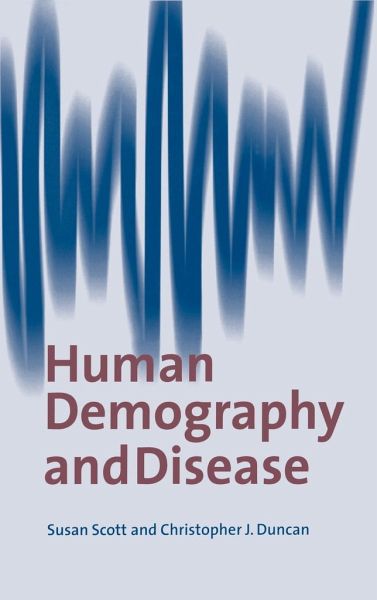
Human Demography and Disease offers an interdisciplinary and integrated perspective on the relationship between historical populations and the dynamics of epidemiological processes. It brings the techniques of time-series analysis and computer matrix modelling to historical demography and geography to extract detailed information concerning the oscillations in births, deaths, migrations and epidemics from parish registers and other data series and to build mathematical models of the population cycles. This book presents a new way of studying pre-industrial communities and explores the subtle, and hitherto undetected effects of fluctuating nutritional levels on mortality patterns and the dynamics of infectious diseases. It will be of interest to researchers, teachers and students in the fields of demography, anthropology, historical geography, social history, population biology and epidemiology.
Table of contents:
Preface; 1. Introduction; 2. Tools for demography and epidemiology; 3. Identification of population oscillations: a case study; 4. Density-dependent control and feedback; 5. Modelling the endogenous oscillations and predictions from time-series analysis; 6. Cycles in the grain price series; 7. Interactions of exogenous cycles: a case study; 8. Mortality crises and the effects of the price of wool; 9. Modelling epidemics for the demographer: the dynamics of smallpox in London; 10. Non-linear modelling of the two-yearly epidemics in smallpox: the genesis of chaos?; 11. Measles and whooping cough in London; 12. Integration of the dynamics of infectious diseases with the demography of London; 13. Smallpox in rural towns in England in the seventeenth and eighteenth centuries; 14. Infectious diseases in England and Wales in the nineteenth century; 15. Prospectives - towards a meta-population study; References; Index.
Much information on population cycles is contained in parish registers. Mathematical techniques described here can provide an insight into mortality patterns in past societies and the ways in which they are subtly influenced by levels of nutrition and by cyclical epidemics of lethal infectious diseases.
Integrated and novel approach to demographic and epidemiological studies of human populations.
Table of contents:
Preface; 1. Introduction; 2. Tools for demography and epidemiology; 3. Identification of population oscillations: a case study; 4. Density-dependent control and feedback; 5. Modelling the endogenous oscillations and predictions from time-series analysis; 6. Cycles in the grain price series; 7. Interactions of exogenous cycles: a case study; 8. Mortality crises and the effects of the price of wool; 9. Modelling epidemics for the demographer: the dynamics of smallpox in London; 10. Non-linear modelling of the two-yearly epidemics in smallpox: the genesis of chaos?; 11. Measles and whooping cough in London; 12. Integration of the dynamics of infectious diseases with the demography of London; 13. Smallpox in rural towns in England in the seventeenth and eighteenth centuries; 14. Infectious diseases in England and Wales in the nineteenth century; 15. Prospectives - towards a meta-population study; References; Index.
Much information on population cycles is contained in parish registers. Mathematical techniques described here can provide an insight into mortality patterns in past societies and the ways in which they are subtly influenced by levels of nutrition and by cyclical epidemics of lethal infectious diseases.
Integrated and novel approach to demographic and epidemiological studies of human populations.