
Andere Kunden interessierten sich auch für
 Criminology37,99 €
 Social Comprehension and Judgment172,99 €
 The Self in Social Judgment171,99 €
 Attitude in Relation to the Psychophysical Judgment ..25,99 €
 Intuition in Judgment and Decision Making172,99 €
 Human Discords23,99 €
 Situational Judgment Tests170,99 €



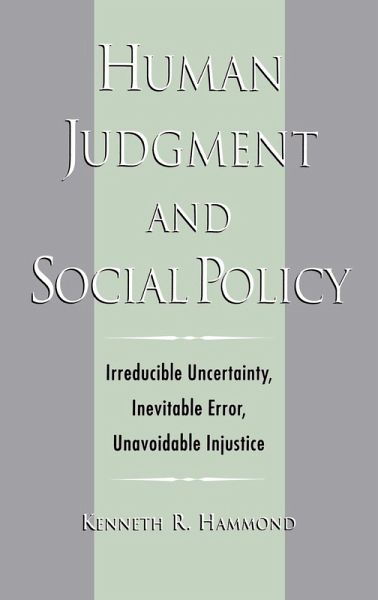
This book introduces a new topic; a critical researched-based analysis of the role of human judgment in social policy formation. It applies what has been learned from research on human judgment to specific examples - from the Challenger disaster to present-day debates on health care. Human judgment can be a source of both hope and fear in the creation of social policy. Yet this important process has rarely been examined because research on human judgment has been scarce. Now, however, the results of 50 years of empirical work offer an unprecedented opportunity to examine human judgment and the basis of our hopes and fears. Numerous examples from law, medicine, engineering, and economics are used throughout to demonstrate these and other features of human judgment in action.
From the O.J. Simpson verdict to peace-making in the Balkans, the critical role of human judgement--complete with its failures, flaws, and successes--has never been more hotly debated and analyzed than it is today. This landmark work examines the dynamics of judgement and its impact on events that take place in human society, which require the direction and control of social policy. Research on social policy typically focuses on content. This book concentrates instead on the decision-making process itself. Drawing on 50 years of empirical research in decision theory, Hammond examines the possibilities for wisdom and cognitive competence in the formation of social policies, and applies these lessons to specific examples, such as the space shuttle Challenger disaster and the health care debate. Uncertainly, he tells us, can seldom be fully eliminated; thus error is inevitable, and injustice for some unavoidable. But the capacity for make wise judgments increases to the extent that we understand the potential pitfalls and their origin. The judgment process for example involves an ongoing rivalry between intuition and analysis, accuracy and rationality. The source of this tension requires an examination of the evolutionary roots of human judgement and how these fundamental features may be changing as our civilization increasingly becomes an information and knowledge-based society. With numerous examples from law, medicine, engineering, and economics, the author dramatizes the importance of judgment and its role in the formation of social policies which affect us all, and issues the first comprehensive examination of its underlying dynamics.
From the O.J. Simpson verdict to peace-making in the Balkans, the critical role of human judgement--complete with its failures, flaws, and successes--has never been more hotly debated and analyzed than it is today. This landmark work examines the dynamics of judgement and its impact on events that take place in human society, which require the direction and control of social policy. Research on social policy typically focuses on content. This book concentrates instead on the decision-making process itself. Drawing on 50 years of empirical research in decision theory, Hammond examines the possibilities for wisdom and cognitive competence in the formation of social policies, and applies these lessons to specific examples, such as the space shuttle Challenger disaster and the health care debate. Uncertainly, he tells us, can seldom be fully eliminated; thus error is inevitable, and injustice for some unavoidable. But the capacity for make wise judgments increases to the extent that we understand the potential pitfalls and their origin. The judgment process for example involves an ongoing rivalry between intuition and analysis, accuracy and rationality. The source of this tension requires an examination of the evolutionary roots of human judgement and how these fundamental features may be changing as our civilization increasingly becomes an information and knowledge-based society. With numerous examples from law, medicine, engineering, and economics, the author dramatizes the importance of judgment and its role in the formation of social policies which affect us all, and issues the first comprehensive examination of its underlying dynamics.