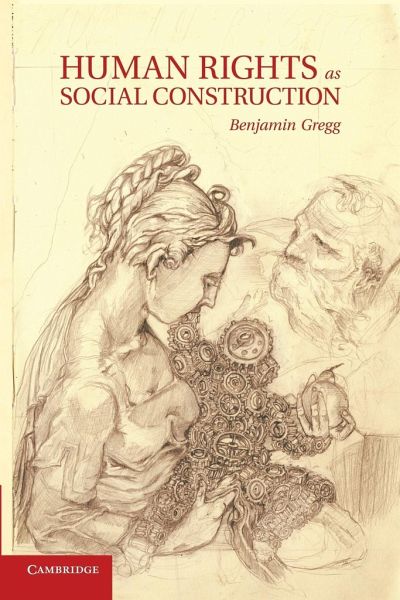
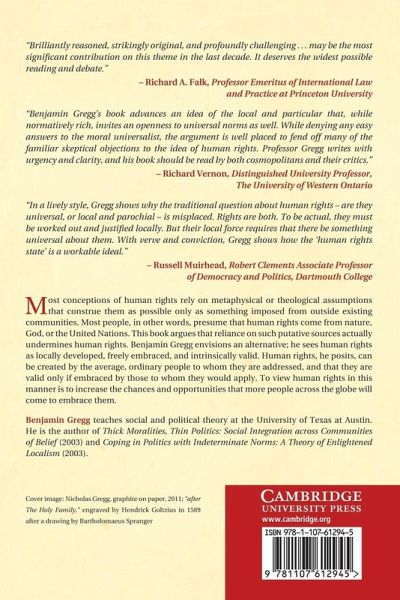
Most conceptions of human rights rely on metaphysical or theological assumptions that construe them as possible only as something imposed from outside existing communities. Most people, in other words, presume that human rights come from nature, God, or the United Nations. This book argues that reliance on such putative sources actually undermines human rights. Benjamin Gregg envisions an alternative; he sees human rights as locally developed, freely embraced, and indigenously valid. Human rights, he posits, can be created by the average, ordinary people to whom they are addressed, and that…mehr
Most conceptions of human rights rely on metaphysical or theological assumptions that construe them as possible only as something imposed from outside existing communities. Most people, in other words, presume that human rights come from nature, God, or the United Nations. This book argues that reliance on such putative sources actually undermines human rights. Benjamin Gregg envisions an alternative; he sees human rights as locally developed, freely embraced, and indigenously valid. Human rights, he posits, can be created by the average, ordinary people to whom they are addressed, and that they are valid only if embraced by those to whom they would apply. To view human rights in this manner is to increase the chances and opportunities that more people across the globe will come to embrace them.
Benjamin Gregg teaches social and political theory at the University of Texas, Austin. He is the author of Thick Moralities, Thin Politics: Social Integration across Communities of Belief (2003) and Coping in Politics with Indeterminate Norms: A Theory of Enlightened Localism (2003). His articles have appeared in Political Theory, the Review of Politics, Theory and Society, Polity, Ratio Juris, Comparative Sociology and the International Review of Sociology.
Inhaltsangabe
Part I. This-Worldly Norms, Local Not Universal: 1. Human rights: political not theological; 2. Human rights: political not metaphysical; 3. Generating universal human rights out of local norms; Part II. This-Worldly Resources for Human Rights as Social Construction: 4. Cultural resources: individuals as authors of human rights; 5. Neurobiological resources: emotions and natural altruism in support of human rights; Part III. This-Worldly Means of Advancing the Human-Rights Idea: 6. Translating human rights into local cultural vernaculars; 7. Advancing human rights through cognitive re-framing; Part IV. Human Rights, Future Tense: Human Nature and Political Community Reconceived: 8. Human rights via human nature as cultural choice; 9. The human-rights state; Part V. Coda: 10. What is lost, and what gained, by human rights as social construction.
Es gelten unsere Allgemeinen Geschäftsbedingungen: www.buecher.de/agb
Impressum
www.buecher.de ist ein Internetauftritt der buecher.de internetstores GmbH
Geschäftsführung: Monica Sawhney | Roland Kölbl | Günter Hilger
Sitz der Gesellschaft: Batheyer Straße 115 - 117, 58099 Hagen
Postanschrift: Bürgermeister-Wegele-Str. 12, 86167 Augsburg
Amtsgericht Hagen HRB 13257
Steuernummer: 321/5800/1497
USt-IdNr: DE450055826