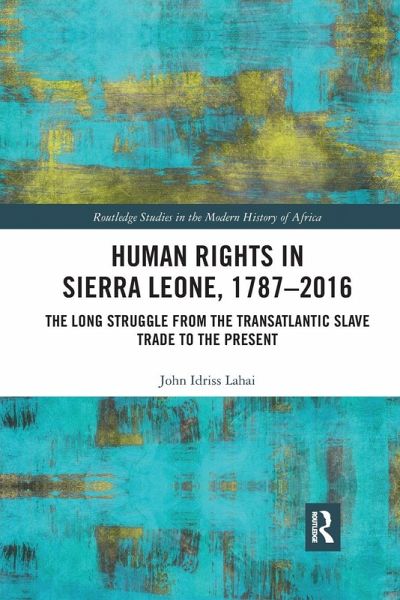
While acknowledging the challenges associated with the promotion of human rights in an environment of uncertainty, political fragility, lawlessness and deprivation, Lahai sheds light on the engagement of the people of Sierra Leone with a variety of societal conditionsto influence constitutional change and acceptable human rights practice.
While acknowledging the challenges associated with the promotion of human rights in an environment of uncertainty, political fragility, lawlessness and deprivation, Lahai sheds light on the engagement of the people of Sierra Leone with a variety of societal conditionsto influence constitutional change and acceptable human rights practice.
John Idriss Lahai is a Research Fellow at the University of New England, Australia.
Inhaltsangabe
Foreword Introduction 1. The Transatlantic Slave Trade and the Illusions of "Freedom," 1787-1790 2. The Restitutive Justice Policy of the Sierra Leone Company, 1791-1808 3. No Taxation without Representation, 1820-1920 4. Citizens and Protected Persons, 1920-1951 5. Racism and the Rise of Party Politics, 1950-1960 6. Class Conflict: Chiefs, Politicians, and Peasants and the Revolts of 1955 and 1956 7. Women in the Colonial Spaces: From the Founding of the Colony to 1960 8. Political Independence and the Africanization Project, 1960-1967 9. The Narratives on Human Rights in a Neopatrimonial State, 1967-1984 10. Ethnopolitics, Tribal-Nationalism, and the Youth Empowerment Crisis, 1985-1991 11. (Wo)Men's Rights in the Neopatrimonial/Ethnopolitical Spaces, 1967-1991 12. The Idea of Liberation in the War Communities, 1991-2002: Representation, Adaptation, and Outcomes 13. Contested Truth: The Truth Commission and Restorative Justice, 2002-2004 14. The War Victims' Fund and the Emergence of Contributive Justice after 2004 15. The Quest for Another Province of Freedom: The Human Rights Commission and the Constitutional Review Committee, 1994-2016 16. Conclusion
Foreword Introduction 1. The Transatlantic Slave Trade and the Illusions of "Freedom," 1787-1790 2. The Restitutive Justice Policy of the Sierra Leone Company, 1791-1808 3. No Taxation without Representation, 1820-1920 4. Citizens and Protected Persons, 1920-1951 5. Racism and the Rise of Party Politics, 1950-1960 6. Class Conflict: Chiefs, Politicians, and Peasants and the Revolts of 1955 and 1956 7. Women in the Colonial Spaces: From the Founding of the Colony to 1960 8. Political Independence and the Africanization Project, 1960-1967 9. The Narratives on Human Rights in a Neopatrimonial State, 1967-1984 10. Ethnopolitics, Tribal-Nationalism, and the Youth Empowerment Crisis, 1985-1991 11. (Wo)Men's Rights in the Neopatrimonial/Ethnopolitical Spaces, 1967-1991 12. The Idea of Liberation in the War Communities, 1991-2002: Representation, Adaptation, and Outcomes 13. Contested Truth: The Truth Commission and Restorative Justice, 2002-2004 14. The War Victims' Fund and the Emergence of Contributive Justice after 2004 15. The Quest for Another Province of Freedom: The Human Rights Commission and the Constitutional Review Committee, 1994-2016 16. Conclusion
Es gelten unsere Allgemeinen Geschäftsbedingungen: www.buecher.de/agb
Impressum
www.buecher.de ist ein Internetauftritt der buecher.de internetstores GmbH
Geschäftsführung: Monica Sawhney | Roland Kölbl | Günter Hilger
Sitz der Gesellschaft: Batheyer Straße 115 - 117, 58099 Hagen
Postanschrift: Bürgermeister-Wegele-Str. 12, 86167 Augsburg
Amtsgericht Hagen HRB 13257
Steuernummer: 321/5800/1497
USt-IdNr: DE450055826