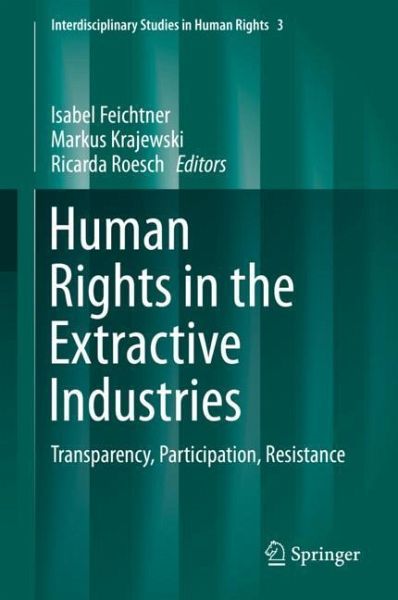
This book addresses key challenges and conflicts arising in extractive industries (mining, oil drilling) concerning the human rights of workers, their families, local communities and other stakeholders. Further, it analyses various instruments that have sought to mitigate human rights violations by defining transparency-related obligations and participation rights. These include the Extractive Industries Transparency Initiative (EITI), disclosure requirements, and free, prior and informed consent (FPIC). The book critically assesses these instruments, demonstrating that, in some cases, they…mehr
This book addresses key challenges and conflicts arising in extractive industries (mining, oil drilling) concerning the human rights of workers, their families, local communities and other stakeholders. Further, it analyses various instruments that have sought to mitigate human rights violations by defining transparency-related obligations and participation rights. These include the Extractive Industries Transparency Initiative (EITI), disclosure requirements, and free, prior and informed consent (FPIC). The book critically assesses these instruments, demonstrating that, in some cases, they produce unwanted effects. Furthermore, it highlights the importance of resistance to extractive industry projects as a response to human rights violations, and discusses how transparency, participation and resistance are interconnected.
Artikelnr. des Verlages: 87025102, 978-3-030-11381-0
1st ed. 2019
Seitenzahl: 564
Erscheinungstermin: 26. Juni 2019
Englisch
Abmessung: 241mm x 160mm x 36mm
Gewicht: 1003g
ISBN-13: 9783030113810
ISBN-10: 3030113817
Artikelnr.: 54734126
Herstellerkennzeichnung
Springer-Verlag GmbH
Tiergartenstr. 17
69121 Heidelberg
ProductSafety@springernature.com
Inhaltsangabe
Introduction.- Part One: Transparency.- The Extractive Industries Transparency Initiative (EITI) as a Human Rights Instrument: Potentials and Shortcomings.- United States Law and Conflict Minerals.- The 2017 EU Conflict Minerals Regulation: A Promising European Rite to Remove the Natural Resource Curse?.- Community Development Agreements as Tools for Local Participation in Natural Resource Projects in Africa.- Stabilization Clauses and Human Rights: The Role of Transparency Initiatives.- Improving Tax Strategy Transparency in the Extractive Industries Sector for the Advancement of Human Rights.- Part II: Participation.- The Evolving Duty to Consult and Obtain Free Prior and Informed Consent of Indigenous Peoples for Extractive Projects in the United States and Canada.- Asserting the Principle of Free, Prior and Informed Consent (FPIC) in Sub-Saharan Africa in the Extractive Industry Sector.- The Corporate Responsibility to Respect Consultation Rights in the Americas: How the Inter-American System Can Better Promote Free, Prior, and Informed Consent.- Free, Prior, and Informed Consent in the Philippines: A Fourth World Critique.- Norm Contestation and (Non-)Compliance: The Right to Prior Consultation and FPIC in the Extractive Industries.- State-Investor Contracts and Human Rights: Taking a Critical Look at Transparency and Participation.- Disruption and Institutional Development: Corporate Standards and Practices on Responsible Mining.- Part III: Resistance.- Taking Sides in Scientific Research? The Struggle for the Right to Participate in Public Decision-Making Related to a Mining Project in Brazil.- Building the Case for a Home-State Grievance Mechanism: Law Reform Strategies in the Canadian Resource Justice Movement.- Transnational Human Rights and Environmental Litigation: A Study of Case Law Relating to Shell in Nigeria.
Introduction.- Part One: Transparency.- The Extractive Industries Transparency Initiative (EITI) as a Human Rights Instrument: Potentials and Shortcomings.- United States Law and Conflict Minerals.- The 2017 EU Conflict Minerals Regulation: A Promising European Rite to Remove the Natural Resource Curse?.- Community Development Agreements as Tools for Local Participation in Natural Resource Projects in Africa.- Stabilization Clauses and Human Rights: The Role of Transparency Initiatives.- Improving Tax Strategy Transparency in the Extractive Industries Sector for the Advancement of Human Rights.- Part II: Participation.- The Evolving Duty to Consult and Obtain Free Prior and Informed Consent of Indigenous Peoples for Extractive Projects in the United States and Canada.- Asserting the Principle of Free, Prior and Informed Consent (FPIC) in Sub-Saharan Africa in the Extractive Industry Sector.- The Corporate Responsibility to Respect Consultation Rights in the Americas: How the Inter-American System Can Better Promote Free, Prior, and Informed Consent.- Free, Prior, and Informed Consent in the Philippines: A Fourth World Critique.- Norm Contestation and (Non-)Compliance: The Right to Prior Consultation and FPIC in the Extractive Industries.- State-Investor Contracts and Human Rights: Taking a Critical Look at Transparency and Participation.- Disruption and Institutional Development: Corporate Standards and Practices on Responsible Mining.- Part III: Resistance.- Taking Sides in Scientific Research? The Struggle for the Right to Participate in Public Decision-Making Related to a Mining Project in Brazil.- Building the Case for a Home-State Grievance Mechanism: Law Reform Strategies in the Canadian Resource Justice Movement.- Transnational Human Rights and Environmental Litigation: A Study of Case Law Relating to Shell in Nigeria.
Es gelten unsere Allgemeinen Geschäftsbedingungen: www.buecher.de/agb
Impressum
www.buecher.de ist ein Internetauftritt der buecher.de internetstores GmbH
Geschäftsführung: Monica Sawhney | Roland Kölbl | Günter Hilger
Sitz der Gesellschaft: Batheyer Straße 115 - 117, 58099 Hagen
Postanschrift: Bürgermeister-Wegele-Str. 12, 86167 Augsburg
Amtsgericht Hagen HRB 13257
Steuernummer: 321/5800/1497
USt-IdNr: DE450055826