
Andere Kunden interessierten sich auch für
 Humanities Data in R49,99 €
 Humanities Data in R68,99 €
 R kompakt39,99 €
 Statistik für alle22,99 €
 Applied Multidimensional Scaling and Unfolding53,99 €
 Statistik im Forschungsprozess139,99 €
 Computerized Adaptive and Multistage Testing with R69,54 €


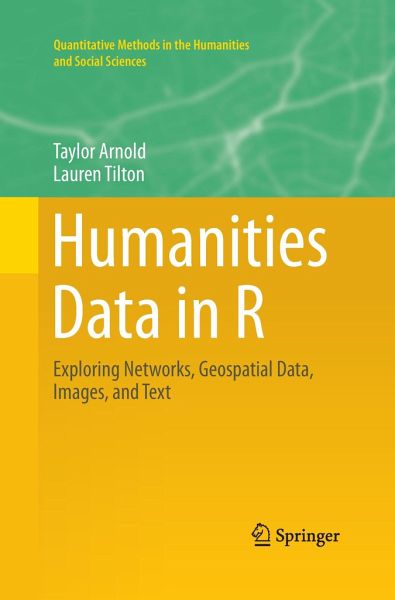
This pioneering book teaches readers to use R within four core analytical areas applicable to the Humanities: networks, text, geospatial data, and images. This book is also designed to be a bridge: between quantitative and qualitative methods, individual and collaborative work, and the humanities and social sciences. Humanities Data with R does not presuppose background programming experience. Early chapters take readers from R set-up to exploratory data analysis (continuous and categorical data, multivariate analysis, and advanced graphics with emphasis on aesthetics and facility). Following this, networks, geospatial data, image data, natural language processing and text analysis each have a dedicated chapter. Each chapter is grounded in examples to move readers beyond the intimidation of adding new tools to their research. Everything is hands-on: networks are explained using U.S. Supreme Court opinions, and low-level NLP methods are applied to short stories by Sir Arthur ConanDoyle. After working through these examples with the provided data, code and book website, readers are prepared to apply new methods to their own work. The open source R programming language, with its myriad packages and popularity within the sciences and social sciences, is particularly well-suited to working with humanities data. R packages are also highlighted in an appendix. This book uses an expanded conception of the forms data may take and the information it represents. The methodology will have wide application in classrooms and self-study for the humanities, but also for use in linguistics, anthropology, and political science. Outside the classroom, this intersection of humanities and computing is particularly relevant for research and new modes of dissemination across archives, museums and libraries.
Arnold and Tilton are a brilliant team, and this highly accessible book will appeal to a wide range of digital humanists. The text analysis chapters are very good, and the authors' work to develop an R package for interacting with the Stanford CoreNLP java Library fills a huge hole in the R text processing landscape.
Matthew L. Jockers, University of Nebraska-Lincoln; author of Text Analysis with R for Students of Literature (Springer, 2014)
This is the first book that covers analysis of all main parts of humanities data: texts, images, geospatial data, and networks. Now digital humanities finally has its perfect textbook. This is the book many of us were awaiting for years. It teaches you R (the most widely used open source data analysis platform today worldwide) using many examples. The writing is very clear, and information is organized in a logical and easy to follow manner. Whether you are just considering working with humanities data or already have experience, this is the must read book.
Lev Manovich, The Graduate Center, City University of New York; author of The Language of New Media (MIT, 2001)
This book gives a concise yet broadly accessible introduction to R, through the lens of exploratory data analysis, coupled with well-planned forays into key humanities data types and their analysis -- including a nice primer on network analysis.
Eric D. Kolaczyk, Boston University; author of Statistical Analysis of Network Data with R (Springer, 2014)
Matthew L. Jockers, University of Nebraska-Lincoln; author of Text Analysis with R for Students of Literature (Springer, 2014)
This is the first book that covers analysis of all main parts of humanities data: texts, images, geospatial data, and networks. Now digital humanities finally has its perfect textbook. This is the book many of us were awaiting for years. It teaches you R (the most widely used open source data analysis platform today worldwide) using many examples. The writing is very clear, and information is organized in a logical and easy to follow manner. Whether you are just considering working with humanities data or already have experience, this is the must read book.
Lev Manovich, The Graduate Center, City University of New York; author of The Language of New Media (MIT, 2001)
This book gives a concise yet broadly accessible introduction to R, through the lens of exploratory data analysis, coupled with well-planned forays into key humanities data types and their analysis -- including a nice primer on network analysis.
Eric D. Kolaczyk, Boston University; author of Statistical Analysis of Network Data with R (Springer, 2014)