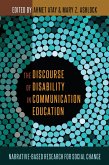
This edited volume features innovative contributions from researchers and practitioners in the global South who use qualitative methodologies to deconstruct colonial and positivist traditions in disability and inclusive education research. The editors extend ongoing intersectional dialogues in Critical Disability Studies (CDS) and Disability Critical Race Studies (DisCrit) by collaborating with leading disability scholars and activists worldwide. This collection offers innovative, humanizing, and internationally grounded disability-centric qualitative research practices that scholars,…mehr
This edited volume features innovative contributions from researchers and practitioners in the global South who use qualitative methodologies to deconstruct colonial and positivist traditions in disability and inclusive education research. The editors extend ongoing intersectional dialogues in Critical Disability Studies (CDS) and Disability Critical Race Studies (DisCrit) by collaborating with leading disability scholars and activists worldwide. This collection offers innovative, humanizing, and internationally grounded disability-centric qualitative research practices that scholars, practitioners, and activists can apply in their own spaces of advocacy and praxis.
Artikelnr. des Verlages: 89282131, 978-3-032-01311-8
Seitenzahl: 392
Erscheinungstermin: 2. November 2025
Englisch
Abmessung: 216mm x 153mm x 26mm
Gewicht: 616g
ISBN-13: 9783032013118
ISBN-10: 3032013119
Artikelnr.: 74787233
Herstellerkennzeichnung
Springer-Verlag GmbH
Tiergartenstr. 17
69121 Heidelberg
ProductSafety@springernature.com
Autorenporträt
Brent C. Elder is Associate Professor of Inclusive Education at Rowan University, USA. His research and practice center on creating sustainable inclusive education practices in under-resourced schools across the US and low-resourced countries globally. His first book, The Future of Inclusive Education: Intersectional Perspectives, was co-authored with Valentina Migliarini. Valentina Migliarini is Associate Professor in Education Studies in the Department of Education and Social Justice at the University of Birmingham, UK. She is the Department Research Lead and an active member of the Centre for Research on Race in Education. Her work focuses on equitable access to education for multiply marginalized students, especially disabled students from migrant and forced migrant backgrounds in secondary education.
Inhaltsangabe
1. Introduction.- 2. Motherhood and disability in context: Transgenerational, intersectional, and situated narratives in Argentina (1981-2024).- 3. Tending the Murnong: Reflecting on a journey to amplify the voices and experiences of First Nations people who are Deaf and Hard of Hearing in research, practice, and community.- 4. Story telling and meaning making in the Himalaya: Ethnographic spatial mapping with disabled persons in Bhutan.- 5. Moving forward with Indigenous disability knowledge: An act of inclusion.- 6. Counterstories as disruptive tools in DisCrit and Dis/Ability research and theorizing: A Latin American mathematics education illustration.- 7. Supporting disabled migrant students and families from the global South in Italy.- 8. Generating data from persons with intellectual disabilities in Kenya: From focus group discussion to drawings.- 9. No one cares about children with disabilities! : Shifting the narrative and centering Syrian refugee children with disabilities and their parents experiences in Lebanon.- 10. Inclusive education and organizations of persons with disabilities (OPDs): Innovations from Malawi.- 11. Shifting inclusive education practices and structures: Critical Disability Studies in the Saudi Arabia education system.- 12. Inside-Out: An innovative localized approach to localized disability discourse research.- 13. Conclusion.
1. Introduction.- 2. Motherhood and disability in context: Transgenerational, intersectional, and situated narratives in Argentina (1981-2024).- 3. Tending the Murnong: Reflecting on a journey to amplify the voices and experiences of First Nations people who are Deaf and Hard of Hearing in research, practice, and community.- 4. Story telling and meaning making in the Himalaya: Ethnographic spatial mapping with disabled persons in Bhutan.- 5. Moving forward with Indigenous disability knowledge: An act of inclusion.- 6. Counterstories as disruptive tools in DisCrit and Dis/Ability research and theorizing: A Latin American mathematics education illustration.- 7. Supporting disabled migrant students and families from the global South in Italy.- 8. Generating data from persons with intellectual disabilities in Kenya: From focus group discussion to drawings.- 9. No one cares about children with disabilities! : Shifting the narrative and centering Syrian refugee children with disabilities and their parents experiences in Lebanon.- 10. Inclusive education and organizations of persons with disabilities (OPDs): Innovations from Malawi.- 11. Shifting inclusive education practices and structures: Critical Disability Studies in the Saudi Arabia education system.- 12. Inside-Out: An innovative localized approach to localized disability discourse research.- 13. Conclusion.
Es gelten unsere Allgemeinen Geschäftsbedingungen: www.buecher.de/agb
Impressum
www.buecher.de ist ein Internetauftritt der buecher.de internetstores GmbH
Geschäftsführung: Monica Sawhney | Roland Kölbl | Günter Hilger
Sitz der Gesellschaft: Batheyer Straße 115 - 117, 58099 Hagen
Postanschrift: Bürgermeister-Wegele-Str. 12, 86167 Augsburg
Amtsgericht Hagen HRB 13257
Steuernummer: 321/5800/1497
USt-IdNr: DE450055826