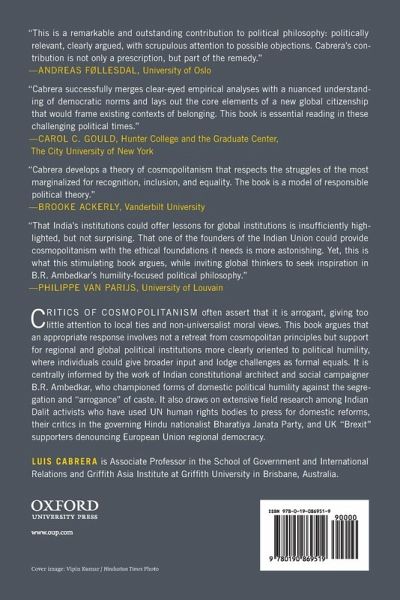
Is a strong cosmopolitan stance irretrievably arrogant? Cosmopolitanism, which affirms universal moral principles and grants no fundamental moral significance to the state, has become increasingly central to normative political theory. Yet, it has faced persistent claims that it disdains local attachments and cultures, while also seeking the neo-imperialistic imposition of Western moral views on all persons. The critique is said to apply with even greater force to institutional cosmopolitan approaches, which seek the development of global political institutions capable of promoting global aims…mehr
Is a strong cosmopolitan stance irretrievably arrogant? Cosmopolitanism, which affirms universal moral principles and grants no fundamental moral significance to the state, has become increasingly central to normative political theory. Yet, it has faced persistent claims that it disdains local attachments and cultures, while also seeking the neo-imperialistic imposition of Western moral views on all persons. The critique is said to apply with even greater force to institutional cosmopolitan approaches, which seek the development of global political institutions capable of promoting global aims for human rights, democracy, etc. This book works to address such objections through developing a novel theory of cosmopolitan political humility. It draws on the work of Indian constitutional architect and social activist B.R. Ambedkar, who cited universal principles of equality and rights in confronting domestic exclusions and the "arrogance" of caste. He sought to advance forms of political humility, or the recognition of equal standing, and openness to input and challenge within political institutions. This book explores how an "institutional global citizenship" approach to cosmopolitanism could similarly promote political humility globally, by supporting the development of democratic input and challenge mechanisms beyond the state. Such developments would challenge an essential political arrogance identified in the current system, where sovereign states are empowered to simply dismiss rights-based challenges from outsiders or their own populations--even as they serve as the designated guarantors of human rights. The book employs an innovative grounded normative theory method, where extensive original field research informs the development of moral claims. Insights are taken from Dalit activists reaching out to United Nations human rights bodies for support in challenging caste discrimination, and from their critics in the governing Bharatiya Janata Party. Further insights are drawn from Turkish protestors confronting a rising domestic authoritarianism, and from UK Independence Party members demanding "Brexit" from the European Union--in part because predominantly Muslim Turkey could eventually join. Overall, it is shown, an institutional global citizenship approach can inform the development of a global framework which would orient fundamentally to political humility rather than arrogance, and which could significantly advance global rights protections.
Luis Cabrera is Associate Professor in the School of Government and International Relations and Griffith Asia Institute at Griffith University in Brisbane, Australia. He has published widely on issues of global justice and ethics, including global citizenship, migration and individual rights, and on the development of more democratically accountable regional and global political institutions. He has conducted related field research in India, Mexico, Southeast Asia, several European Union countries, Turkey, and the United States.
Inhaltsangabe
* Preface and Acknowledgments * Chapter 1: Introduction: Claims of Cosmopolitan Arrogance and Humility * Part I: Configuring Cosmopolitan Humility * Chapter 2: Ambedkar on Political Humility and Challenging Political Arrogance * Chapter 3: Embracing the "Fiction of Equality": Grounding Equal Moral Worth and Categories of Fundamental Rights * Chapter 4: The "Soul of Democracy": Instrumental Justification and Political Humility * Chapter 5: NCDHR's Global Challenge * Chapter 6: The Arrogance of States * Part II Addressing Claims of Cosmopolitan Arrogance * Chapter 7: The Soul of Global Democracy * Chapter 8: Breaking India: Moral Parochialism and Neo-imperialism Objections * Chapter 9: Political Arrogance and National Belonging: UKIP, Turkey and the European Union * Chapter 10: Conclusion * Notes * References * Index
* Preface and Acknowledgments * Chapter 1: Introduction: Claims of Cosmopolitan Arrogance and Humility * Part I: Configuring Cosmopolitan Humility * Chapter 2: Ambedkar on Political Humility and Challenging Political Arrogance * Chapter 3: Embracing the "Fiction of Equality": Grounding Equal Moral Worth and Categories of Fundamental Rights * Chapter 4: The "Soul of Democracy": Instrumental Justification and Political Humility * Chapter 5: NCDHR's Global Challenge * Chapter 6: The Arrogance of States * Part II Addressing Claims of Cosmopolitan Arrogance * Chapter 7: The Soul of Global Democracy * Chapter 8: Breaking India: Moral Parochialism and Neo-imperialism Objections * Chapter 9: Political Arrogance and National Belonging: UKIP, Turkey and the European Union * Chapter 10: Conclusion * Notes * References * Index
Es gelten unsere Allgemeinen Geschäftsbedingungen: www.buecher.de/agb
Impressum
www.buecher.de ist ein Internetauftritt der buecher.de internetstores GmbH
Geschäftsführung: Monica Sawhney | Roland Kölbl | Günter Hilger
Sitz der Gesellschaft: Batheyer Straße 115 - 117, 58099 Hagen
Postanschrift: Bürgermeister-Wegele-Str. 12, 86167 Augsburg
Amtsgericht Hagen HRB 13257
Steuernummer: 321/5800/1497
USt-IdNr: DE450055826