The book reflects upon the Russian Revolution of 1917 and the ensuing developments in Russia, the rest of the former Soviet Union, Central and Eastern Europe and elsewhere in the world. It discusses the impact of the legacies of the Russian Revolution on political systems, ideologies, economic and social structures and culture. The book answers some pertinent questions: To what extent are these legacies relevant today for the contextualisation of memory politics, social institutions, and international relations? How does an analysis of 1917 and its legacies contribute to the comparative study of revolutions and social change?…mehr
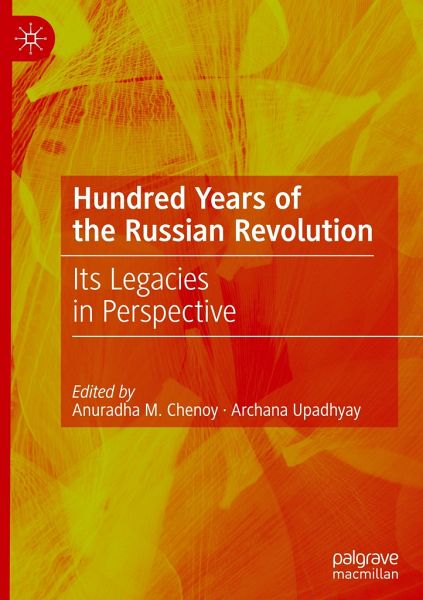
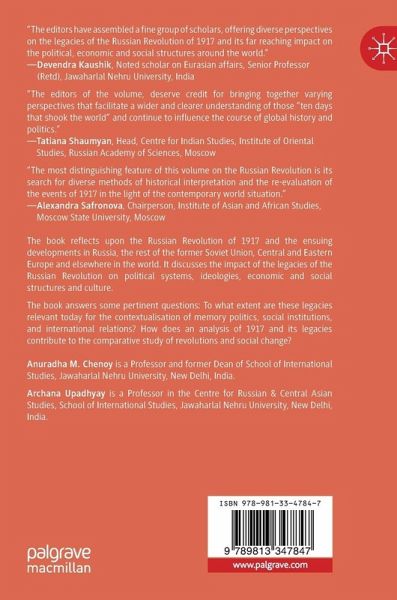
The book reflects upon the Russian Revolution of 1917 and the ensuing developments in Russia, the rest of the former Soviet Union, Central and Eastern Europe and elsewhere in the world. It discusses the impact of the legacies of the Russian Revolution on political systems, ideologies, economic and social structures and culture.
The book answers some pertinent questions: To what extent are these legacies relevant today for the contextualisation of memory politics, social institutions, and international relations? How does an analysis of 1917 and its legacies contribute to the comparative study of revolutions and social change?
Anuradha M. Chenoy is a Professor and former Dean of School of International Studies, Jawaharlal Nehru University, New Delhi, India. She has written extensively on international politics, Soviet/Russian foreign and security policy, political system and political processes in Russia, Indian foreign policy, human security and gender in international relations. Her books include Re-emerging Russia: Structures, Institutions and Processes (co-authored, 2017); The BRICS in International Development (2016); Maoists and Other Armed Conflicts (co-authored, 2010); Human Security: Concept and Implications (co-authored, 2006); Militarism and Women in South Asia (2002); and The Making of New Russia (2001). Archana Upadhyay is a Professor in the Centre for Russian & Central Asian Studies, School of International Studies, Jawaharlal Nehru University, New Delhi, India. She has been the recipient of the Commonwealth Fellowship with affiliation to International Policy Institute, King's College, London, UK. Her research interests include international relations with special focus on South Asian, Russian and Eurasian Issues. Her previous publications are India's Fragile Borderlands: Dynamics of Terrorism in North-East India (2009); Multiparty System in the Russian Federation: Problems & Prospects (2000); and a monograph Human Rights (co-authored). Her recent publications are on religion and politics in post-Soviet societies.
Inhaltsangabe
Chapter 1: Introduction: Hundred Years of the Russian Revolution: Its Legacies in Perspective.- Part 1 1917: Enduring Legacies.- Chapter 2: Recalling October Revolution.- Chapter 3: October Revolution: The History and Legacy.- Chapter 4: Russian Revolution: Past in the Present.- Chapter 5: Russian Revolution and the Global South.- Chapter 6: Russian Revolution in Perspective: Reflections on Its impact on the Indian Freedom Struggle.- Part II Socio-cultural transformations post-1917.- Chapter 7: Religion and cultural identity in Russia: Contextualising the 1917 events.- Chapter 8: October Revolution and its fruits for Women.- Chapter 9: India -Russia Diplomatic Engagement: The Stalin's Years.- Chapter 10: Looking back at Soviet Cinema.- Part III Memory politics and inherited legacies.- Chapter 11: Memory Politics and the Evolution of Celebrations: Rethinking the Role ofNovember 7 Festivities.- Chapter 12: 1917 Revolution in Historical Policy of the Russian Federation and the Republic of Belarus.- Chapter 13: The Russian Revolution and its Legacies in the Socio-political transformations in Central and Eastern Europe.- Part IV Soviet legacies in Russian foreign policy and governance.- Chapter 14: Soviet Legacy and Russia's Foreign Policy.- Chapter 15: Soviet Legacy and Russian Chinese Relations.- Chapter 16: Soviet Legacies and Economic Governance in Contemporary Russia.- Chapter 17: Legacies of Soviet Federalism in post-Soviet Federal Arrangement.
Chapter 1: Introduction: Hundred Years of the Russian Revolution: Its Legacies in Perspective.- Part 1 1917: Enduring Legacies.- Chapter 2: Recalling October Revolution.- Chapter 3: October Revolution: The History and Legacy.- Chapter 4: Russian Revolution: Past in the Present.- Chapter 5: Russian Revolution and the Global South.- Chapter 6: Russian Revolution in Perspective: Reflections on Its impact on the Indian Freedom Struggle.- Part II Socio-cultural transformations post-1917.- Chapter 7: Religion and cultural identity in Russia: Contextualising the 1917 events.- Chapter 8: October Revolution and its fruits for Women.- Chapter 9: India -Russia Diplomatic Engagement: The Stalin's Years.- Chapter 10: Looking back at Soviet Cinema.- Part III Memory politics and inherited legacies.- Chapter 11: Memory Politics and the Evolution of Celebrations: Rethinking the Role ofNovember 7 Festivities.- Chapter 12: 1917 Revolution in Historical Policy of the Russian Federation and the Republic of Belarus.- Chapter 13: The Russian Revolution and its Legacies in the Socio-political transformations in Central and Eastern Europe.- Part IV Soviet legacies in Russian foreign policy and governance.- Chapter 14: Soviet Legacy and Russia's Foreign Policy.- Chapter 15: Soviet Legacy and Russian Chinese Relations.- Chapter 16: Soviet Legacies and Economic Governance in Contemporary Russia.- Chapter 17: Legacies of Soviet Federalism in post-Soviet Federal Arrangement.
Es gelten unsere Allgemeinen Geschäftsbedingungen: www.buecher.de/agb
Impressum
www.buecher.de ist ein Internetauftritt der buecher.de internetstores GmbH
Geschäftsführung: Monica Sawhney | Roland Kölbl | Günter Hilger
Sitz der Gesellschaft: Batheyer Straße 115 - 117, 58099 Hagen
Postanschrift: Bürgermeister-Wegele-Str. 12, 86167 Augsburg
Amtsgericht Hagen HRB 13257
Steuernummer: 321/5800/1497
USt-IdNr: DE450055826