
Andere Kunden interessierten sich auch für
 Intergroup Emotions and Competitive Victimhoods98,99 €
 Warum sind sie wieder da?12,90 €
 Rassismuskritik29,80 €
 Die von Europa träumen22,00 €
 Migration, Refugees and Human Security in the Mediterranean and MENA91,99 €
 Drugs, Gangs, and Violence49,99 €
 EurAfrican Borders and Migration Management129,99 €







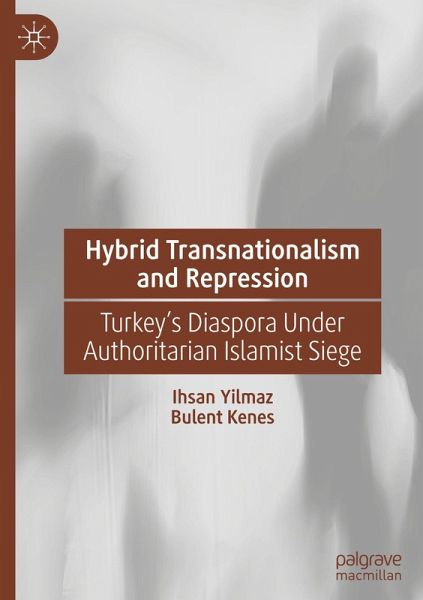
This book investigates how authoritarian regimes extend repression beyond borders by targeting diaspora communities. Focusing on the strategic fusion of soft, sharp, and hard power, it introduces the concept of hybrid transnationalism to explain Turkey s deployment of cultural diplomacy, religious outreach, surveillance, abductions, and legal manipulation such as the misuse of Interpol Red Notices. These mechanisms are shown not as isolated acts but as part of a coherent strategy to suppress dissent, enforce ideological loyalty, and consolidate authoritarian rule transnationally.
The book draws on rich empirical data, including institutional case studies and cross-border repression incidents, revealing how Turkish institutions like the Directorate of Religious Affairs (Diyanet) serve dual roles facilitating cultural ties while enabling surveillance and community control.
Situated within the broader landscape of global authoritarianism, the book offers comparative insights, highlighting shared tools of diaspora surveillance and the manipulation of international institutions. It emphasizes how Turkey s position within liberal internationalism allows it to exploit democratic norms and mechanisms while undermining them from within.
Timely and theoretically innovative, the book contributes vital understanding of how authoritarianism becomes mobile, adaptive, and emotionally resonant in the 21st century. Readers will benefit from an in-depth understanding of how authoritarian regimes operate across borders and the vulnerabilities in global governance systems they exploit. This book is essential for scholars, policymakers, human rights advocates, and diaspora members seeking to understand and counter the challenges posed by transnational repression. It offers actionable insights into safeguarding democratic values, protecting vulnerable populations, and reforming international institutions. The book fills a critical gap in the literatureon authoritarianism, diaspora studies, and international law, making it a timely and indispensable resource.
The book draws on rich empirical data, including institutional case studies and cross-border repression incidents, revealing how Turkish institutions like the Directorate of Religious Affairs (Diyanet) serve dual roles facilitating cultural ties while enabling surveillance and community control.
Situated within the broader landscape of global authoritarianism, the book offers comparative insights, highlighting shared tools of diaspora surveillance and the manipulation of international institutions. It emphasizes how Turkey s position within liberal internationalism allows it to exploit democratic norms and mechanisms while undermining them from within.
Timely and theoretically innovative, the book contributes vital understanding of how authoritarianism becomes mobile, adaptive, and emotionally resonant in the 21st century. Readers will benefit from an in-depth understanding of how authoritarian regimes operate across borders and the vulnerabilities in global governance systems they exploit. This book is essential for scholars, policymakers, human rights advocates, and diaspora members seeking to understand and counter the challenges posed by transnational repression. It offers actionable insights into safeguarding democratic values, protecting vulnerable populations, and reforming international institutions. The book fills a critical gap in the literatureon authoritarianism, diaspora studies, and international law, making it a timely and indispensable resource.