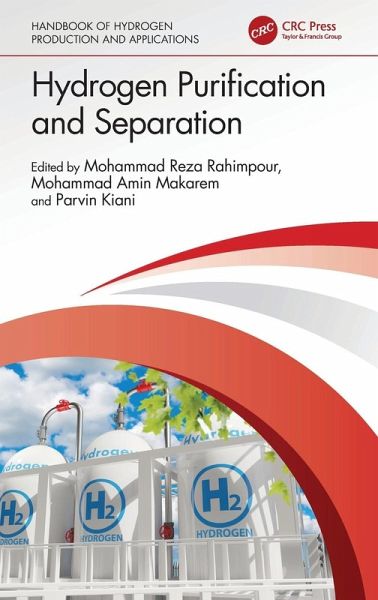
The purification of hydrogen is necessary to fulfill purity standards of a wide variety of prospective uses, and it is also a key concern regarding the efficient supply of hydrogen. Hydrogen Purification and Separation reviews various hydrogen separation methods as well as membranes used in hydrogen separation. It discusses absorption and adsorption methods, as well as novel technologies such as cryogenic methods and plasma assisted technology, and the related economic assessments and environmental challenges. Introduces miscellaneous membrane assisted processes for hydrogen separationProvides…mehr
The purification of hydrogen is necessary to fulfill purity standards of a wide variety of prospective uses, and it is also a key concern regarding the efficient supply of hydrogen. Hydrogen Purification and Separation reviews various hydrogen separation methods as well as membranes used in hydrogen separation. It discusses absorption and adsorption methods, as well as novel technologies such as cryogenic methods and plasma assisted technology, and the related economic assessments and environmental challenges. Introduces miscellaneous membrane assisted processes for hydrogen separationProvides different physiochemical absorption methods for hydrogen purificationDiscusses application of sorbents and swing technologies in hydrogen purificationUniquely covers hydrogen separation using novel methodsIncludes economic assessments and environmental challenges of hydrogen purification in detail Part of the multivolume Handbook of Hydrogen Production and Applications, this standalone book guides researchers and academics in chemical, environmental, energy, and related areas of engineering interested in development and implementation of hydrogen production technologies.
Mohammad Reza Rahimpour is a Distinguished Professor of Chemical Engineering at Shiraz University, Iran. He earned a PhD in chemical engineering at Shiraz University, in collaboration with the University of Sydney, Australia, in 1988. He leads a pioneering research group specializing in fuel processing technology, with a particular focus on the catalytic conversion of both fossil fuels, such as natural gas, and renewable fuels, like biöoils derived from lignin, into valuable energy sources. Throughout his academic career, Dr. Rahimpour has specialized in hydrogen production technologies, including steam methane reforming, water electrolysis, photocatalytic hydrogen production, and hydrogen production from both renewable sources and fossil fuels. His extensive expertise and innovative research significantly contribute to advancements in hydrogen production and its practical applications. Mohammad Amin Makarem earned a PhD in chemical engineering at Shiraz University. His research interests include gas separation and purification, nanofluids, microfluidics, catalyst synthesis, reactor design, and green energy. Parvin Kiani earned a degree in chemical engineering at Shiraz University. Her research has focused on gas separation, clean energy, and catalyst synthesis.
Inhaltsangabe
Section I: An Overview of Hydrogen Purification and Separation Methods. 1. Introduction to Hydrogen Separation and Purification Technologies. 2. Economic Assessments and Environmental Challenges of Hydrogen Separation and Purification Technologies. Section II: Hydrogen Separation Using Membranes. 3. Polymeric Membranes for Hydrogen Separation. 4. Zeolite Membranes for Hydrogen Separation. 5. Hydrogen Separation Using Ceramic Membranes. 6. Hybrid Membranes for Hydrogen Separation. 7. Silica Membrane for Hydrogen Separation. 8. Mixed Matrix Membranes for Hydrogen Separation. 9. Hollow Fiber Membrane for Hydrogen Separation. 10. Porous Inorganic Membranes for Hydrogen Separation. Section III: Absorption and Absorption Methods for Hydrogen Purification. 11. Hydrogen Purification by Ionic Liquids and Deep Eutectic Solvents. 12. Carbonaceous Sorbents for Hydrogen Purification. 13. Metal-Organic Frameworks for Hydrogen Purification. 14. Swing Technologies for Hydrogen Purification. Section IV: Other Technologies for Hydrogen Purification. 15. PlasmäAssisted Technology for Hydrogen Purification.
Section I: An Overview of Hydrogen Purification and Separation Methods. 1. Introduction to Hydrogen Separation and Purification Technologies. 2. Economic Assessments and Environmental Challenges of Hydrogen Separation and Purification Technologies. Section II: Hydrogen Separation Using Membranes. 3. Polymeric Membranes for Hydrogen Separation. 4. Zeolite Membranes for Hydrogen Separation. 5. Hydrogen Separation Using Ceramic Membranes. 6. Hybrid Membranes for Hydrogen Separation. 7. Silica Membrane for Hydrogen Separation. 8. Mixed Matrix Membranes for Hydrogen Separation. 9. Hollow Fiber Membrane for Hydrogen Separation. 10. Porous Inorganic Membranes for Hydrogen Separation. Section III: Absorption and Absorption Methods for Hydrogen Purification. 11. Hydrogen Purification by Ionic Liquids and Deep Eutectic Solvents. 12. Carbonaceous Sorbents for Hydrogen Purification. 13. Metal-Organic Frameworks for Hydrogen Purification. 14. Swing Technologies for Hydrogen Purification. Section IV: Other Technologies for Hydrogen Purification. 15. PlasmäAssisted Technology for Hydrogen Purification.
Es gelten unsere Allgemeinen Geschäftsbedingungen: www.buecher.de/agb
Impressum
www.buecher.de ist ein Internetauftritt der buecher.de internetstores GmbH
Geschäftsführung: Monica Sawhney | Roland Kölbl | Günter Hilger
Sitz der Gesellschaft: Batheyer Straße 115 - 117, 58099 Hagen
Postanschrift: Bürgermeister-Wegele-Str. 12, 86167 Augsburg
Amtsgericht Hagen HRB 13257
Steuernummer: 321/5800/1497
USt-IdNr: DE450055826