
Andere Kunden interessierten sich auch für
 ¿¿i Vi¿t and Champa84,99 €
 India20,99 €
 Packaging Post/Coloniality53,99 €
 Census Of The Philippine Islands, Taken Under The Direction Of The Philippine Commission In The Year 1903, In Four Volumes ... Comp. And Pub. By The U15,99 €
 Burma, The Land and The People23,99 €
 The Expedition to Borneo of H.M.S. Dido25,99 €
 A Voyage To Cochinchina, In The Years 1792 And 179326,99 €







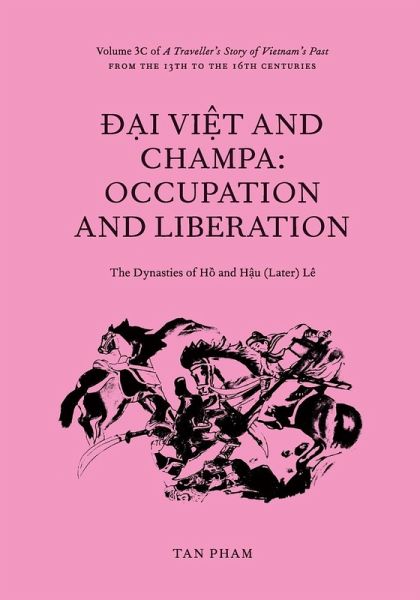
On a cold winter day-3 January 1428-the overall commander of the Ming forces in Giao Ch¿ (northern Vietnam) led a column of senior officers, soldiers, and civilians out through the gate of ¿ông Quan (in modern Hanoi) to begin their long journey back to southern China. Wang Tong, the commander, travelled by land, likely through L¿ng S¿n, while others followed the Red River down to the East Sea, returning to Guangzhou by water. Across the Red River, Lê L¿i, the man who had successfully driven the Ming occupiers from ¿¿i Vi¿t, stood quietly with his chief secretary, Nguy¿n Trãi, as the long-awaited withdrawal unfolded. Lê L¿i would go on to found the Later Lê dynasty, which endured for nearly three centuries. Neither man could have foreseen that within five years, Lê L¿i would be dead, and barely a decade later, Nguy¿n Trãi-together with three generations of his family-would perish under the orders of Lê L¿i's son. This volume, Volume 3C, continues from where Volume 3A: ¿¿i Vi¿t and Champa: The Early Centuries - The Dynasties of ¿inh, Ti¿n (Former) Lê, Lý, and Tr¿n ends. It recounts the intertwined stories of these two men and other figures who shaped two turbulent centuries in the histories of ¿¿i Vi¿t and Champa. The narrative opens with the final years of the Tr¿n dynasty, including the tale of Princess Huy¿n Trân, who married a Cham king. Internal divisions weakened the Tr¿n, allowing Champa, under Ch¿ B¿ng Nga, to rise and repeatedly sack Th¿ng Long, the northern capital. Amid this turmoil, H¿ Quý Ly seized power, deposed the Tr¿n, and founded the H¿ dynasty, expanding ¿¿i Vi¿t's southern frontier to Qüng Ngãi. Claiming to restore legitimate rule, the Ming Empire invaded in 1406; by 1407, H¿ Quý Ly and his sons were captured and taken to Beijing. The H¿ dynasty was crushed, and the Ming imposed direct colonial rule, exploiting the land and suppressing resistance. Uprisings continued until Lê L¿i from Thanh Hóa, launched a rebellion in 1416, eventually expelling the Ming and founding a new dynasty. Under Lê T¿ Thành (King Lê Thánh Tông), Lê L¿i's grandson, ¿¿i Vi¿t entered a golden age marked by administrative reform, intellectual renewal, and territorial expansion-most notably the 1471 conquest of Champa, which dismantled the kingdom, and the 1479 campaign into Laos. Yet after Lê T¿ Thành's death, the realm descended into factional strife leading to the rise of the M¿c dynasty and the end of the early phase of Later Lê rule. In over two centuries that followed, ¿¿i Vi¿t became divided-a fragmentation whose origins can be traced to the turbulent years after Lê T¿ Thành's death. This next chapter of division and rivalry will be explored in Volume Four. Associate Professor Dr Nguy¿n Th¿ M¿ H¿nh of the Hanoi National University of Education reviewed the manuscript, and Hue-Tam Ho Tai, Professor of Sino-Vietnamese History emerita of Harvard University, commented on the draft and wrote the foreword to the book. She wrote Not all wars took place on battlefields. Some happened on paper. Tan Pham has mined the copious correspondence between Dai Viet and Ming China, some threatening, some conciliatory, over issues of dynastic legitimacy, tribute missions, precious commodities and disputed territory. Other conflicts took place within royal palaces and harems. Included in the volume are portraits of emperors, both good and bad, as well as of some significant historical figures. Alas, the lives and personal names of women, including royal ones, seldom made it into the pages of dynastic histories. Tan Pham's multi-volume history of Viet Nam is a labor of love. Readers will be able to follow in the footsteps of emperors, officials, soldiers and rebels; to visualize monuments, temples and shrines and to conceive of the landscape as the repository of the past.