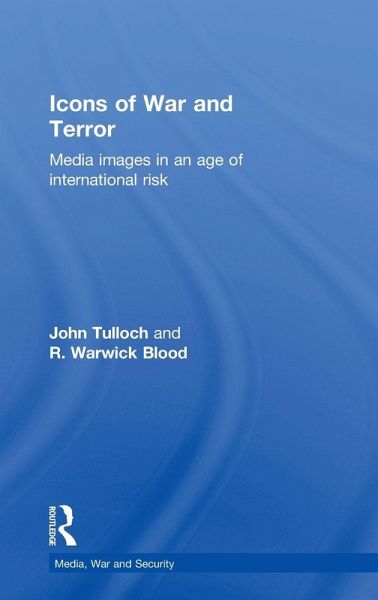
John Tulloch is Professor of Communication, University of Newcastle, Australia. He is the author of 18 books in media and television studies, film history and theory, literary and theatre studies, and the sociology of risk. His books include the widely cited Risk and Everyday Life (with Deborah Lupton, Routledge, 2003) and monographs on Doctor Who (1984), A Country Practice (1986) and Trevor Griffiths (2007). R. Warwick Blood is Professor of Communication, Faculty of Arts and Design, University of Canberra, Australia. Previously, he was a reporter, foreign correspondent and producer for the Australian Broadcasting Corporation. He has published on risk, and news reporting and portrayal of health issues.
Inhaltsangabe
Introduction Image: Nedia 1. Guernica: Icon of State Terror Image: Simon Schama and Guernica 2. Ways of Seeing the Napalmed Girl: Icons of Agony and Beauty Image: The Napalmed Girl 3.Two Bangladeshi Boys and Public Culture: Iconic or Absent Images: Two Boys in Bangladesh; the Shamed One 4. 'The Gulf War Did Not Take Place': Smart-Weapon Imaging Images: Carnage at Amiryah Shelter 5. Picturing Kosovo: Virtual, New or Old War? Image: The Serbian massacre of Kosovar Albanian villagers at Racak. 6.'Change Everything'? Icons out of a Clear Blue Sky Images: the second of the Twin Towers attacked by a plane on 9/11 7. Shock Doctrine in Iraq: the 'Marlboro Marine' and 'Shock and Awe' Images: 'Shock and Awe'; the Marlboro Marine 8. Abu Ghraib, Regimes of Looking and Risk: Icons, Index and Symbol Images: Abu Ghraib - the hooded man 9. Witnessing Terrorism in New York and London: Trauma Icons Images: the 'Falling Man'; iconic image of John Tulloch after the 7/7 terrorist attack 10. Culture Warriors: Images of the Colonial, Then and Now Image: Julie Dowling's 'Walyer' Conclusion: Walls and Borders
Introduction Image: Nedia 1. Guernica: Icon of State Terror Image: Simon Schama and Guernica 2. Ways of Seeing the Napalmed Girl: Icons of Agony and Beauty Image: The Napalmed Girl 3.Two Bangladeshi Boys and Public Culture: Iconic or Absent Images: Two Boys in Bangladesh; the Shamed One 4. 'The Gulf War Did Not Take Place': Smart-Weapon Imaging Images: Carnage at Amiryah Shelter 5. Picturing Kosovo: Virtual, New or Old War? Image: The Serbian massacre of Kosovar Albanian villagers at Racak. 6.'Change Everything'? Icons out of a Clear Blue Sky Images: the second of the Twin Towers attacked by a plane on 9/11 7. Shock Doctrine in Iraq: the 'Marlboro Marine' and 'Shock and Awe' Images: 'Shock and Awe'; the Marlboro Marine 8. Abu Ghraib, Regimes of Looking and Risk: Icons, Index and Symbol Images: Abu Ghraib - the hooded man 9. Witnessing Terrorism in New York and London: Trauma Icons Images: the 'Falling Man'; iconic image of John Tulloch after the 7/7 terrorist attack 10. Culture Warriors: Images of the Colonial, Then and Now Image: Julie Dowling's 'Walyer' Conclusion: Walls and Borders
Es gelten unsere Allgemeinen Geschäftsbedingungen: www.buecher.de/agb
Impressum
www.buecher.de ist ein Internetauftritt der buecher.de internetstores GmbH
Geschäftsführung: Monica Sawhney | Roland Kölbl | Günter Hilger
Sitz der Gesellschaft: Batheyer Straße 115 - 117, 58099 Hagen
Postanschrift: Bürgermeister-Wegele-Str. 12, 86167 Augsburg
Amtsgericht Hagen HRB 13257
Steuernummer: 321/5800/1497
USt-IdNr: DE450055826