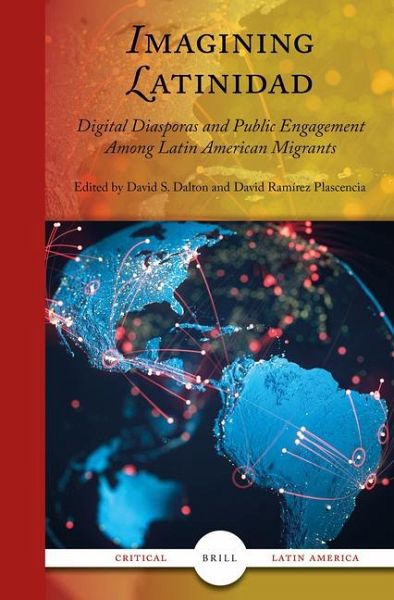
Imagining Latinidad examines how Latin American migrants use technology for public engagement, social activism, and to build digital, diasporic communities. Thanks to platforms like Facebook and YouTube, immigrants from Latin America can stay in contact with the culture they left behind. Members of these groups share information related to their homeland through discussions of food, music, celebrations, and other cultural elements. Despite their physical distance, these diasporic virtual communities are not far removed from the struggles in their homelands, and migrant activists play a central…mehr
Imagining Latinidad examines how Latin American migrants use technology for public engagement, social activism, and to build digital, diasporic communities. Thanks to platforms like Facebook and YouTube, immigrants from Latin America can stay in contact with the culture they left behind. Members of these groups share information related to their homeland through discussions of food, music, celebrations, and other cultural elements. Despite their physical distance, these diasporic virtual communities are not far removed from the struggles in their homelands, and migrant activists play a central role in shaping politics both in their home country and in their host country. Contributors are: Amanda Arrais, Karla Castillo Villapudua, David S. Dalton, Jason H. Dormady, Carmen Gabriela Febles, Álvaro González Alba, Yunuen Ysela Mandujano-Salazar, Anna Marta Marini, Diana Denisse Merchant Ley, Covadonga Lamar Prieto, María del Pilar Ramírez Gröbli, David Ramírez Plascencia, Jessica Retis, Nancy Rios-Contreras, and Patria Román-Velázquez. Imagining Latinidad: Digital Diasporas and Public Engagement Among Latin American Migrants is now available in paperback for individual customers.
David S. Dalton is an associate professor of Spanish and director of Latin American Studies at the University of North Carolina, Charlotte. His research theorizes the interface of science, technology, and the body both in Greater Mexico and throughout Latin America. He is the author of Robo Sacer: Necroliberalism and Cyborg Resistance in Mexican and Chicanx Dystopias (Vanderbilt University Press, 2023) and Mestizo Modernity: Race, Technology, and the Body in Postrevolutionary Mexico (University of Florida Press, 2018). He has edited or coedited one edited volume and two special editions, and he has published an array of articles and book chapters. David Ramírez Plascencia, Ph.D. (1980), is Professor at the University of Guadalajara, specializing in the study of information law and digital policies. His recent works include The Politics of Technology in Latin America (Volume 1): Data Protection, Homeland Security and the Labor Market and The Politics of Technology in Latin America (Volume 2): Digital Media, Daily Life and Public Engagement (Routledge, 2020), and "Ending the Digital Gender Divide. Are Coding Clubs the Solution?" in the journal Trípodos. He has done fieldwork in diverse cities in Spain. His research focuses on the study of the possibilities and dilemmas of information technologies in developing countries. He is interested in digital activism, information control and social media use in Latin America.
Es gelten unsere Allgemeinen Geschäftsbedingungen: www.buecher.de/agb
Impressum
www.buecher.de ist ein Internetauftritt der buecher.de internetstores GmbH
Geschäftsführung: Monica Sawhney | Roland Kölbl | Günter Hilger
Sitz der Gesellschaft: Batheyer Straße 115 - 117, 58099 Hagen
Postanschrift: Bürgermeister-Wegele-Str. 12, 86167 Augsburg
Amtsgericht Hagen HRB 13257
Steuernummer: 321/5800/1497
USt-IdNr: DE450055826