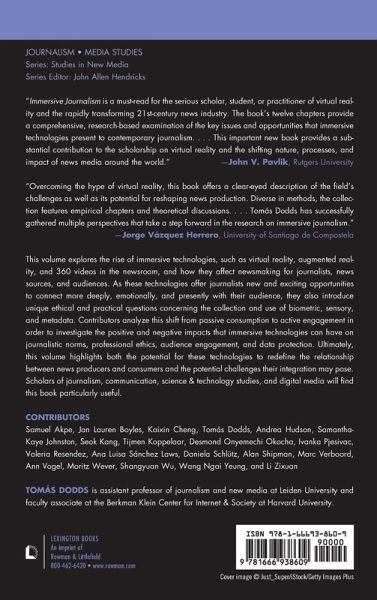
This collection explores how immersive technologies affect newsmaking and the positive and negative impacts they may have on journalistic norms, professional ethics, audience engagement, and data protection.
This collection explores how immersive technologies affect newsmaking and the positive and negative impacts they may have on journalistic norms, professional ethics, audience engagement, and data protection.
Tomás Dodds is assistant professor of journalism and new media at Leiden University and faculty associate at the Berkman Klein Center for Internet & Society at Harvard University.
Inhaltsangabe
Part I Chapter 1: Immersive Journalism After the VR Hype from Media Professionals' Perspective Chapter 2: Immersive Journalism Skills as Cultural Capital: Gaining Legitimacy in the Contemporary Newsroom Chapter 3: Immersive Journalism and Emerging News Values of Emotional Objectivity and Subjective Accuracy: Between Effects and Norms Chapter 4: The Young Reporter Programme: A Digital Intelligence Perspective Part II Chapter 5: 360-Degree Journalism: Ethics and Challenges of Immersive Storytelling in Africa Chapter 6: Emotional Engagement and Information Recall in Immersive Journalism: A Systematic Literature Review Chapter 7: "Above all, it was fun": Interactive Documentaries as Immersive Journalism Chapter 8: Combating and Co-opting Immersion: Lessons from Audio-Visual Entertainment Part III Chapter 9: Immersive Environments, Evolving Ethics: How Computational, Data and Immersive Journalists Can Learn from Each Other Chapter 10: Ethics of Care: Considerations in Collecting Audience Data for Immersive Journalism Chapter 11: Information Processing of Augmented Reality News about History: Mediation Role of Transportation and Flow Experience between Telepresence and Attitudes Toward Civil Rights Chapter 12: Biometric Immersive Journalism: Understanding a New Technological Frontier
Part I Chapter 1: Immersive Journalism After the VR Hype from Media Professionals' Perspective Chapter 2: Immersive Journalism Skills as Cultural Capital: Gaining Legitimacy in the Contemporary Newsroom Chapter 3: Immersive Journalism and Emerging News Values of Emotional Objectivity and Subjective Accuracy: Between Effects and Norms Chapter 4: The Young Reporter Programme: A Digital Intelligence Perspective Part II Chapter 5: 360-Degree Journalism: Ethics and Challenges of Immersive Storytelling in Africa Chapter 6: Emotional Engagement and Information Recall in Immersive Journalism: A Systematic Literature Review Chapter 7: "Above all, it was fun": Interactive Documentaries as Immersive Journalism Chapter 8: Combating and Co-opting Immersion: Lessons from Audio-Visual Entertainment Part III Chapter 9: Immersive Environments, Evolving Ethics: How Computational, Data and Immersive Journalists Can Learn from Each Other Chapter 10: Ethics of Care: Considerations in Collecting Audience Data for Immersive Journalism Chapter 11: Information Processing of Augmented Reality News about History: Mediation Role of Transportation and Flow Experience between Telepresence and Attitudes Toward Civil Rights Chapter 12: Biometric Immersive Journalism: Understanding a New Technological Frontier
Es gelten unsere Allgemeinen Geschäftsbedingungen: www.buecher.de/agb
Impressum
www.buecher.de ist ein Internetauftritt der buecher.de internetstores GmbH
Geschäftsführung: Monica Sawhney | Roland Kölbl | Günter Hilger
Sitz der Gesellschaft: Batheyer Straße 115 - 117, 58099 Hagen
Postanschrift: Bürgermeister-Wegele-Str. 12, 86167 Augsburg
Amtsgericht Hagen HRB 13257
Steuernummer: 321/5800/1497
USt-IdNr: DE450055826