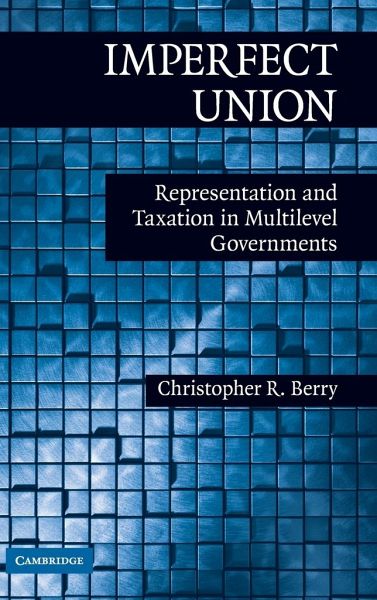
Imperfect Union offers the first political theory of special purpose jurisdictions, which constitute the most common form of local government in the United States today. Collectively, special purpose governments have more civilian employees than the federal government and spend more than all city governments combined. The proliferation of special purpose jurisdictions has fundamentally altered the nature of representation and taxation in local government. Citizens today are commonly represented by dozens - in some cases hundreds - of local officials in multiple layers of government. As a…mehr
Imperfect Union offers the first political theory of special purpose jurisdictions, which constitute the most common form of local government in the United States today. Collectively, special purpose governments have more civilian employees than the federal government and spend more than all city governments combined. The proliferation of special purpose jurisdictions has fundamentally altered the nature of representation and taxation in local government. Citizens today are commonly represented by dozens - in some cases hundreds - of local officials in multiple layers of government. As a result, political participation in local elections is low and special interest groups associated with each function exert disproportionate influence. With multiple special-interest governments tapping the same tax base, the local tax base takes on the character of a common-pool resource, leading to familiar problems of overexploitation. Strong political parties can often mitigate the common-pool problem by informally coordinating the policies of multiple overlapping governments.
Christopher R. Berry is an assistant professor in the Harris School of Public Policy at the University of Chicago. Previously, he was a post-doctoral fellow at Harvard University, Massachusetts in the Department of Government. Professor Berry received his BA from Vassar College, New York, Master of Regional Planning (MRP) from Cornell University, New York, PhD from the Department of Political Science at the University of Chicago, and post-doctoral training at Harvard University. He was also a Charles E. Merriam Fellow at the University of Chicago. Professor Berry is active in community development and was formerly a director in the MetroEdge division of ShoreBank, America's oldest and largest community development financial institution. He has published in journals such as the American Journal of Political Science, the Journal of Politics, the Journal of Law and Economics, and the Journal of Law, Economics, and Organization.
Inhaltsangabe
1. Introduction: into the fiscal common fund 2. What's special about special-purpose governments? 3. A political theory of special-purpose government 4. Piling on: the problem of concurrent taxation 5. Specializing and quality 6. Governing the fiscal commons 7. Conclusion.
1. Introduction: into the fiscal common fund 2. What's special about special-purpose governments? 3. A political theory of special-purpose government 4. Piling on: the problem of concurrent taxation 5. Specializing and quality 6. Governing the fiscal commons 7. Conclusion.
Es gelten unsere Allgemeinen Geschäftsbedingungen: www.buecher.de/agb
Impressum
www.buecher.de ist ein Internetauftritt der buecher.de internetstores GmbH
Geschäftsführung: Monica Sawhney | Roland Kölbl | Günter Hilger
Sitz der Gesellschaft: Batheyer Straße 115 - 117, 58099 Hagen
Postanschrift: Bürgermeister-Wegele-Str. 12, 86167 Augsburg
Amtsgericht Hagen HRB 13257
Steuernummer: 321/5800/1497
USt-IdNr: DE450055826