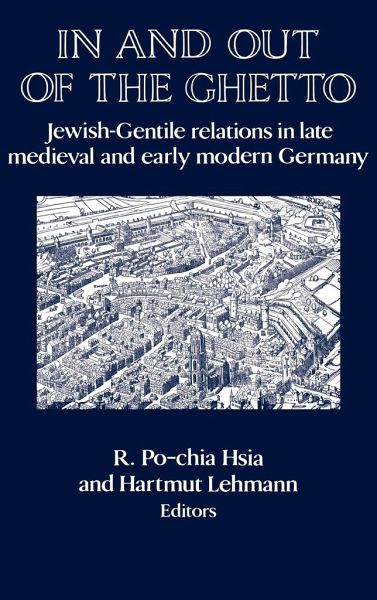
The essays examine the role of economics, politics, social organization, language, and religion in the relations between Jews and non-Jews in central Europe from the fifteenth through eighteenth centuries. The authors grapple with such relevant issues as cultural identity, representation, toleration, and minority-majority relations. Individually, the essays probe the central questions of Jewish social, economic, and cultural development within the territorial states, secular and clerical, and in both rural and urban environments. Collectively, they focus more attention on the period before the…mehr
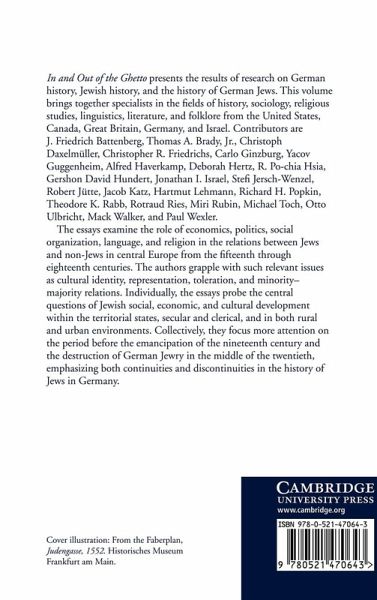
The essays examine the role of economics, politics, social organization, language, and religion in the relations between Jews and non-Jews in central Europe from the fifteenth through eighteenth centuries. The authors grapple with such relevant issues as cultural identity, representation, toleration, and minority-majority relations. Individually, the essays probe the central questions of Jewish social, economic, and cultural development within the territorial states, secular and clerical, and in both rural and urban environments. Collectively, they focus more attention on the period before the emancipation of the nineteenth century and the destruction of German Jewry in the middle of the twentieth, emphasizing both continuities and discontinuities in the history of Jews in Germany.
Introduction R. Po-Chia Hsia; Opening essay Jacob Katz; Part I. Jewish Cultural Identity and the Price of Exclusiveness: The Legacy of the Middle Ages: 1. The Jewish quarters in German towns during the late Middle Ages Alfred Haverkamp; 2. Organisational forms of Jewish popular culture since the Middle Ages Christoph Daxelmüller; 3. Criminality and punishment of the Jews in the early modern period Otto Ulbricht; 4. Jews and Gentiles in the Holy Roman Empire - a comment Theodore K. Rabb; Part II. The Social and Economic Structure of German Jewry from the Fifteenth to the Eighteenth Century: 5. Aspects of stratification of early modern German Jewry: population history and village Jews Michael Toch; 6. The economic activity of the Jews in early modern times Stefi Jersch-Wenzel; 7. Comparative perspectives on economy and society - a comment Gershon David Hundert; Part III. Jewish-Gentile Contacts and Relations in the Pre-Emancipation Period: 8. Languages in contact: the case of Rotwelsch and the two Yiddisches Paul Wexler; 9. Meeting on the road: encounters between German Jews and Christians on the margins of society Yacov Guggenheim; 10. Contacts at the bedside: Jewish physicians and their Christian patients Robert Jütte; 11. Contacts and relations in the pre-emancipation period - a comment Deborah Hertz; Part IV. Representations of German Jewry: Images, Prejudices, and Ideas: 12. The usurious Jew: economic structure and religious representations in an anti Semitic discourse R. Po-Chia Hsia; 13. Imagining the Jew: the late medieval eucharistic discourse Miri Rubin; 14. Representations of German Jewry - a comment Carlo Ginzburg; Part V. The Pattern of Authority and the Limits of Toleration: The Case of German Jewry: 15. German territorial princes and the Jews Rotraud Ries; 16. Jews in ecclesiastical territories of the Holy Roman Empire J. Friedrich Battenberg; 17. Jews in the imperial cities: a political perspective Christopher R. Friedrichs; 18. Germans with a difference? The Holy Roman Empire's Jews during the early modern era - a comment Thomas A. Brady, Jr; Part VI. In and Out of the Ghetto: Jewish-Gentile Relations in Late Medieval and Early Modern Germany: 19. Germany and its Jews: a changing relationship (1500-1800) Jonathan I. Israel; 20. The Jewish minority and the Christian majority in early modern central Europe Hartmut Lehmann; 21. Germans and Jews in late medieval and early modern Germany Richard H. Popkin; 22. Jewish identity in a world of corporations and estates Mack Walker.
Introduction R. Po-Chia Hsia; Opening essay Jacob Katz; Part I. Jewish Cultural Identity and the Price of Exclusiveness: The Legacy of the Middle Ages: 1. The Jewish quarters in German towns during the late Middle Ages Alfred Haverkamp; 2. Organisational forms of Jewish popular culture since the Middle Ages Christoph Daxelmüller; 3. Criminality and punishment of the Jews in the early modern period Otto Ulbricht; 4. Jews and Gentiles in the Holy Roman Empire - a comment Theodore K. Rabb; Part II. The Social and Economic Structure of German Jewry from the Fifteenth to the Eighteenth Century: 5. Aspects of stratification of early modern German Jewry: population history and village Jews Michael Toch; 6. The economic activity of the Jews in early modern times Stefi Jersch-Wenzel; 7. Comparative perspectives on economy and society - a comment Gershon David Hundert; Part III. Jewish-Gentile Contacts and Relations in the Pre-Emancipation Period: 8. Languages in contact: the case of Rotwelsch and the two Yiddisches Paul Wexler; 9. Meeting on the road: encounters between German Jews and Christians on the margins of society Yacov Guggenheim; 10. Contacts at the bedside: Jewish physicians and their Christian patients Robert Jütte; 11. Contacts and relations in the pre-emancipation period - a comment Deborah Hertz; Part IV. Representations of German Jewry: Images, Prejudices, and Ideas: 12. The usurious Jew: economic structure and religious representations in an anti Semitic discourse R. Po-Chia Hsia; 13. Imagining the Jew: the late medieval eucharistic discourse Miri Rubin; 14. Representations of German Jewry - a comment Carlo Ginzburg; Part V. The Pattern of Authority and the Limits of Toleration: The Case of German Jewry: 15. German territorial princes and the Jews Rotraud Ries; 16. Jews in ecclesiastical territories of the Holy Roman Empire J. Friedrich Battenberg; 17. Jews in the imperial cities: a political perspective Christopher R. Friedrichs; 18. Germans with a difference? The Holy Roman Empire's Jews during the early modern era - a comment Thomas A. Brady, Jr; Part VI. In and Out of the Ghetto: Jewish-Gentile Relations in Late Medieval and Early Modern Germany: 19. Germany and its Jews: a changing relationship (1500-1800) Jonathan I. Israel; 20. The Jewish minority and the Christian majority in early modern central Europe Hartmut Lehmann; 21. Germans and Jews in late medieval and early modern Germany Richard H. Popkin; 22. Jewish identity in a world of corporations and estates Mack Walker.
Es gelten unsere Allgemeinen Geschäftsbedingungen: www.buecher.de/agb
Impressum
www.buecher.de ist ein Internetauftritt der buecher.de internetstores GmbH
Geschäftsführung: Monica Sawhney | Roland Kölbl | Günter Hilger
Sitz der Gesellschaft: Batheyer Straße 115 - 117, 58099 Hagen
Postanschrift: Bürgermeister-Wegele-Str. 12, 86167 Augsburg
Amtsgericht Hagen HRB 13257
Steuernummer: 321/5800/1497
USt-IdNr: DE450055826