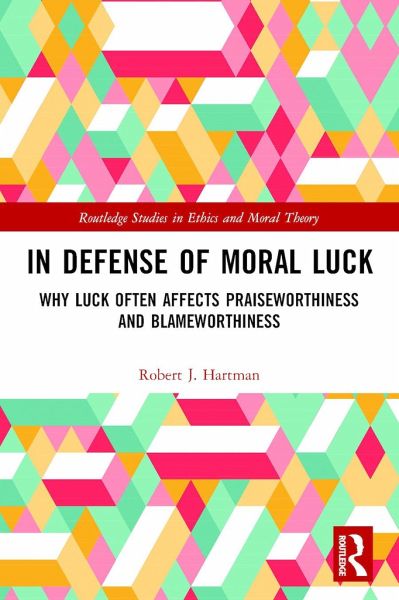
The problem of moral luck is that there is a contradiction in our common sense ideas about moral responsibility. In one strand of our thinking, we believe that a person can become more blameworthy by luck. For example, two reckless drivers manage their vehicles in the same way, and one but not the other kills a pedestrian. We blame the killer driver more than the merely reckless driver, because we believe that the killer driver is more blameworthy. Nevertheless, this idea contradicts another feature of our thinking captured in this moral principle: A person's blameworthiness cannot be affected…mehr
The problem of moral luck is that there is a contradiction in our common sense ideas about moral responsibility. In one strand of our thinking, we believe that a person can become more blameworthy by luck. For example, two reckless drivers manage their vehicles in the same way, and one but not the other kills a pedestrian. We blame the killer driver more than the merely reckless driver, because we believe that the killer driver is more blameworthy. Nevertheless, this idea contradicts another feature of our thinking captured in this moral principle: A person's blameworthiness cannot be affected by that which is not within her control. Thus, our ordinary thinking about moral responsibility implies that the drivers are and are not equally blameworthy. In Defense of Moral Luck aims to make progress in resolving this contradiction. Hartman defends the claim that certain kinds of luck in results, circumstance, and character can partially determine the degree of a person's blameworthiness. He also explains why there is a puzzle in our thinking about moral responsibility in the first place if luck often affects a person's praiseworthiness and blameworthiness. Furthermore, the book's methodology provides a unique way to advance the moral luck debate with arguments from diverse areas in philosophy that do not bottom out in standard pro-moral luck intuitions.
Robert Hartman first developed an interest in UFOs in 1974 when he witnessed three enormous lights side by side in full daylight, hovering over Little Mountain in South Carolina. He gravitated toward a written study of the Roswell Incident due to its superior documentation, prior study, and his travels in New Mexico. Mr. Hartman, now 57 years old, is a southern country lawyer. He is a graduate of the University of South Carolina with B.A. and J.D. degrees. He has practiced law in the State and Federal Courts for 28 years. He is also a private pilot, artist, art collector, tree farmer, and former town politician. His college thesis was used in Walter Edgar's History of South Carolina regarding civil war life in Lancaster County. He is married to another lawyer, and 6th circuit deputy public defender Kay Boulware, and is the father of two children being Olivia and Erin Hartman.
Inhaltsangabe
1. Introducing the Problem of Moral Luck 2. The Concept of Moral Luck 3. Against the Skeptical Denial of Moral Luck 4. Against the Non-Skeptical Denial of Moral Luck 5. In Defense of Moral Luck 6. Error Theory for the Luck-Free Intuition
1. Introducing the Problem of Moral Luck 2. The Concept of Moral Luck 3. Against the Skeptical Denial of Moral Luck 4. Against the Non-Skeptical Denial of Moral Luck 5. In Defense of Moral Luck 6. Error Theory for the Luck-Free Intuition
Es gelten unsere Allgemeinen Geschäftsbedingungen: www.buecher.de/agb
Impressum
www.buecher.de ist ein Internetauftritt der buecher.de internetstores GmbH
Geschäftsführung: Monica Sawhney | Roland Kölbl | Günter Hilger
Sitz der Gesellschaft: Batheyer Straße 115 - 117, 58099 Hagen
Postanschrift: Bürgermeister-Wegele-Str. 12, 86167 Augsburg
Amtsgericht Hagen HRB 13257
Steuernummer: 321/5800/1497
USt-IdNr: DE450055826