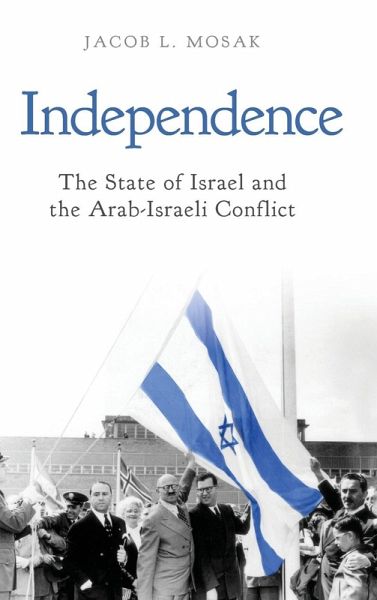
In this thoroughly researched and compelling book, Jacob Mosak celebrates the epic rebirth of the Jewish State of Israel within its ancient national and religious homeland and explores its history against a backdrop of anti-Semitism and political sabotage. Mosak contends that the reason why the Arab-Israeli conflict has endured for so long is the Arabs' refusal to recognize the legitimacy of the Jewish State, and he reminds readers that even the Koran recognizes Jerusalem as the location of the Jewish Holy Temples. He also maintains that the Jewish people's right to statehood in Palestine is…mehr
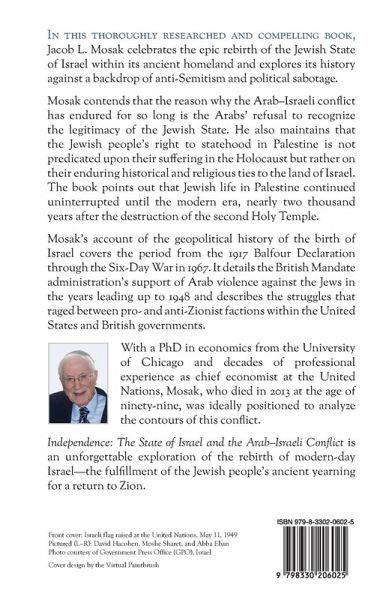
In this thoroughly researched and compelling book, Jacob Mosak celebrates the epic rebirth of the Jewish State of Israel within its ancient national and religious homeland and explores its history against a backdrop of anti-Semitism and political sabotage. Mosak contends that the reason why the Arab-Israeli conflict has endured for so long is the Arabs' refusal to recognize the legitimacy of the Jewish State, and he reminds readers that even the Koran recognizes Jerusalem as the location of the Jewish Holy Temples. He also maintains that the Jewish people's right to statehood in Palestine is not predicated upon their suffering in the Holocaust but rather on their enduring historical and religious ties to the land of Israel. The book points out that Jewish life in Palestine continued uninterrupted until the modern era, nearly two thousand years after the destruction of the second Holy Temple. Mosak's account of the complex geopolitical history of the birth of Israel covers the period from the 1917 Balfour Declaration through the Six-Day War in 1967. The book details the British Mandate administration's support of Arab violence and military campaigns against the Jews in the years leading up to 1948 and describes the fascinating behind-the-scenes struggles that raged between pro- and anti-Zionist factions within the United States and British governments. Mosak identifies Soviet military support for the Arab nations in the 1960s as a significant factor in bringing about the Six-Day War. With a PhD in economics from the University of Chicago and decades of experience in economic research, policy, and development as chief economist at the United Nations, Mosak, who died in 2013 at the age of ninety-nine, was ideally positioned to analyze the contours of this conflict. Independence: The State of Israel and the Arab-Israeli Conflict is an unforgettable exploration of the rebirth of modern-day Israel-the fulfillment of the Jewish people's ancient yearning for a return to Zion.
Jacob Louis Mosak received his PhD in 1941 from the University of Chicago, where he taught in its economics department and was associated with the Cowles Commission for Research in Econometrics in 1944. He was the author of several books on world economics and was best known for his book General-Equilibrium Theory in International Trade (1944).During World War II, Mosak served as the regional head of the Office of Price Administration and as the director of economic stabilization in the Office of War Mobilization and Reconversion. In 1947, he joined the United Nations, rising to the rank of assistant secretary-general as the United Nations' chief economist. He guided the work of a staff of economists from all parts of the world and was in charge of many expert committees. He dealt with major international economic issues before the United Nations General Assembly and the Economic and Social Council. During World War II, he held high-level posts in several wartime economic agencies of the United States government in Washington, DC. He was also an adjunct professor at Columbia University.After his retirement, Dr. Mosak devoted decades to researching the history of the Arab-Israeli conflict. He passed away in 2013, six weeks short of his hundredth birthday.
Es gelten unsere Allgemeinen Geschäftsbedingungen: www.buecher.de/agb
Impressum
www.buecher.de ist ein Internetauftritt der buecher.de internetstores GmbH
Geschäftsführung: Monica Sawhney | Roland Kölbl | Günter Hilger
Sitz der Gesellschaft: Batheyer Straße 115 - 117, 58099 Hagen
Postanschrift: Bürgermeister-Wegele-Str. 12, 86167 Augsburg
Amtsgericht Hagen HRB 13257
Steuernummer: 321/5800/1497
USt-IdNr: DE450055826