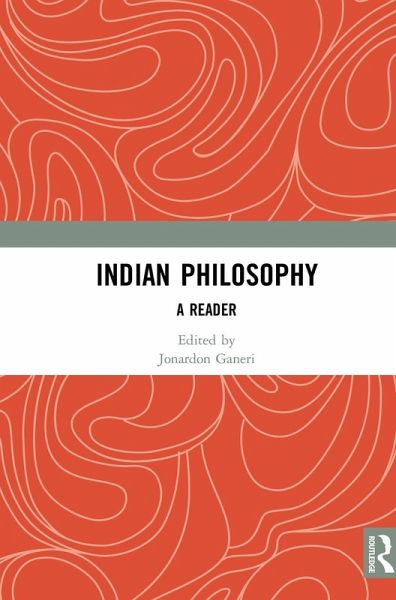
The purpose of this volume is to reintroduce the heritage of 'Indian Philosophy' to a contemporary readership through acquainting the reader with some of the core concepts of Indian philosophy such as the concept of philosophy, philosophy as a search for the self, Buddhist philosophy of mind, metaphysics, epistemology, language and logic.
The purpose of this volume is to reintroduce the heritage of 'Indian Philosophy' to a contemporary readership through acquainting the reader with some of the core concepts of Indian philosophy such as the concept of philosophy, philosophy as a search for the self, Buddhist philosophy of mind, metaphysics, epistemology, language and logic.
Jonardon Ganeri is a philosopher, specializing in philosophy of mind and in South Asian and Buddhist philosophical traditions.
Inhaltsangabe
1. On the concept of philosophy in India 2. Rationality in Indian philosophy 3. Intellectual India: reason, identity, dissent 4. The Upani ads 5. Hidden in the Cave: the Upani adic self 6. Indian theories of mind 7. From the five agreggates to phenomenal consciousness: towards a cross-cultural cognitive science 8. Subjectivity, selfhood, and the use of the word 'I' 9. The self as a dynamic constant: R makä ha's middle ground between a Naiy yika eternal self-substance and a Buddhist stream of consciousness-moments 10. Arguing from synthesis to the self: Utpaladeva and Abhinavagupta respond to Buddhist No-selfism 11. 'I am of the nature of seeing': phenomenological reflections on the Indian notion of witness-consciousness 12. The Ny ya-Vai e ika theory of universals 13. Objectivity and proof in a classical Indian theory of number 14. A realist view of perception 15. Ny ya perceptual theory: disjunctivism or anti-individualism? 16. The context principle and some Indian controversies over meaning 17. Bhart hari's wiew of spho a 18. " k a" and other names 19. Semiotic conceptions in the Indian theory of argumentation 20. Jaina logic and the philosophical basis of pluralism
1. On the concept of philosophy in India 2. Rationality in Indian philosophy 3. Intellectual India: reason, identity, dissent 4. The Upani ads 5. Hidden in the Cave: the Upani adic self 6. Indian theories of mind 7. From the five agreggates to phenomenal consciousness: towards a cross-cultural cognitive science 8. Subjectivity, selfhood, and the use of the word 'I' 9. The self as a dynamic constant: R makä ha's middle ground between a Naiy yika eternal self-substance and a Buddhist stream of consciousness-moments 10. Arguing from synthesis to the self: Utpaladeva and Abhinavagupta respond to Buddhist No-selfism 11. 'I am of the nature of seeing': phenomenological reflections on the Indian notion of witness-consciousness 12. The Ny ya-Vai e ika theory of universals 13. Objectivity and proof in a classical Indian theory of number 14. A realist view of perception 15. Ny ya perceptual theory: disjunctivism or anti-individualism? 16. The context principle and some Indian controversies over meaning 17. Bhart hari's wiew of spho a 18. " k a" and other names 19. Semiotic conceptions in the Indian theory of argumentation 20. Jaina logic and the philosophical basis of pluralism
Es gelten unsere Allgemeinen Geschäftsbedingungen: www.buecher.de/agb
Impressum
www.buecher.de ist ein Internetauftritt der buecher.de internetstores GmbH
Geschäftsführung: Monica Sawhney | Roland Kölbl | Günter Hilger
Sitz der Gesellschaft: Batheyer Straße 115 - 117, 58099 Hagen
Postanschrift: Bürgermeister-Wegele-Str. 12, 86167 Augsburg
Amtsgericht Hagen HRB 13257
Steuernummer: 321/5800/1497
USt-IdNr: DE450055826