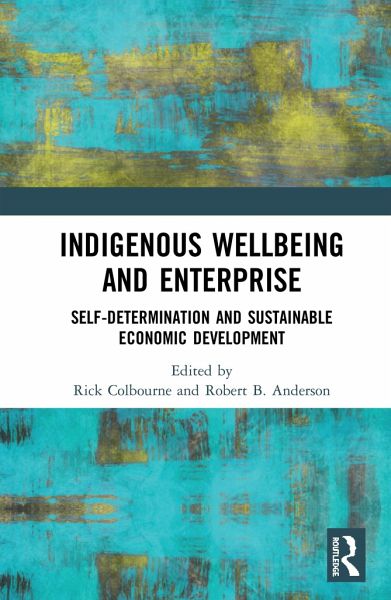
Written by the leading scholars in the field, this book provides models for sustainable enterprise that address key issues related to economic, environmental, social and cultural value creation activities within Indigenous communities.
Written by the leading scholars in the field, this book provides models for sustainable enterprise that address key issues related to economic, environmental, social and cultural value creation activities within Indigenous communities.
Rick Colbourne is Algonquin Anishinaabe. He is a Fulbright Fellow and Assistant Professor in Indigenous Leadership and Management at Carleton University's Sprott School of Business. His research is focused on understanding the intersection of Indigenous ways of knowing and organizing economic development and entrepreneurship. Robert B. Anderson is Professor Emeritus at the Hill/Levene Schools of Business, University of Regina. His areas of interest include entrepreneurship/economic development, resource management/sustainable development, corporate social responsibility, corporate/Indigenous alliances, Indigenous land claims/economic development, financial reporting in Indigenous organizations and the creation/commercialization of intellectual property.
Inhaltsangabe
Introduction 1. Invitation to ethical space: a dialogue on sustainability and reconciliation 2. Coyote learns commerce 3. Resistance to 'development' amongst the Kogui of the Sierra Nevada de Santa Marta 4. Consultation or free, informed and prior consent? A comparative legal analysis of Indigenous consultation during natural resource activities in Australia and Canada 5. Towards measuring Indigenous sustainability: merging vernacular and modern knowledge 6. The Inuit: sustaining themselves, the Arctic and the World 7. Self-gentrification as a pro-active response to tourism development: cases of Indigenous entrepreneurship in mainland China and Taiwan 8. What is a river? Cross-disciplinary and Indigenous assessment 9. Indigenous and Community Conserved Areas (ICCAs) in Galiza: indigeneity or peasanthood? 10. Sustainable development through Indigenous community-based enterprises 11. Andean enterprises: a case study of Bolivia's Royal Quinoa entrepreneurs 12. Relational and social aspects of Indigenous entrepreneurship: the Hupacasath case Index
Introduction 1. Invitation to ethical space: a dialogue on sustainability and reconciliation 2. Coyote learns commerce 3. Resistance to 'development' amongst the Kogui of the Sierra Nevada de Santa Marta 4. Consultation or free, informed and prior consent? A comparative legal analysis of Indigenous consultation during natural resource activities in Australia and Canada 5. Towards measuring Indigenous sustainability: merging vernacular and modern knowledge 6. The Inuit: sustaining themselves, the Arctic and the World 7. Self-gentrification as a pro-active response to tourism development: cases of Indigenous entrepreneurship in mainland China and Taiwan 8. What is a river? Cross-disciplinary and Indigenous assessment 9. Indigenous and Community Conserved Areas (ICCAs) in Galiza: indigeneity or peasanthood? 10. Sustainable development through Indigenous community-based enterprises 11. Andean enterprises: a case study of Bolivia's Royal Quinoa entrepreneurs 12. Relational and social aspects of Indigenous entrepreneurship: the Hupacasath case Index
Es gelten unsere Allgemeinen Geschäftsbedingungen: www.buecher.de/agb
Impressum
www.buecher.de ist ein Internetauftritt der buecher.de internetstores GmbH
Geschäftsführung: Monica Sawhney | Roland Kölbl | Günter Hilger
Sitz der Gesellschaft: Batheyer Straße 115 - 117, 58099 Hagen
Postanschrift: Bürgermeister-Wegele-Str. 12, 86167 Augsburg
Amtsgericht Hagen HRB 13257
Steuernummer: 321/5800/1497
USt-IdNr: DE450055826