12,99 €
inkl. MwSt.
Versandkostenfrei*
Versandfertig in 1-2 Wochen
payback
6 °P sammeln
  • Broschiertes Buch

This scarce antiquarian book is a facsimile reprint of the original. Due to its age, it may contain imperfections such as marks, notations, marginalia and flawed pages. Because we believe this work is culturally important, we have made it available as part of our commitment for protecting, preserving, and promoting the world's literature in affordable, high quality, modern editions that are true to the original work.

Produktbeschreibung
This scarce antiquarian book is a facsimile reprint of the original. Due to its age, it may contain imperfections such as marks, notations, marginalia and flawed pages. Because we believe this work is culturally important, we have made it available as part of our commitment for protecting, preserving, and promoting the world's literature in affordable, high quality, modern editions that are true to the original work.
Autorenporträt
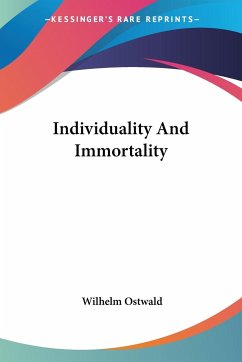
Wilhelm Friedrich Ostwald was a Latvian-born chemist and philosopher who became a key figure in the establishment of physical chemistry as a formal scientific discipline. Born to Johann Gottfried Ostwald and Elisabeth Leuckel, he received his education at Riga Technical University and the University of Tartu, laying the groundwork for a distinguished career that spanned experimental and theoretical chemistry. Ostwald s groundbreaking work on catalysis, reaction rates, and chemical equilibria earned him wide recognition, including the Nobel Prize in Chemistry. Alongside scientific research, he was deeply interested in the philosophy of science, focusing on the organization and unification of scientific knowledge. His contributions extended beyond chemistry into fields such as energetics, where he emphasized the primacy of energy transformations in understanding natural processes. Ostwald married Helene von Reyher, with whom he had several children, including Wolfgang Ostwald. He also advocated for reforms in scientific terminology and was active in promoting international scientific cooperation. His legacy is remembered not only for his substantial scientific contributions but also for his efforts to bridge the gaps between disciplines and to articulate a coherent philosophical vision of scientific work. Ostwald s influence endures in both chemistry and the broader intellectual landscape.