
Andere Kunden interessierten sich auch für
 Logic Program Synthesis and Transformation39,99 €
 Logic-Based Program Synthesis and Transformation38,99 €
 Logic Based Program Synthesis and Transformation39,99 €
 Logic-Based Program Synthesis and Transformation38,99 €
 Logic Program Synthesis and Transformation39,99 €
 Functional and Logic Programming39,99 €
 Analogical and Inductive Inference39,99 €
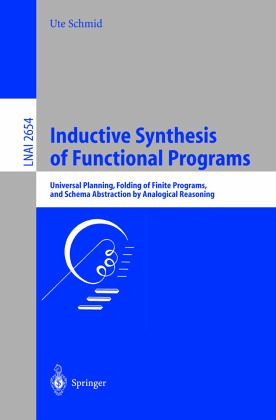
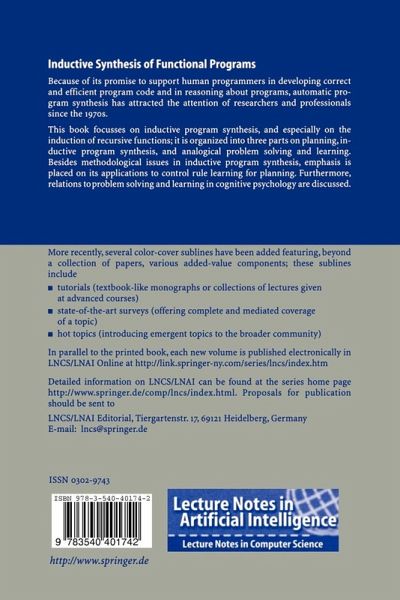
Because of its promise to support human programmers in developing correct and efficient program code and in reasoning about programs, automatic program synthesis has attracted the attention of researchers and professionals since the 1970s.
This book focusses on inductive program synthesis, and especially on the induction of recursive functions; it is organized into three parts on planning, inductive program synthesis, and analogical problem solving and learning. Besides methodological issues in inductive program synthesis, emphasis is placed on its applications to control rule learning for planning. Furthermore, relations to problem solving and learning in cognitive psychology are discussed.
This book focusses on inductive program synthesis, and especially on the induction of recursive functions; it is organized into three parts on planning, inductive program synthesis, and analogical problem solving and learning. Besides methodological issues in inductive program synthesis, emphasis is placed on its applications to control rule learning for planning. Furthermore, relations to problem solving and learning in cognitive psychology are discussed.