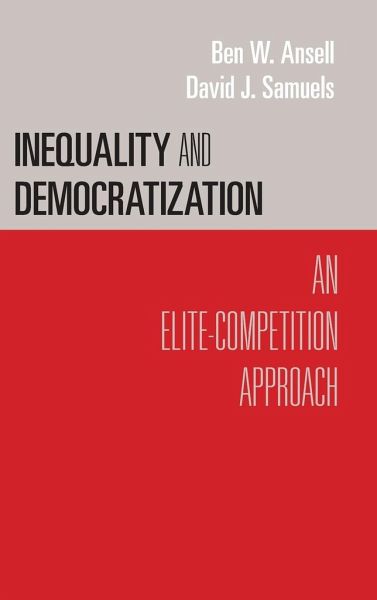
Research on the economic origins of democracy and dictatorship has shifted away from the impact of growth and turned toward the question of how different patterns of growth - equal or unequal - shape regime change. This book offers a new theory of the historical relationship between economic modernization and the emergence of democracy on a global scale, focusing on the effects of land and income inequality. Contrary to most mainstream arguments, Ben W. Ansell and David J. Samuels suggest that democracy is more likely to emerge when rising, yet politically disenfranchised, groups demand more…mehr
Research on the economic origins of democracy and dictatorship has shifted away from the impact of growth and turned toward the question of how different patterns of growth - equal or unequal - shape regime change. This book offers a new theory of the historical relationship between economic modernization and the emergence of democracy on a global scale, focusing on the effects of land and income inequality. Contrary to most mainstream arguments, Ben W. Ansell and David J. Samuels suggest that democracy is more likely to emerge when rising, yet politically disenfranchised, groups demand more influence because they have more to lose, rather than when threats of redistribution to elite interests are low.
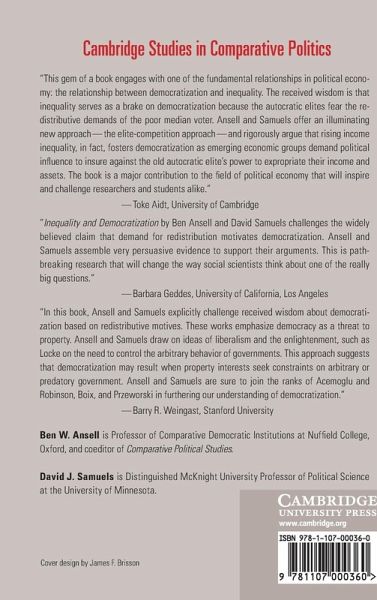
Ben W. Ansell is Professor of Comparative Democratic Institutions at Nuffield College, Oxford, and co-editor of Comparative Political Studies. His work on education, democracy, and housing markets has appeared in the American Political Science Review, Comparative Political Studies, World Politics, and International Organization. His book From the Ballot to the Blackboard (Cambridge, 2010) was awarded the 2011 William Riker Prize by the Political Economy Section of the American Political Science Association.
Inhaltsangabe
1. Introduction 2. Inequality, development, and distribution 3. Actors and interests 4. An elite-competition model of democratization 5. Assessing the relationship between inequality and democratization 6. Inequality and democratization: empirical extensions 7. Democracy, inequality, and public spending: reassessing the evidence 8. Democracy, redistribution, and preferences 9. Conclusion.
1. Introduction 2. Inequality, development, and distribution 3. Actors and interests 4. An elite-competition model of democratization 5. Assessing the relationship between inequality and democratization 6. Inequality and democratization: empirical extensions 7. Democracy, inequality, and public spending: reassessing the evidence 8. Democracy, redistribution, and preferences 9. Conclusion.
Es gelten unsere Allgemeinen Geschäftsbedingungen: www.buecher.de/agb
Impressum
www.buecher.de ist ein Internetauftritt der buecher.de internetstores GmbH
Geschäftsführung: Monica Sawhney | Roland Kölbl | Günter Hilger
Sitz der Gesellschaft: Batheyer Straße 115 - 117, 58099 Hagen
Postanschrift: Bürgermeister-Wegele-Str. 12, 86167 Augsburg
Amtsgericht Hagen HRB 13257
Steuernummer: 321/5800/1497
USt-IdNr: DE450055826