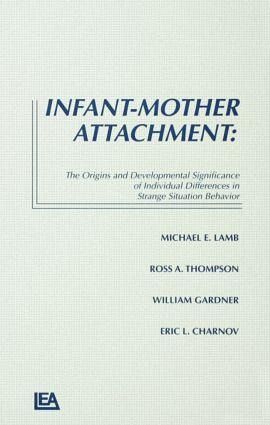
The Origins and Developmental Significance of Individual Differences in Strange Situation Behavior Herausgeber: Lamb, Michael E.; Gardner, William; Thompson, Ross A.
The Origins and Developmental Significance of Individual Differences in Strange Situation Behavior Herausgeber: Lamb, Michael E.; Gardner, William; Thompson, Ross A.
Michael E. Lamb University of Utah, Ross A. Thompson University of Nebraska, William Gardner University of Virginia, Eric L. Charnov University of Utah
Inhaltsangabe
Preface SECTION 1: BACKGROUND 1. Introduction 2. The development of attachment theory 3. Individual differences in attachment SECTION II: INTERPRETING STRANGE SITUATION BEHAVIOR 4. The biological interpretation of Strange Situation behavior 5. Parent-infant interaction and subsequent Strange Situation behavior 6. Temperament, attachment, and Strange Situation behavior 7. Integration: The origins and interpretation of Strange Situation behavior SECTION III: STABILITY AND PREDICTION 8. The temporal stability of attachment classifications 9. Predictive validity of Strange Situation classifications 10. Integration: Stability and prediction SECTION IV: CROSS NATIONAL RESEARCH 11. Cross-cultural studies using the Strange Situation SECTION V: ALTERNATIVE ANALYTIC APPROACHES 12. Measuring individual differences in Strange Situation behavior 13. A component process approach to the study of individual differences and developmental change in attachment system functioning 14. New directions for attachment research: Design, measurement, and analysis SECTION VI: FUTURE DIRECTIONS 15. Future directions for research on Strange Situation behavior
Preface SECTION 1: BACKGROUND 1. Introduction 2. The development of attachment theory 3. Individual differences in attachment SECTION II: INTERPRETING STRANGE SITUATION BEHAVIOR 4. The biological interpretation of Strange Situation behavior 5. Parent-infant interaction and subsequent Strange Situation behavior 6. Temperament, attachment, and Strange Situation behavior 7. Integration: The origins and interpretation of Strange Situation behavior SECTION III: STABILITY AND PREDICTION 8. The temporal stability of attachment classifications 9. Predictive validity of Strange Situation classifications 10. Integration: Stability and prediction SECTION IV: CROSS NATIONAL RESEARCH 11. Cross-cultural studies using the Strange Situation SECTION V: ALTERNATIVE ANALYTIC APPROACHES 12. Measuring individual differences in Strange Situation behavior 13. A component process approach to the study of individual differences and developmental change in attachment system functioning 14. New directions for attachment research: Design, measurement, and analysis SECTION VI: FUTURE DIRECTIONS 15. Future directions for research on Strange Situation behavior
Es gelten unsere Allgemeinen Geschäftsbedingungen: www.buecher.de/agb
Impressum
www.buecher.de ist ein Internetauftritt der buecher.de internetstores GmbH
Geschäftsführung: Monica Sawhney | Roland Kölbl | Günter Hilger
Sitz der Gesellschaft: Batheyer Straße 115 - 117, 58099 Hagen
Postanschrift: Bürgermeister-Wegele-Str. 12, 86167 Augsburg
Amtsgericht Hagen HRB 13257
Steuernummer: 321/5800/1497
USt-IdNr: DE450055826