
Andere Kunden interessierten sich auch für
 Material Removal and Grinding Wheel Wear Mechanisms during Grinding of Polycrystalline Cubic Boron Nitride49,00 €
 Material Removal Mechanisms during Grinding of Fiber-Reinforced Ceramics with Porous Matrix39,00 €
 Material Removal Behavior during Grinding of Fiber-Reinforced Non-Oxide Ceramics54,00 €
 Computational Solutions for FGM Plates under Thermo-Mechanical Loads46,99 €
 Burrs - Analysis, Control and Removal166,99 €
 Burrs - Analysis, Control and Removal166,99 €
 Automated Zonal Finishing Process Design, Modeling and Optimization39,00 €





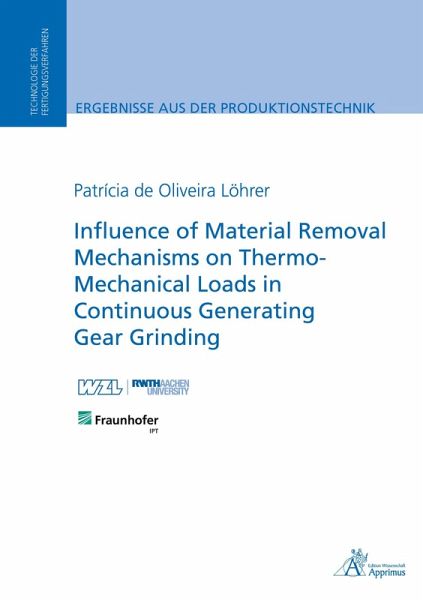
Continuous generating grinding is a precision finishing process used at the final stage of gear manufacturing to meet stringent requirements for dimensional accuracy and surface integrity. To prevent undesirable alterations in surface integrity caused by thermal effects during grinding, it is essential to understand and control the heat flux entering the workpiece. Predictive models can aid in this by providing insights into heat flux behavior during the grinding process. However, most existing models only partially account for the characteristics of the grinding worm and other factors that influence grain engagement. When these factors are considered, it is often done in a highly empirical way.This work presents a methodology for calculating thermo-mechanical loads in generating gear grinding, taking into account the specific characteristics of the grinding worm and the factors affecting grain engagement. The methodology begins with a grain grinding energy model that considers the chip formation mechanisms according to the kinematics of the generating gear grinding process.The next step involved adapting the single-grain grinding energy model to account for multiple-grain engagements in the generating gear grinding process. This adaptation required calculating the micro-interaction characteristics based on the kinematics and specific conditions of generating gear grinding through process simulation. Grinding energy was then calculated and verified through analogy trials, which were designed to simplify force measurements at specific contact points during the process. Using the validated grinding energy model, thermal loads were calculated based on multiple-grain engagement, incorporating a new method for defining the heat partition coefficient, f, based on the previously calculated grinding energy. This heat flux calculation was subsequently applied to predict the maximum temperature in the grinding contact zone. Temperature measurements from analogy trials were used to validate the heat flux and temperature calculation models.In conclusion, the thermo-mechanical load models developed in this work were successfully tested and verified. The model effectively identified critical levels of thermal energy under varying process parameters, offering a reliable tool that considers characteristics of the grinding worm as well as factors influencing grain engagement in a non-empirical manner.