This book challenges previous assumptions about institutions, social capital, and the nature of the African state by investigating the history of political and economic change in villages on either side of the Ghana-Cote d'Ivoire border. Prior to European colonial rule, these Akan villages had very similar political and cultural institutions. By the late 1990s, however, Lauren M. MacLean found puzzling differences in the informal institutions of reciprocity and indigenous notions of citizenship. MacLean argues that divergent histories of state formation not only shape how villagers help each…mehr
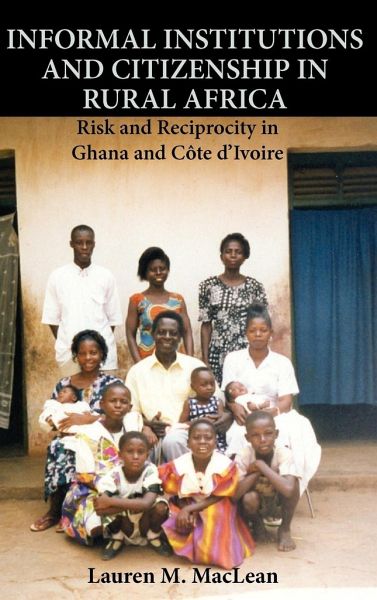
This book challenges previous assumptions about institutions, social capital, and the nature of the African state by investigating the history of political and economic change in villages on either side of the Ghana-Cote d'Ivoire border. Prior to European colonial rule, these Akan villages had very similar political and cultural institutions. By the late 1990s, however, Lauren M. MacLean found puzzling differences in the informal institutions of reciprocity and indigenous notions of citizenship. MacLean argues that divergent histories of state formation not only shape how villagers help each other but also influence how local groups and communities define citizenship and then choose to engage with the state on an everyday basis. She examines the historical construction of the state role in mediating risk at the local level across three policy areas: political administration, social service delivery, and agriculture.
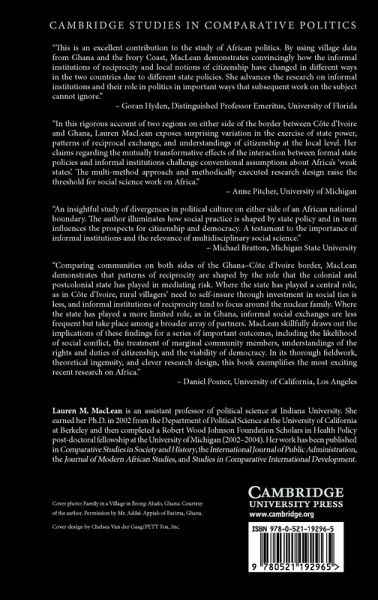
Lauren M. MacLean is an Assistant Professor of Political Science at Indiana University. She earned her Ph.D. in 2002 from the Department of Political Science at the University of California, Berkeley and then completed a Robert Wood Johnson Foundation Scholars in Health Policy post-doctoral fellowship at the University of Michigan (2002-4). Her work has been published in Comparative Studies in Society and History, the International Journal of Public Administration, the Journal of Modern African Studies, and Studies in Comparative International Development.
Inhaltsangabe
Part I. Informal Institutions of Reciprocity in Ghana and Cote d'Ivoire: 1. Introduction; 2. The information institutions of reciprocity: a quantitative puzzle and analysis; 3. Local conflicts over the meaning of reciprocity: a qualitative analysis of change; Part II. Legacies of the State Role in Mediating Risk in Ghana and Cote d'Ivoire: 4. The legacies of the colonial administrative state in constructing the citizen, family, and community role; 5. The construction and retrenchment of state social service provision and the unintended consequences for reciprocity; 6. The empire of the young: contrasting legacies of state agricultural policy for local capitalism and reciprocity; Part III. Informal Institutions of Reciprocity and the Prospects for Democratic Citizenship: 7. Transformations of the informal institutions of reciprocity and the implications for citizenship; 8. Conclusion.
Es gelten unsere Allgemeinen Geschäftsbedingungen: www.buecher.de/agb
Impressum
www.buecher.de ist ein Internetauftritt der buecher.de internetstores GmbH
Geschäftsführung: Monica Sawhney | Roland Kölbl | Günter Hilger
Sitz der Gesellschaft: Batheyer Straße 115 - 117, 58099 Hagen
Postanschrift: Bürgermeister-Wegele-Str. 12, 86167 Augsburg
Amtsgericht Hagen HRB 13257
Steuernummer: 321/5800/1497
USt-IdNr: DE450055826