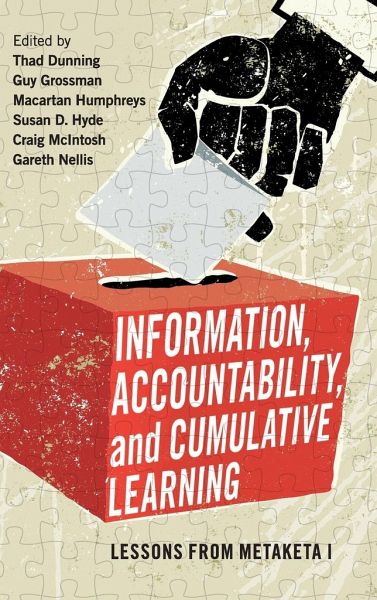
"Throughout the world, voters lack access to information about politicians, government performance, and public services. Efforts to remedy these informational deficits are numerous. Yet do informational campaigns influence voter behavior and increase democratic accountability? Through the first project of the Metaketa Initiative, sponsored by the Evidence in Governance and Politics (EGAP) research network, this book aims to address this substantive question and at the same time introduce a new model for cumulative learning that increases coordination among otherwise independent researcher…mehr
"Throughout the world, voters lack access to information about politicians, government performance, and public services. Efforts to remedy these informational deficits are numerous. Yet do informational campaigns influence voter behavior and increase democratic accountability? Through the first project of the Metaketa Initiative, sponsored by the Evidence in Governance and Politics (EGAP) research network, this book aims to address this substantive question and at the same time introduce a new model for cumulative learning that increases coordination among otherwise independent researcher teams. It presents the overall results (using meta-analysis) from six independently conducted but coordinated field experimental studies, the results from each individual study, and the findings from a related evaluation of whether practitioners utilize this information as expected. It also discusses lessons learned from EGAP's efforts to coordinate field experiments, increase replication of theoretically important studies across contexts, and increase the external validity of field experimental research"--
Part I. Information Accountability and a New Approach to Cumulative Learning: 1. Do informational campaigns promote electoral accountability? Thad Dunning Guy Grossman Macartan Humphreys Susan D. Hyde Craig McIntosh and Gareth Nellis; 2. The Metaketa Initiative Thad Dunning Guy Grossman Macartan Humphreys Susan D. Hyde and Craig McIntosh; 3. Informational interventions: theory and measurement Thad Dunning Guy Grossman Macartan Humphreys Susan D. Hyde Craig McIntosh and Gareth Nellis; Part II. Field Experiments: 4. Under what conditions does performance information influence voting behavior? Lessons from Benin Claire Adida Jessica Gottlieb Eric Kramon and Gwyneth Mcclendon; 5. When does information increase electoral accountability? Lessons from a field experiment in Mexico Eric Arias Horacio Larreguy John Marshall and Pablo Querubin; 6. Candidate videos and vote choice in Ugandan parliamentary elections Melina R. Platas and Pia Raffler; 7. Budgets SMS texts and votes in Uganda Mark T. Buntaine Sarah S. Bush Ryan Jablonski Daniel L. Nielson and Paula M. Pickering; 8. Performance-based voting in local elections: experimental evidence from Burkina Faso Malte Lierl and Marcus Holmlund; 9. Horizontal but not vertical: accountability institutions and electoral sanctioning in Northeast Brazil Taylor C. Boas F. Daniel Hidalgo and Marcus A. Melo; 10. Dilemmas and challenges of citizen information campaigns: lessons from a failed experiment in India Neelanjan Sircar and Simon Chauchard; Part III. Cumulative Learning: 11. Meta-analysis Thad Dunning Clara Bicalho Anirvan Chowdhury Guy Grossman Macartan Humphreys Susan D. Hyde Craig McIntosh and Gareth Nellis; 12. Learning about cumulative learning: an experiment with policy practitioners Gareth Nellis Thad Dunning Guy Grossman Macartan Humphreys Susan D. Hyde Craig McIntosh and Catlan Reardon; Part IV. Conclusion: 13. Challenges and opportunities Thad Dunning Guy Grossman Macartan Humphreys Susan D. Hyde Craig McIntosh and Gareth Nellis; Part V. End Matter: 14. Appendix: meta-preanalysis plan (MPAP); 15. References; Part VI. Online Appendix.
Part I. Information Accountability and a New Approach to Cumulative Learning: 1. Do informational campaigns promote electoral accountability? Thad Dunning Guy Grossman Macartan Humphreys Susan D. Hyde Craig McIntosh and Gareth Nellis; 2. The Metaketa Initiative Thad Dunning Guy Grossman Macartan Humphreys Susan D. Hyde and Craig McIntosh; 3. Informational interventions: theory and measurement Thad Dunning Guy Grossman Macartan Humphreys Susan D. Hyde Craig McIntosh and Gareth Nellis; Part II. Field Experiments: 4. Under what conditions does performance information influence voting behavior? Lessons from Benin Claire Adida Jessica Gottlieb Eric Kramon and Gwyneth Mcclendon; 5. When does information increase electoral accountability? Lessons from a field experiment in Mexico Eric Arias Horacio Larreguy John Marshall and Pablo Querubin; 6. Candidate videos and vote choice in Ugandan parliamentary elections Melina R. Platas and Pia Raffler; 7. Budgets SMS texts and votes in Uganda Mark T. Buntaine Sarah S. Bush Ryan Jablonski Daniel L. Nielson and Paula M. Pickering; 8. Performance-based voting in local elections: experimental evidence from Burkina Faso Malte Lierl and Marcus Holmlund; 9. Horizontal but not vertical: accountability institutions and electoral sanctioning in Northeast Brazil Taylor C. Boas F. Daniel Hidalgo and Marcus A. Melo; 10. Dilemmas and challenges of citizen information campaigns: lessons from a failed experiment in India Neelanjan Sircar and Simon Chauchard; Part III. Cumulative Learning: 11. Meta-analysis Thad Dunning Clara Bicalho Anirvan Chowdhury Guy Grossman Macartan Humphreys Susan D. Hyde Craig McIntosh and Gareth Nellis; 12. Learning about cumulative learning: an experiment with policy practitioners Gareth Nellis Thad Dunning Guy Grossman Macartan Humphreys Susan D. Hyde Craig McIntosh and Catlan Reardon; Part IV. Conclusion: 13. Challenges and opportunities Thad Dunning Guy Grossman Macartan Humphreys Susan D. Hyde Craig McIntosh and Gareth Nellis; Part V. End Matter: 14. Appendix: meta-preanalysis plan (MPAP); 15. References; Part VI. Online Appendix.
Es gelten unsere Allgemeinen Geschäftsbedingungen: www.buecher.de/agb
Impressum
www.buecher.de ist ein Internetauftritt der buecher.de internetstores GmbH
Geschäftsführung: Monica Sawhney | Roland Kölbl | Günter Hilger
Sitz der Gesellschaft: Batheyer Straße 115 - 117, 58099 Hagen
Postanschrift: Bürgermeister-Wegele-Str. 12, 86167 Augsburg
Amtsgericht Hagen HRB 13257
Steuernummer: 321/5800/1497
USt-IdNr: DE450055826