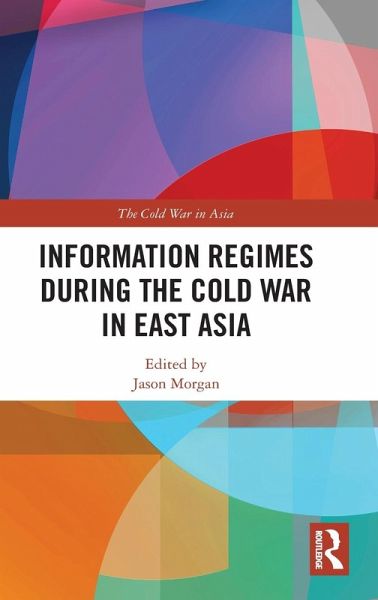
Morgan and his contributors develop the concept of the Information Regime as a way to understand the use, abuse, and control of information in East Asia during the Cold war period.
Morgan and his contributors develop the concept of the Information Regime as a way to understand the use, abuse, and control of information in East Asia during the Cold war period.
Jason Morgan is Associate Professor in the Faculty of Global Studies at Reitaku University, Japan
Inhaltsangabe
Part One: Diplomacy, Public Diplomacy, and Espionage 1. Behind the Curtains: How Soviet Intelligence Masters and Japanese Journalists Brought About Soviet-Japan Diplomatic Normalization-Without the Return of the Northern Territories 2. Saving China, Losing China: The Transformation of a Prewar to Cold War Information Regime 3. Piecing Together the "Broken Dialogue": Ambassador Douglas MacArthur and the Controversy over Professor Edwin O. Reischauer's Foreign Affairs Article Part Two: Knowledge Networks and Scholarship 4. Ky sei Renk (Forced Mobilization): Pak Ky ng-sik and Zainichi Identity as Inspired by North Korea 5. The Effect of Chinese Communism on an Australian in British Malaya, 1950-1971: Escaping Ideology by Nearly "Going Native" Part Three: Ideologies, Religion, and Culture 6. Catholicism and the Cold War in Japan 7. The Cold War as Gestalt for North Korea as a Diplomatic Subject 8. The Club of Rome in East Asia: U.S.-Led Population-Control Information Regimes and Waging the Cold War in the Far East
Part One: Diplomacy, Public Diplomacy, and Espionage 1. Behind the Curtains: How Soviet Intelligence Masters and Japanese Journalists Brought About Soviet-Japan Diplomatic Normalization-Without the Return of the Northern Territories 2. Saving China, Losing China: The Transformation of a Prewar to Cold War Information Regime 3. Piecing Together the "Broken Dialogue": Ambassador Douglas MacArthur and the Controversy over Professor Edwin O. Reischauer's Foreign Affairs Article Part Two: Knowledge Networks and Scholarship 4. Ky sei Renk (Forced Mobilization): Pak Ky ng-sik and Zainichi Identity as Inspired by North Korea 5. The Effect of Chinese Communism on an Australian in British Malaya, 1950-1971: Escaping Ideology by Nearly "Going Native" Part Three: Ideologies, Religion, and Culture 6. Catholicism and the Cold War in Japan 7. The Cold War as Gestalt for North Korea as a Diplomatic Subject 8. The Club of Rome in East Asia: U.S.-Led Population-Control Information Regimes and Waging the Cold War in the Far East
Es gelten unsere Allgemeinen Geschäftsbedingungen: www.buecher.de/agb
Impressum
www.buecher.de ist ein Internetauftritt der buecher.de internetstores GmbH
Geschäftsführung: Monica Sawhney | Roland Kölbl | Günter Hilger
Sitz der Gesellschaft: Batheyer Straße 115 - 117, 58099 Hagen
Postanschrift: Bürgermeister-Wegele-Str. 12, 86167 Augsburg
Amtsgericht Hagen HRB 13257
Steuernummer: 321/5800/1497
USt-IdNr: DE450055826