Information technology is an integral part of the practices and institutions of post-industrial society. It is also a source of hard moral questions and thus is both a probing and relevant area for moral theory. In this volume, an international team of philosophers sheds light on many of the ethical issues arising from information technology, including informational privacy, digital divide and equal access, e-trust and tele-democracy. Collectively, these essays demonstrate how accounts of equality and justice, property and privacy benefit from taking into account how information technology has…mehr
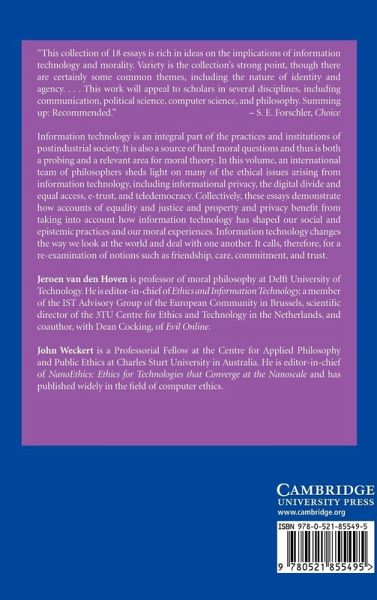
Information technology is an integral part of the practices and institutions of post-industrial society. It is also a source of hard moral questions and thus is both a probing and relevant area for moral theory. In this volume, an international team of philosophers sheds light on many of the ethical issues arising from information technology, including informational privacy, digital divide and equal access, e-trust and tele-democracy. Collectively, these essays demonstrate how accounts of equality and justice, property and privacy benefit from taking into account how information technology has shaped our social and epistemic practices and our moral experiences. Information technology changes the way that we look at the world and deal with one another. It calls, therefore, for a re-examination of notions such as friendship, care, commitment and trust.
Jeroen van den Hoven is professor of moral philosophy at Delft University of Technology. He is Editor-in -Chief of Ethics and Information Technology, member of the IST Advisory Group of the EC in Brussels, Scientific Director of the Centre for Ethics and Technology of the Three Technical Universities in The Netherlands, as well as co-author, with Dean Cocking, of Evil On-Line.
John Weckert is Professorial Fellow at the Center for Applied Philosophy and Public Ethics at Charles Sturt University in Australia. He has published widely in the field of computer ethics.
Inhaltsangabe
Introduction; 1. Norbert Wiener and the rise of information ethics Terrell Ward Bynum; 2. Why we need better ethics for emerging technologies James H. Moor; 3. Information ethics: its nature and scope Luciano Floridi; 4. The transformation of the public sphere: political authority, communicative freedom, and internet publics James Bohman; 5. Democracy and the internet Cass R. Sunstein; 6. The social epistemology of blogging Alvin I. Goldman; 7. Plural selves and relational identity: intimacy and privacy online Dean Cocking; 8. Identity and information technology Steve Matthews; 9. Trust, reliance, and the internet Philip Pettit; 10. Esteem, identifiability, and the internet Geoffrey Brennan and Philip Pettit; 11. Culture and global networks: hope for a global ethics? Charles Ess; 12. Collective responsibility and information and communication technology Seumas Miller; 13. Computers as surrogate agents Deborah G. Johnson and Thomas M. Powers; 14. Moral philosophy, information technology, and copyright: the Grokster case Wendy J. Gordon; 15. Information technology, privacy, and the protection of personal data Jeroen van den Hoven; 16. Embodying values in technology: theory and practice Mary Flanagan, Daniel C. Howe and Helen Nissenbaum; 17. Information technology research ethics Dag Elgesem; 18. Distributive justice and the value of information: a (broadly) Rawlsian approach Jeroen van den Hoven and Emma Rooksby.
Introduction; 1. Norbert Wiener and the rise of information ethics Terrell Ward Bynum; 2. Why we need better ethics for emerging technologies James H. Moor; 3. Information ethics: its nature and scope Luciano Floridi; 4. The transformation of the public sphere: political authority, communicative freedom, and internet publics James Bohman; 5. Democracy and the internet Cass R. Sunstein; 6. The social epistemology of blogging Alvin I. Goldman; 7. Plural selves and relational identity: intimacy and privacy online Dean Cocking; 8. Identity and information technology Steve Matthews; 9. Trust, reliance, and the internet Philip Pettit; 10. Esteem, identifiability, and the internet Geoffrey Brennan and Philip Pettit; 11. Culture and global networks: hope for a global ethics? Charles Ess; 12. Collective responsibility and information and communication technology Seumas Miller; 13. Computers as surrogate agents Deborah G. Johnson and Thomas M. Powers; 14. Moral philosophy, information technology, and copyright: the Grokster case Wendy J. Gordon; 15. Information technology, privacy, and the protection of personal data Jeroen van den Hoven; 16. Embodying values in technology: theory and practice Mary Flanagan, Daniel C. Howe and Helen Nissenbaum; 17. Information technology research ethics Dag Elgesem; 18. Distributive justice and the value of information: a (broadly) Rawlsian approach Jeroen van den Hoven and Emma Rooksby.
Es gelten unsere Allgemeinen Geschäftsbedingungen: www.buecher.de/agb
Impressum
www.buecher.de ist ein Internetauftritt der buecher.de internetstores GmbH
Geschäftsführung: Monica Sawhney | Roland Kölbl | Günter Hilger
Sitz der Gesellschaft: Batheyer Straße 115 - 117, 58099 Hagen
Postanschrift: Bürgermeister-Wegele-Str. 12, 86167 Augsburg
Amtsgericht Hagen HRB 13257
Steuernummer: 321/5800/1497
USt-IdNr: DE450055826