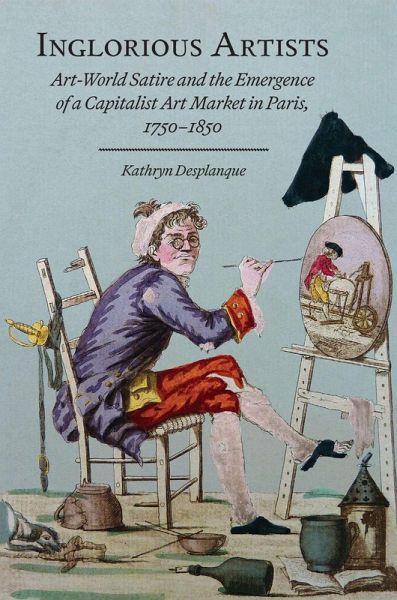
Inglorious Artists traces the origins of the image of the starving artist to late eighteenth- and early nineteenth-century France, where practicing and aspiring visual artists mobilized the emerging genre of graphic satire to publish hundreds of satirical images that satirized the Paris art world. By examining many of these images, which have never before been studied or published, this book provides a new social history of the status of the artist, revealing the ways in which the starving artist trope was used to protest the emergence of an early capitalist art market and to distinguish…mehr
Inglorious Artists traces the origins of the image of the starving artist to late eighteenth- and early nineteenth-century France, where practicing and aspiring visual artists mobilized the emerging genre of graphic satire to publish hundreds of satirical images that satirized the Paris art world. By examining many of these images, which have never before been studied or published, this book provides a new social history of the status of the artist, revealing the ways in which the starving artist trope was used to protest the emergence of an early capitalist art market and to distinguish artists and their work from an increasingly commercial world. During this period, a series of political revolutions brought the possibility of radical change in the French art world. Parisian artists struggled to keep pace with the emergence of modern financial speculative capitalism, transitioning away from an art system dominated by guild and corporate interest. We have neglected the complaints visual artists made about these changes, expressed in the medium most accessible to them: the graphic image. In examining this imagery for the first time, Inglorious Artists reveals that the emergence of our modern conception of the artist is far more conflicted than has been considered. This book is also freely available online as an open access digital edition.
Produktdetails
Produktdetails
Studies in Seventeenth- and Eighteenth-Century Art and Culture
Kathryn Desplanque is an assistant professor of eighteenth- and nineteenth-Century European art in the Department of Art and Art History at the University of North Carolina at Chapel Hill. Her work specializes in eighteenth- and nineteenth-century European visual culture, particularly French and English imagery. She has authored numerous book chapters and has published articles in such journals as Eighteenth-Century Studies, Biblio 17: Voyages, rencontres, Échanges au XVIIe siÈcle, and The Art Bulletin . Her current book project, Papermania, charts the growing popularity of scrap sheets and scrapbooking across France, England, and North America during the late eighteenth and nineteenth centuries.
Inhaltsangabe
Acknowledgements List of Figures and Tables Introduction Chapter One: The Artiste Libre in the Ancien RÉgime Chapter Two: Revolutionary Instabilities of Liberty and Autonomy Chapter Three: The Starving Artist in the Salon System Chapter Four: The Apotheosis of Bohemia Conclusion Endnotes Bibliography Index
Acknowledgements List of Figures and Tables Introduction Chapter One: The Artiste Libre in the Ancien RÉgime Chapter Two: Revolutionary Instabilities of Liberty and Autonomy Chapter Three: The Starving Artist in the Salon System Chapter Four: The Apotheosis of Bohemia Conclusion Endnotes Bibliography Index
Es gelten unsere Allgemeinen Geschäftsbedingungen: www.buecher.de/agb
Impressum
www.buecher.de ist ein Internetauftritt der buecher.de internetstores GmbH
Geschäftsführung: Monica Sawhney | Roland Kölbl | Günter Hilger
Sitz der Gesellschaft: Batheyer Straße 115 - 117, 58099 Hagen
Postanschrift: Bürgermeister-Wegele-Str. 12, 86167 Augsburg
Amtsgericht Hagen HRB 13257
Steuernummer: 321/5800/1497
USt-IdNr: DE450055826