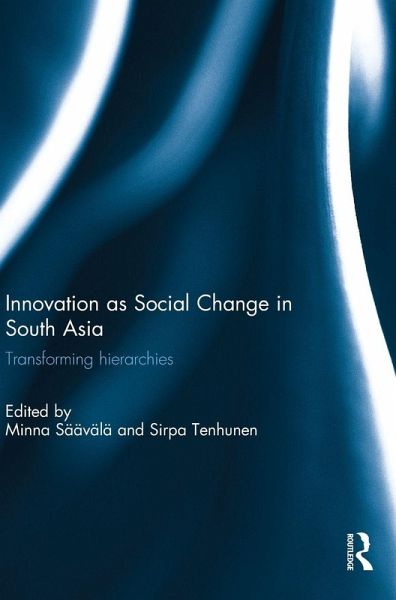
South Asia is the cradle of much innovation, the most notable being microfinance. When technological and social innovation takes place in starkly hierarchical societies, such as in South Asia, do they actually make life better? And if so, for whom? This book presents case studies of technological and social innovations that point to limitations but also to the promise of engendering lasting change. This book was originally published as a special issue of Contemporary South Asia.
South Asia is the cradle of much innovation, the most notable being microfinance. When technological and social innovation takes place in starkly hierarchical societies, such as in South Asia, do they actually make life better? And if so, for whom? This book presents case studies of technological and social innovations that point to limitations but also to the promise of engendering lasting change. This book was originally published as a special issue of Contemporary South Asia.
Minna Säävälä is an adjunct professor of social anthropology in the University of Helsinki, Finland and works as a senior researcher in the Population Research Institute, Finland. Her current research projects relate to family formation in India and reproductive health of migrant populations in Europe. Sirpa Tenhunen is an anthropologist who teaches in the University of Jyväskylä, Finland as a professor (interim) and university lecturer. She has also taught anthropology in the University of Helsinki, Finland and worked as a researcher in the Academy of Finland. In addition to new media, her research interests cover gender, work and politics in India.
Inhaltsangabe
1. Introduction: Innovation: transforming hierarchies in South Asia 2. Katibs and computers: innovation and ideology in the Urdu newspaper revival 3. Microcredit and building social capital in rural Bangladesh - drawing the uneasy link 4. Mobile telephony, mediation, and gender in rural India 5. Supply and demand demographics: dowry, daughter aversion and marriage markets in contemporary north India 6. Domestic violence made public: a case study of the use of alternative dispute resolution among underprivileged women in Bangladesh
1. Introduction: Innovation: transforming hierarchies in South Asia 2. Katibs and computers: innovation and ideology in the Urdu newspaper revival 3. Microcredit and building social capital in rural Bangladesh - drawing the uneasy link 4. Mobile telephony, mediation, and gender in rural India 5. Supply and demand demographics: dowry, daughter aversion and marriage markets in contemporary north India 6. Domestic violence made public: a case study of the use of alternative dispute resolution among underprivileged women in Bangladesh
Es gelten unsere Allgemeinen Geschäftsbedingungen: www.buecher.de/agb
Impressum
www.buecher.de ist ein Internetauftritt der buecher.de internetstores GmbH
Geschäftsführung: Monica Sawhney | Roland Kölbl | Günter Hilger
Sitz der Gesellschaft: Batheyer Straße 115 - 117, 58099 Hagen
Postanschrift: Bürgermeister-Wegele-Str. 12, 86167 Augsburg
Amtsgericht Hagen HRB 13257
Steuernummer: 321/5800/1497
USt-IdNr: DE450055826