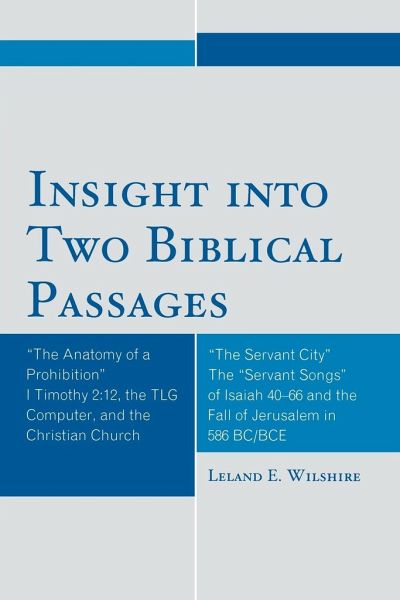
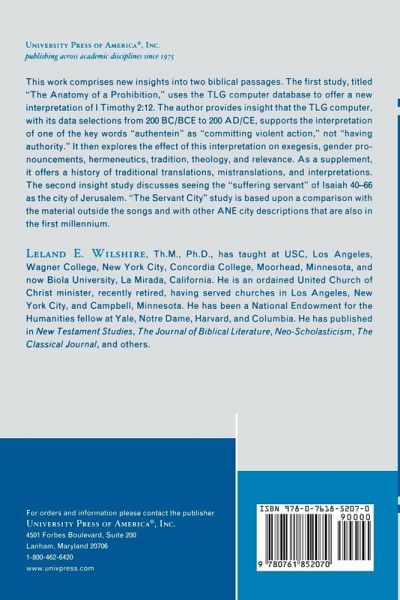
The first study uses the TLG computer database for a new interpretation of I Timothy 2.12, exploring the effect of the interpretation on exegesis, gender pronouncements, hermeneutics, tradition, theology, and relevance. The second insight study discusses seeing the 'suffering servant' of Isaiah 40-55 as the city of Jerusalem.
The first study uses the TLG computer database for a new interpretation of I Timothy 2.12, exploring the effect of the interpretation on exegesis, gender pronouncements, hermeneutics, tradition, theology, and relevance. The second insight study discusses seeing the 'suffering servant' of Isaiah 40-55 as the city of Jerusalem.
Leland E. Wilshire, Th.M., Ph.D., has taught at USC, Los Angeles, Wagner College, New York City, Concordia College, Moorhead, Minnesota, and now Biola University, La Mirada, California. He is an ordained United Church of Christ minister, recently retired, having served churches in Los Angeles, New York City, and Campbell, Minnesota. He has been a National Endowment for the Humanities fellow at Yale, Notre Dame, Harvard, and Columbia. He has published in New Testament Studies,The Journal of Biblical Literature, Neo-Scholasticism,The Classical Journal, and others.
Inhaltsangabe
Part 1 The Anatomy of Prohibition: I Timothy 2.12, the TLG Computer, and the Christian Church Chapter 2 Foreword Chapter 3 Preface Part 4 Part I Chapter 5 1. The I Timothy 2.12 Passage and Its Difficulties Chapter 6 2. Phillology, Lexicons, and the Computer Databank: A New Opening in Understanding the I Tim. 2.12 Prohibition Chapter 7 3. A 1984 Attempt by George W. Knight III, by the use of Lexicons, to deal with the word authentein Chapter 8 4. The Use of the Computer Data and Other Citations in a Background Study of the Word AUTHENTEO in I Tim. 2.12 Chapter 9 5. A New Interpretation of the I Tim. 2.12 Prohibition in Light of the New Computer Databank Understanding Chapter 10 6. Three Sample Alternative Approaches: that of Paul W. Barnett, Catherine C. Kroeger, and the Editors of Women in the Church Part 11 Part II Chapter 12 Introduction: The Anatomy of Prohibition: The New Interpretation and its Contemporary Applications Chapter 13 1. Exegesis Chapter 14 2. Gender Chapter 15 3. Hermeneutics Chapter 16 4. Tradition Chapter 17 5. Theology Chapter 18 6. Authority Chapter 19 7. Ecclesiology Chapter 20 8. Relevance Part 21 Supplement: The Anatomy of Prohibition: A History of Traditional Translations, Mistranslations, and Interpretations Chapter 22 1. The Use of I Tim. 2.12 Prohibition in the Traditional Interpretations of the Greek Early Church Chapter 23 2. The Use of the Prohibition in the Traditional Translations and Interpretations of the Latin Early Church Chapter 24 3. Traditional Translations and Interpretations of the Prohibition during the Middle Ages Chapter 25 4. Reformulations of the Prohibition during the Era of the Renaissance and Reformation Chapter 26 5. Differing English Translations of the I Tim. 2.12 Prohibition in Modern History and their Use in the Current Understandings of Women in Ecclesiastical Leadership Chapter 27 Notes Chapter 28 Working Bibliography Part 29 The Servant City: The "Servant Songs" of Isaiah 40-66 and the Fall of Jerusalem in 586 BC/BCE Chapter 30 Foreword Chapter 31 Preface Chapter 32 1. Background: Three Interpretations of the Fall of Jerusalem 586 BC/BCE Chapter 33 2. The "Suffering Servant" Metaphor in the "Servant Songs" of Isaiah 40-66 Relating to the Destruction of the City of Jerusalem Chapter 34 3. The Voice of the Isaianic "Servant Songs" within the Ancient Near Eastern Literary Tradition of Destroyed Cultic Centers Chapter 35 4. The Meaning and Future of the "Suffering Servant" Metaphor in "Isaiah" (Isaiah 40-66) Concerning the Destruction of Jerusalem Chapter 36 Notes Chapter 37 Working Bibliography
Part 1 The Anatomy of Prohibition: I Timothy 2.12, the TLG Computer, and the Christian Church Chapter 2 Foreword Chapter 3 Preface Part 4 Part I Chapter 5 1. The I Timothy 2.12 Passage and Its Difficulties Chapter 6 2. Phillology, Lexicons, and the Computer Databank: A New Opening in Understanding the I Tim. 2.12 Prohibition Chapter 7 3. A 1984 Attempt by George W. Knight III, by the use of Lexicons, to deal with the word authentein Chapter 8 4. The Use of the Computer Data and Other Citations in a Background Study of the Word AUTHENTEO in I Tim. 2.12 Chapter 9 5. A New Interpretation of the I Tim. 2.12 Prohibition in Light of the New Computer Databank Understanding Chapter 10 6. Three Sample Alternative Approaches: that of Paul W. Barnett, Catherine C. Kroeger, and the Editors of Women in the Church Part 11 Part II Chapter 12 Introduction: The Anatomy of Prohibition: The New Interpretation and its Contemporary Applications Chapter 13 1. Exegesis Chapter 14 2. Gender Chapter 15 3. Hermeneutics Chapter 16 4. Tradition Chapter 17 5. Theology Chapter 18 6. Authority Chapter 19 7. Ecclesiology Chapter 20 8. Relevance Part 21 Supplement: The Anatomy of Prohibition: A History of Traditional Translations, Mistranslations, and Interpretations Chapter 22 1. The Use of I Tim. 2.12 Prohibition in the Traditional Interpretations of the Greek Early Church Chapter 23 2. The Use of the Prohibition in the Traditional Translations and Interpretations of the Latin Early Church Chapter 24 3. Traditional Translations and Interpretations of the Prohibition during the Middle Ages Chapter 25 4. Reformulations of the Prohibition during the Era of the Renaissance and Reformation Chapter 26 5. Differing English Translations of the I Tim. 2.12 Prohibition in Modern History and their Use in the Current Understandings of Women in Ecclesiastical Leadership Chapter 27 Notes Chapter 28 Working Bibliography Part 29 The Servant City: The "Servant Songs" of Isaiah 40-66 and the Fall of Jerusalem in 586 BC/BCE Chapter 30 Foreword Chapter 31 Preface Chapter 32 1. Background: Three Interpretations of the Fall of Jerusalem 586 BC/BCE Chapter 33 2. The "Suffering Servant" Metaphor in the "Servant Songs" of Isaiah 40-66 Relating to the Destruction of the City of Jerusalem Chapter 34 3. The Voice of the Isaianic "Servant Songs" within the Ancient Near Eastern Literary Tradition of Destroyed Cultic Centers Chapter 35 4. The Meaning and Future of the "Suffering Servant" Metaphor in "Isaiah" (Isaiah 40-66) Concerning the Destruction of Jerusalem Chapter 36 Notes Chapter 37 Working Bibliography
Es gelten unsere Allgemeinen Geschäftsbedingungen: www.buecher.de/agb
Impressum
www.buecher.de ist ein Internetauftritt der buecher.de internetstores GmbH
Geschäftsführung: Monica Sawhney | Roland Kölbl | Günter Hilger
Sitz der Gesellschaft: Batheyer Straße 115 - 117, 58099 Hagen
Postanschrift: Bürgermeister-Wegele-Str. 12, 86167 Augsburg
Amtsgericht Hagen HRB 13257
Steuernummer: 321/5800/1497
USt-IdNr: DE450055826