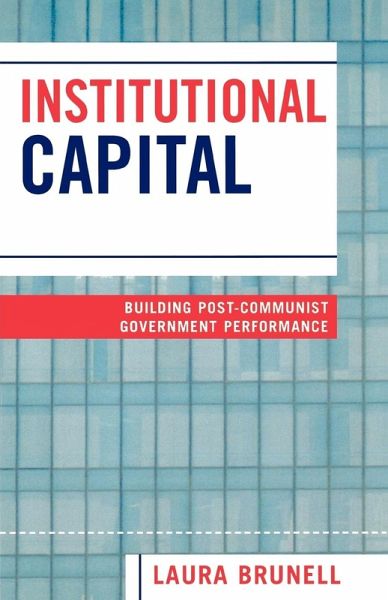
Institutional Capital documents and explores the new forms of relationships developing between local governments and organized elements of civil society in post-Communist Poland.
Institutional Capital documents and explores the new forms of relationships developing between local governments and organized elements of civil society in post-Communist Poland.
Laura Brunell received her B.A. in Communications, Legal Institutions, Economics and Government from American University, in Washington, D.C., and her M.A. and Ph.D. in Political Science from the University of Colorado, Boulder. She was awarded a Fulbright Fellowship in 1995-96 to study the development of civil society in post-Communist Poland. She is Assistant Professor of Political Science at Gonzaga University, Spokane, Washington.
Inhaltsangabe
Chapter 1 Making Post-Communist Democracies Work: State-Society Relations in Post-Communist Europe; Civil Society and State Performance; Civic Traditions, Economic Development and the State Variation in Performance within Regimes; Explaining Performance; Link Chapter 2 Measuring Institutional Capital and Research Methods: Analytic Conceptualization and Terminology; Conceptualizing the Relationship Between Institutional Capital and Performance; Operationalizing Institutional Capital; State Contributions to Institut Chapter 3 The State and Institutional Capital: Governing the Post-Communist City: Components of the Local State's Institutional Capital; Discursiveness; Information Gathering and Dissemination Strategies; Bureaucratizing Public In formation; Institutionalizin Chapter 4 Raising Institutional Capital in Civil Society: Components of Civil Society's Institutional Capital; Third Sector Heterogeneity: Heterogeneity of Group Type and Size; Heterogeneity of Funding Sources; Horizontal Links among Activists; Activity Acros Chapter 5 New Stocks of Institutional Capital and Prospects for Performance: Discourse and Protest in Krakow's Stock of Institutional Capital; Institutional Capital: Continuity or Change?; Repertorial Continuity; Repertorial Expansion or Contraction?; Krakow' Chapter 6 Putting Institutional Capital to Work: The Political Economy of Development Planning and Waste Disposal: Economic Planning and Waste Disposal Under State Socialism and Today: From Autarky to Governance; New Conditions and Strategies; Managing Waste Chapter 7 Governing Women: Domestic Violence and the Politics of Institutionalizing Women's Social Rights: Social Rights and Gender in Post-Communist Poland: Family Law and Domestic Violence; Domestic Violence in Poland; The Institutional Terrain of Gen Chapter 8 Historical Sources of Institutional Capital: Development, Class Composition and Civic Traditions in Krakow; Development; Self-Government, Class, and Civic Traditions; Development in the 19th Century; Class and Civic Traditions in the 19th Century; C Chapter 9 Opposition Movements Influences on Institutional Capital: Krakow: The Intellectual's City in a Worker's Era; Workers' Srodowiska; Church-based Srodowiska; Student Srodowiska; Intelligentsia Srodowiska; State-Society Relations Chapter 10 Institutional Capital and Post-Communist State Performance: Beyond Civic Traditions; State Initiative; Embedding the State: Creating Partners in Performance; Two Types of Post-Communist Performance; Final Remarks Chapter 11 Appendices: Groups Surveyed; Interviewees; Individual Questionnaire; Group Questionnaire; City Elite Survey Chapter 12 Bibliography Chapter 13 Index
Chapter 1 Making Post-Communist Democracies Work: State-Society Relations in Post-Communist Europe; Civil Society and State Performance; Civic Traditions, Economic Development and the State Variation in Performance within Regimes; Explaining Performance; Link Chapter 2 Measuring Institutional Capital and Research Methods: Analytic Conceptualization and Terminology; Conceptualizing the Relationship Between Institutional Capital and Performance; Operationalizing Institutional Capital; State Contributions to Institut Chapter 3 The State and Institutional Capital: Governing the Post-Communist City: Components of the Local State's Institutional Capital; Discursiveness; Information Gathering and Dissemination Strategies; Bureaucratizing Public In formation; Institutionalizin Chapter 4 Raising Institutional Capital in Civil Society: Components of Civil Society's Institutional Capital; Third Sector Heterogeneity: Heterogeneity of Group Type and Size; Heterogeneity of Funding Sources; Horizontal Links among Activists; Activity Acros Chapter 5 New Stocks of Institutional Capital and Prospects for Performance: Discourse and Protest in Krakow's Stock of Institutional Capital; Institutional Capital: Continuity or Change?; Repertorial Continuity; Repertorial Expansion or Contraction?; Krakow' Chapter 6 Putting Institutional Capital to Work: The Political Economy of Development Planning and Waste Disposal: Economic Planning and Waste Disposal Under State Socialism and Today: From Autarky to Governance; New Conditions and Strategies; Managing Waste Chapter 7 Governing Women: Domestic Violence and the Politics of Institutionalizing Women's Social Rights: Social Rights and Gender in Post-Communist Poland: Family Law and Domestic Violence; Domestic Violence in Poland; The Institutional Terrain of Gen Chapter 8 Historical Sources of Institutional Capital: Development, Class Composition and Civic Traditions in Krakow; Development; Self-Government, Class, and Civic Traditions; Development in the 19th Century; Class and Civic Traditions in the 19th Century; C Chapter 9 Opposition Movements Influences on Institutional Capital: Krakow: The Intellectual's City in a Worker's Era; Workers' Srodowiska; Church-based Srodowiska; Student Srodowiska; Intelligentsia Srodowiska; State-Society Relations Chapter 10 Institutional Capital and Post-Communist State Performance: Beyond Civic Traditions; State Initiative; Embedding the State: Creating Partners in Performance; Two Types of Post-Communist Performance; Final Remarks Chapter 11 Appendices: Groups Surveyed; Interviewees; Individual Questionnaire; Group Questionnaire; City Elite Survey Chapter 12 Bibliography Chapter 13 Index
Es gelten unsere Allgemeinen Geschäftsbedingungen: www.buecher.de/agb
Impressum
www.buecher.de ist ein Internetauftritt der buecher.de internetstores GmbH
Geschäftsführung: Monica Sawhney | Roland Kölbl | Günter Hilger
Sitz der Gesellschaft: Batheyer Straße 115 - 117, 58099 Hagen
Postanschrift: Bürgermeister-Wegele-Str. 12, 86167 Augsburg
Amtsgericht Hagen HRB 13257
Steuernummer: 321/5800/1497
USt-IdNr: DE450055826