- Broschiertes Buch
- Merkliste
- Auf die Merkliste
- Bewerten Bewerten
- Teilen
- Produkt teilen
- Produkterinnerung
- Produkterinnerung
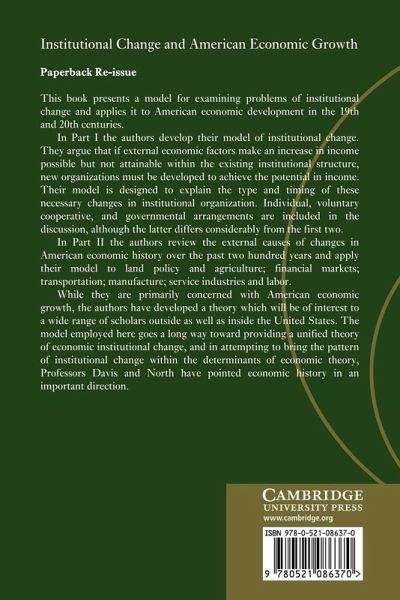
This book presents a model for examining problems of institutional change and applies it to American economic development in the nineteenth and twentieth centuries.
Andere Kunden interessierten sich auch für
Douglass C. North (St Louis Washington University)Institutions, Institutional Change and Economic Performance27,99 €
Douglass C. North (St Louis Washington University)Institutions, Institutional Change and Economic Performance103,99 €
Lara Kriegel (Indiana University)The Crimean War and its Afterlife110,99 €
Laura Gowing (King's College London)Ingenious Trade44,99 €
Sharon TurnerThe History of the Anglo-Saxons57,99 €
David Cowan (University of Cambridge)Politics of the Past96,99 €
Walter BagehotThe English Constitution45,99 €-
-
-
This book presents a model for examining problems of institutional change and applies it to American economic development in the nineteenth and twentieth centuries.
Produktdetails
- Produktdetails
- Verlag: Cambridge University Press
- Seitenzahl: 292
- Erscheinungstermin: 25. Juli 2008
- Englisch
- Abmessung: 229mm x 152mm x 17mm
- Gewicht: 478g
- ISBN-13: 9780521086370
- ISBN-10: 052108637X
- Artikelnr.: 24878987
- Herstellerkennzeichnung
- Libri GmbH
- Europaallee 1
- 36244 Bad Hersfeld
- gpsr@libri.de
- Verlag: Cambridge University Press
- Seitenzahl: 292
- Erscheinungstermin: 25. Juli 2008
- Englisch
- Abmessung: 229mm x 152mm x 17mm
- Gewicht: 478g
- ISBN-13: 9780521086370
- ISBN-10: 052108637X
- Artikelnr.: 24878987
- Herstellerkennzeichnung
- Libri GmbH
- Europaallee 1
- 36244 Bad Hersfeld
- gpsr@libri.de
Part I. The Theory Developed: 1. A theory of institutional change: concepts
and causes; 2. The government, coercion, and the redistribution of income;
3. A theory of institutional innovation: description, analogy,
specification; 4. Changes in the institutional environment: exogenous
shifts and arrangemental innovation; Part II. The Theory Applied: 5. Land
policy and American agriculture; 6. Organization and reorganization in the
financial markets: savings and investment in the American economy,
1820-1950; 7. Transportation developments and economic growth; 8. Economies
of scale, unsuccessful cartelization, and external costs: some sidelights
on the growth of manufacturing in the United States; 9. Institutional
change in the service industries; 9. The labor force: organization and
education; Part III. Conclusions: 11. The changing public-private mix; 12.
History and the analysis of arrangemental change: a look to the past with
an eye to the future.
and causes; 2. The government, coercion, and the redistribution of income;
3. A theory of institutional innovation: description, analogy,
specification; 4. Changes in the institutional environment: exogenous
shifts and arrangemental innovation; Part II. The Theory Applied: 5. Land
policy and American agriculture; 6. Organization and reorganization in the
financial markets: savings and investment in the American economy,
1820-1950; 7. Transportation developments and economic growth; 8. Economies
of scale, unsuccessful cartelization, and external costs: some sidelights
on the growth of manufacturing in the United States; 9. Institutional
change in the service industries; 9. The labor force: organization and
education; Part III. Conclusions: 11. The changing public-private mix; 12.
History and the analysis of arrangemental change: a look to the past with
an eye to the future.
Part I. The Theory Developed: 1. A theory of institutional change: concepts
and causes; 2. The government, coercion, and the redistribution of income;
3. A theory of institutional innovation: description, analogy,
specification; 4. Changes in the institutional environment: exogenous
shifts and arrangemental innovation; Part II. The Theory Applied: 5. Land
policy and American agriculture; 6. Organization and reorganization in the
financial markets: savings and investment in the American economy,
1820-1950; 7. Transportation developments and economic growth; 8. Economies
of scale, unsuccessful cartelization, and external costs: some sidelights
on the growth of manufacturing in the United States; 9. Institutional
change in the service industries; 9. The labor force: organization and
education; Part III. Conclusions: 11. The changing public-private mix; 12.
History and the analysis of arrangemental change: a look to the past with
an eye to the future.
and causes; 2. The government, coercion, and the redistribution of income;
3. A theory of institutional innovation: description, analogy,
specification; 4. Changes in the institutional environment: exogenous
shifts and arrangemental innovation; Part II. The Theory Applied: 5. Land
policy and American agriculture; 6. Organization and reorganization in the
financial markets: savings and investment in the American economy,
1820-1950; 7. Transportation developments and economic growth; 8. Economies
of scale, unsuccessful cartelization, and external costs: some sidelights
on the growth of manufacturing in the United States; 9. Institutional
change in the service industries; 9. The labor force: organization and
education; Part III. Conclusions: 11. The changing public-private mix; 12.
History and the analysis of arrangemental change: a look to the past with
an eye to the future.