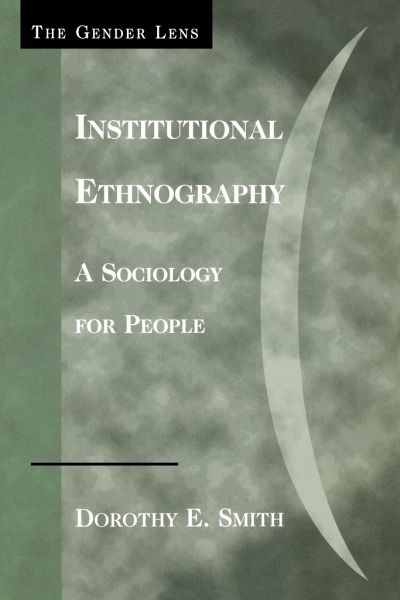
Prominent sociologist Dorothy Smith outlines a method of inquiry that uses everyday experience as a lens to examine social relations and social organization. This sociology from women's standpoints reveals the present but largely unseen social relations of everyday life. This will be a foundational text for classes in sociology, ethnography, and women's studies.
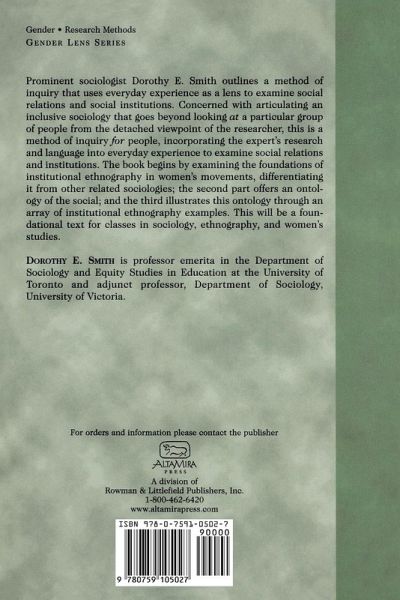
Prominent sociologist Dorothy Smith outlines a method of inquiry that uses everyday experience as a lens to examine social relations and social organization. This sociology from women's standpoints reveals the present but largely unseen social relations of everyday life. This will be a foundational text for classes in sociology, ethnography, and women's studies.
Dorothy E. Smith is professor emerita in the Department of Sociology & Equity Studies in Education at the University of Toronto and adjunct professor, Department of Sociology, University of Victoria, BC.
Inhaltsangabe
Part 1 Introduction Part 2 Part I. Making a Sociology for People Part 3 Chapter 1. Women's Standpoint: Embodied Knowing versus the Ruling Relations Chapter 4 Women's Standpoint and the Ruling Relations Chapter 5 The Historical Trajectory of Gender and the Ruling Relations Part 6 Chapter 2. Knowing the Social: An Alternative Design Chapter 7 Reorganizing the Social Relations of Objectivity Chapter 8 What is Institutional Ethnography? Some Contrasts Chapter 9 Experience and the Ethnographic Problematic Chapter 10 Conclusion Part 11 Part II. An Ontology of the Social Part 12 Chapter 3. Designing an Ontology for Institutional Ethnography Chapter 13 An Ontology of the Social Chapter 14 Institutions, Language, and Texts Chapter 15 Conclusion Part 16 Chapter 4. Language As Coordinating Subjectivities Chapter 17 Reconceptualizing Language as Social Chapter 18 Experiential and Text-based Territories Chapter 19 Conclusion Part 20 Part III. Making Institutions Ethnographically Accessible Part 21 Chapter 5. Texts, Text-Reader Conversations, and Institutional Discourse Chapter 22 The Text-reader Conversation Chapter 23 The Text-reader Conversations of Institutional Discourse Chapter 24 Texts as Institutional Coordinators Chapter 25 Conclusion Part 26 Chapter 6. Experience as Dialogue and Data Chapter 27 Experience as Dialogue: The Problem Chapter 28 An alternative understanding of experience as dialogue Chapter 29 Experience, Language, and Social Organization Chapter 30 The Data Dialogues Chapter 31 Conclusion Part 32 Chapter 7. Work Knowledges Chapter 33 Work Knowledge of University Grades and Grading: A Mini- ethnography Chapter 34 Work Knowledge as the Institutional Ethnographer's Data Chapter 35 Work Knowledge Chapter 36 Assembling and Mapping Work Knowledges Chapter 37 The Problem of Institutional Capture Chapter 38 Conclusion Part 39 Chapter 8. Texts and Institutions Chapter 40 How Texts Coordinate Chapter 41 Conclusion Part 42 Chapter 9. Power, Language, and Institutions Chapter 43 Making Institutional Realities Chapter 44 Regulatory Frames Chapter 45 Conclusion Part 46 Conclusion Part 47 Chapter 10. Where We've Got to and Where We Can Go Chapter 48 Where We've Got To Chapter 49 Expansion Chapter 50 The Collective Work of Institutional Ethnography Part 51 Glossary Part 52 Reference List Part 53 Index Part 54 About the Author
Part 1 Introduction Part 2 Part I. Making a Sociology for People Part 3 Chapter 1. Women's Standpoint: Embodied Knowing versus the Ruling Relations Chapter 4 Women's Standpoint and the Ruling Relations Chapter 5 The Historical Trajectory of Gender and the Ruling Relations Part 6 Chapter 2. Knowing the Social: An Alternative Design Chapter 7 Reorganizing the Social Relations of Objectivity Chapter 8 What is Institutional Ethnography? Some Contrasts Chapter 9 Experience and the Ethnographic Problematic Chapter 10 Conclusion Part 11 Part II. An Ontology of the Social Part 12 Chapter 3. Designing an Ontology for Institutional Ethnography Chapter 13 An Ontology of the Social Chapter 14 Institutions, Language, and Texts Chapter 15 Conclusion Part 16 Chapter 4. Language As Coordinating Subjectivities Chapter 17 Reconceptualizing Language as Social Chapter 18 Experiential and Text-based Territories Chapter 19 Conclusion Part 20 Part III. Making Institutions Ethnographically Accessible Part 21 Chapter 5. Texts, Text-Reader Conversations, and Institutional Discourse Chapter 22 The Text-reader Conversation Chapter 23 The Text-reader Conversations of Institutional Discourse Chapter 24 Texts as Institutional Coordinators Chapter 25 Conclusion Part 26 Chapter 6. Experience as Dialogue and Data Chapter 27 Experience as Dialogue: The Problem Chapter 28 An alternative understanding of experience as dialogue Chapter 29 Experience, Language, and Social Organization Chapter 30 The Data Dialogues Chapter 31 Conclusion Part 32 Chapter 7. Work Knowledges Chapter 33 Work Knowledge of University Grades and Grading: A Mini- ethnography Chapter 34 Work Knowledge as the Institutional Ethnographer's Data Chapter 35 Work Knowledge Chapter 36 Assembling and Mapping Work Knowledges Chapter 37 The Problem of Institutional Capture Chapter 38 Conclusion Part 39 Chapter 8. Texts and Institutions Chapter 40 How Texts Coordinate Chapter 41 Conclusion Part 42 Chapter 9. Power, Language, and Institutions Chapter 43 Making Institutional Realities Chapter 44 Regulatory Frames Chapter 45 Conclusion Part 46 Conclusion Part 47 Chapter 10. Where We've Got to and Where We Can Go Chapter 48 Where We've Got To Chapter 49 Expansion Chapter 50 The Collective Work of Institutional Ethnography Part 51 Glossary Part 52 Reference List Part 53 Index Part 54 About the Author
Es gelten unsere Allgemeinen Geschäftsbedingungen: www.buecher.de/agb
Impressum
www.buecher.de ist ein Internetauftritt der buecher.de internetstores GmbH
Geschäftsführung: Monica Sawhney | Roland Kölbl | Günter Hilger
Sitz der Gesellschaft: Batheyer Straße 115 - 117, 58099 Hagen
Postanschrift: Bürgermeister-Wegele-Str. 12, 86167 Augsburg
Amtsgericht Hagen HRB 13257
Steuernummer: 321/5800/1497
USt-IdNr: DE450055826