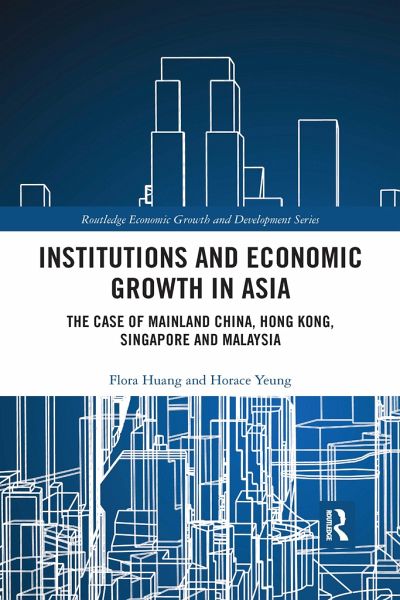
This book explores the role of institutions in economic growth, looking in particular at specific Asian countries and at particular cities within those countries. It considers a wide range of factors besides institutions, including the law, cultural factors and overall government arrangements. The differences between the different countries stud
This book explores the role of institutions in economic growth, looking in particular at specific Asian countries and at particular cities within those countries. It considers a wide range of factors besides institutions, including the law, cultural factors and overall government arrangements. The differences between the different countries stud
Flora Huang is Senior Lecturer in Law at the University of Essex, UK. Horace Yeung is a Lecturer in Commercial Law at the University of Leicester, UK.
Inhaltsangabe
1. Introduction 2. Institutions and Growth: Setting the Scene 1. What Matters? 1. Varieties of Growth Models 2. Importance and Dynamics of Institutions 2. Legal Institutions 1. Role of Law 2. Enforcement 3. Political Institutions 4. Cultural Institutions 5. Economic Institutions 6. Concluding Remarks 1. China 3.1 Economic Growth of China 3.1.1 Planned Economy before 1978 3.1.2 Economic Reform and Growth after 1978 3.2 Legal Institutions 3.2.1 Quality of the Laws 3.2.2 Public Enforcement 3.2.3 Private Enforcement 3.3 Political Institutions 3.4 Cultural Institutions 3.5 Role of Market Infrastructure 3.6 Determinants of Future Growth 3.7 Concluding Remarks 2. Hong Kong 4.1 Economic Growth of Hong Kong 4.1.1 Economic Development as a British Colony 4.1.2 Post-Handover Economic Development 4.2 Legal Institutions 4.2.1 Quality of the Laws 4.2.2 Public Enforcement 4.2.3 Private Enforcement 4.3 Political Institutions 4.4 Cultural Institutions 4.5 Role of Market Infrastructure 4.6 Determinants of Future Growth 4.7 Concluding Remarks 3. Singapore 5.1 Economic Growth of Singapore 5.1.1 Growth before Independence 5.1.2 Post-independence Economy 5.2 Legal Institutions 5.2.1 Quality of the Laws 5.2.2 Public Enforcement 5.2.3 Private Enforcement 5.3 Political Institutions 5.4 Cultural Institutions 5.5 Role of Market Infrastructure 5.6 Determinants of Future Growth 5.7 Concluding Remarks 4. Malaysia 6.1 Economic Growth of Malaysia 6.1.1 Growth before Independence 6.1.2 Post-independence Economy 6.2 Legal Institutions 6.2.1 Quality of the Laws 6.2.2 Public Enforcement 6.2.3 Private Enforcement 6.3 Political Institutions 6.4 Cultural Institutions 6.5 Role of Market Infrastructure 6.6 Determinants of Future Growth 6.7 Concluding Remarks 5. Globalisation, Regionalism and Interdependence of Economies 7.1 Rise of China as Engine of Global and Asian Growth 7.1.1 China and Hong Kong 7.1.2 China and Singapore 7.1.3 China and Malaysia 7.2 Transcontinental and Regional Cooperation: Lessons from ASEAN, TPP and OBOR 7.2.1 ASEAN 7.2.2 TPP 7.2.3 OBOR 7.3 Concluding Remarks 6. Conclusion
1. Introduction 2. Institutions and Growth: Setting the Scene 1. What Matters? 1. Varieties of Growth Models 2. Importance and Dynamics of Institutions 2. Legal Institutions 1. Role of Law 2. Enforcement 3. Political Institutions 4. Cultural Institutions 5. Economic Institutions 6. Concluding Remarks 1. China 3.1 Economic Growth of China 3.1.1 Planned Economy before 1978 3.1.2 Economic Reform and Growth after 1978 3.2 Legal Institutions 3.2.1 Quality of the Laws 3.2.2 Public Enforcement 3.2.3 Private Enforcement 3.3 Political Institutions 3.4 Cultural Institutions 3.5 Role of Market Infrastructure 3.6 Determinants of Future Growth 3.7 Concluding Remarks 2. Hong Kong 4.1 Economic Growth of Hong Kong 4.1.1 Economic Development as a British Colony 4.1.2 Post-Handover Economic Development 4.2 Legal Institutions 4.2.1 Quality of the Laws 4.2.2 Public Enforcement 4.2.3 Private Enforcement 4.3 Political Institutions 4.4 Cultural Institutions 4.5 Role of Market Infrastructure 4.6 Determinants of Future Growth 4.7 Concluding Remarks 3. Singapore 5.1 Economic Growth of Singapore 5.1.1 Growth before Independence 5.1.2 Post-independence Economy 5.2 Legal Institutions 5.2.1 Quality of the Laws 5.2.2 Public Enforcement 5.2.3 Private Enforcement 5.3 Political Institutions 5.4 Cultural Institutions 5.5 Role of Market Infrastructure 5.6 Determinants of Future Growth 5.7 Concluding Remarks 4. Malaysia 6.1 Economic Growth of Malaysia 6.1.1 Growth before Independence 6.1.2 Post-independence Economy 6.2 Legal Institutions 6.2.1 Quality of the Laws 6.2.2 Public Enforcement 6.2.3 Private Enforcement 6.3 Political Institutions 6.4 Cultural Institutions 6.5 Role of Market Infrastructure 6.6 Determinants of Future Growth 6.7 Concluding Remarks 5. Globalisation, Regionalism and Interdependence of Economies 7.1 Rise of China as Engine of Global and Asian Growth 7.1.1 China and Hong Kong 7.1.2 China and Singapore 7.1.3 China and Malaysia 7.2 Transcontinental and Regional Cooperation: Lessons from ASEAN, TPP and OBOR 7.2.1 ASEAN 7.2.2 TPP 7.2.3 OBOR 7.3 Concluding Remarks 6. Conclusion
Es gelten unsere Allgemeinen Geschäftsbedingungen: www.buecher.de/agb
Impressum
www.buecher.de ist ein Internetauftritt der buecher.de internetstores GmbH
Geschäftsführung: Monica Sawhney | Roland Kölbl | Günter Hilger
Sitz der Gesellschaft: Batheyer Straße 115 - 117, 58099 Hagen
Postanschrift: Bürgermeister-Wegele-Str. 12, 86167 Augsburg
Amtsgericht Hagen HRB 13257
Steuernummer: 321/5800/1497
USt-IdNr: DE450055826