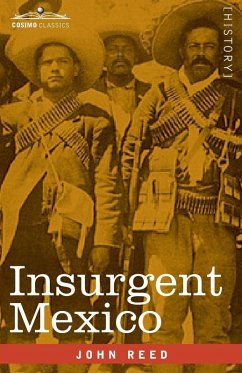
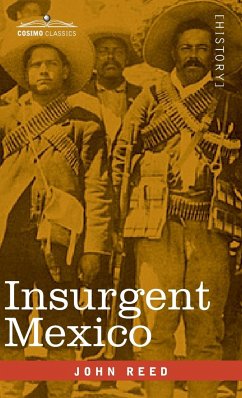
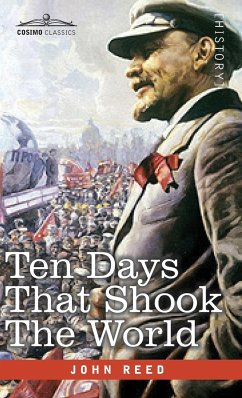
"...Villa was an outlaw for twenty-two years. When he was only a boy of sixteen,... he killed a government official... that in itself would not have outlawed him long in Mexico, where human life is cheap; but once a refugee he committed the unpardonable crime of stealing cattle from the rich "hacendados." And from that time to the outbreak of the Madero revolution, the Mexican government had a price on his head." -John Reed, Insurgent Mexico, (1914) American journalist John Reed was sent in 1913 to Mexico by the Metropolitan Magazine to cover the Mexican Revolution, an armed struggle from 1910…mehr
"...Villa was an outlaw for twenty-two years. When he was only a boy of sixteen,... he killed a government official... that in itself would not have outlawed him long in Mexico, where human life is cheap; but once a refugee he committed the unpardonable crime of stealing cattle from the rich "hacendados." And from that time to the outbreak of the Madero revolution, the Mexican government had a price on his head." -John Reed, Insurgent Mexico, (1914) American journalist John Reed was sent in 1913 to Mexico by the Metropolitan Magazine to cover the Mexican Revolution, an armed struggle from 1910 to 1920 that had a major impact on Mexican culture and government. While reporting on Pancho Villa, a former bandit, who became a Mexican revolutionary general and one of the most prominent figures of the Mexican Revolution, Reed established his national reputation as a war correspondent. Reed's articles were published in his book Insurgent Mexico (1914), which offers a fascinating read for anyone interested in the Mexican Revolution and its history.
John Silas Reed was an American journalist, poet, and communist activist known for his firsthand accounts of revolutionary movements. Born on October 22, 1887, in Portland, Oregon, to Charles Jerome Reed and Margaret Green Reed, he attended Harvard University, where he developed his literary and political interests. Reed gained recognition as a war correspondent, reporting on the Mexican Revolution and later covering World War I for socialist publications. His most famous work documented the Bolshevik Revolution, capturing the upheaval in Russia with vivid detail. Reed's commitment to communist ideals led him to join the Communist Labor Party of America, advocating for socialist change in the United States. His marriage to journalist Louise Bryant further immersed him in political activism, as both sought to promote leftist causes through their writings. Reed s revolutionary fervor brought him back to Russia, where he continued his work until his death from typhus in Moscow on October 17, 1920. He was honored with burial at the Kremlin Wall Necropolis, a rare distinction for a foreigner, solidifying his legacy as a dedicated voice of revolution.
Es gelten unsere Allgemeinen Geschäftsbedingungen: www.buecher.de/agb
Impressum
www.buecher.de ist ein Internetauftritt der buecher.de internetstores GmbH
Geschäftsführung: Monica Sawhney | Roland Kölbl | Günter Hilger
Sitz der Gesellschaft: Batheyer Straße 115 - 117, 58099 Hagen
Postanschrift: Bürgermeister-Wegele-Str. 12, 86167 Augsburg
Amtsgericht Hagen HRB 13257
Steuernummer: 321/5800/1497
USt-IdNr: DE450055826