Andere Kunden interessierten sich auch für
Produktdetails
- Verlag: ACADEMIC
- Seitenzahl: 268
- Erscheinungstermin: 26. Juli 2018
- Englisch
- Abmessung: 240mm x 161mm x 19mm
- Gewicht: 570g
- ISBN-13: 9780198817314
- ISBN-10: 0198817312
- Artikelnr.: 51255453
- Libri GmbH
- Europaallee 1
- 36244 Bad Hersfeld
- gpsr@libri.de
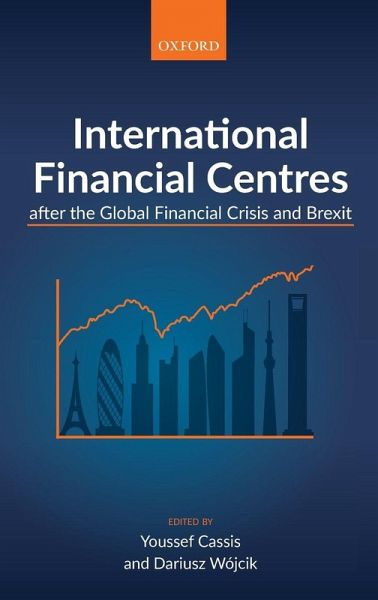
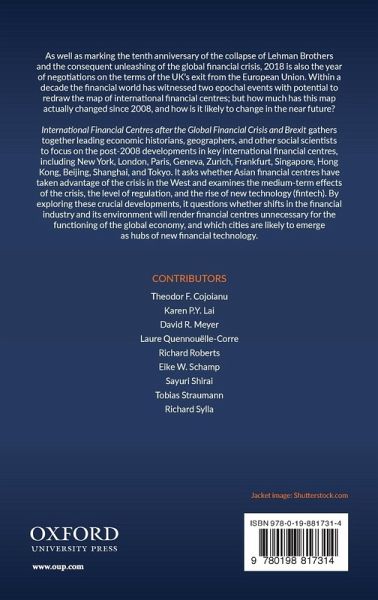
Youssef Cassis is Professor of Economic History at the European University Institute, in Florence. His work mainly focuses on banking and financial history, as well as business history more generally. His most recent publications include Capitals of Capital: A History of International Financial Centres, 1780-2005 (Cambridge University Press, 2006, 2nd revised edition, 2009), Crises and Opportunities: The Shaping of Modern Finance (OUP, 2011), and, with Philip Cottrell, Private Banking in Europe: Rise, Retreat and Resurgence (OUP, 2015). He has also recently co-edited, with Richard Grossman and Catherine Schenk, The Oxford Handbook of Banking and Financial History, (OUP, 2016). Professor Cassis was the cofounder, in 1994, of Financial History Review (Cambridge University Press). Dariusz Wójcik is Professor of Economic Geography at the School of Geography and the Environment, Oxford University, and Fellow of St Peters College Oxford. His research focuses on finance, globalization, and urban and regional development. He has published several books and over fifty articles, and serves on the editorial board of Economic Geography, the Journal of Economic Geography and GeoJournal. His recent books include The Geography of Finance: Corporate Governance in a Global Marketplace (OUP, 2007) and The Global Stock Market: Issuers, Investors and Intermediaries in an Uneven World (OUP, 2011). He is the co-editor of the New Oxford Handbook of Economic Geography (OUP, 2018). He has held visiting positions at the London School of Economics and Political Science, Hong Kong University, National University of Singapore, Beijing Normal University, and the University of Sydney, and convened the Global Conference on Economic Geography 2015.
* 1: Youssef Cassis: Introduction: A Global Overview from a Historical
Perspective
* 2: Richard Sylla: New York: Remains a, if not the, Pre-eminent
International Financial Centre
* 3: Richard Roberts: London: Downturn, Recovery and New Challenges -
but still Pre-eminent
* 4: Laure Quennouëlle-Corre: Paris: The Possibility of Revival as an
International Financial Centre
* 5: Eike W. Schamp: Frankfurt: A Tale of Resilience in the Crises
* 6: Tobias Straumann: Zurich and Geneva: The End of the Golden Age
* 7: David R. Meyer: Hong Kong, Shanghai, and Beijing: China's
Contenders for Global Financial Centre Leadership
* 8: Karen P.Y. Lai: Singapore: Connecting Asian Markets with Global
Finance
* 9: Sayuri Shirai: Tokyo: Still Below its Potential as a Global
Financial Centre
* 10: Dariusz Wójcik and Theodor F. Cojoianu: Conclusions: A Global
Overview from a Geographical Perspective
* 1: Youssef Cassis: Introduction: A Global Overview from a Historical
Perspective
* 2: Richard Sylla: New York: Remains a, if not the, Pre-eminent
International Financial Centre
* 3: Richard Roberts: London: Downturn, Recovery and New Challenges -
but still Pre-eminent
* 4: Laure Quennouëlle-Corre: Paris: The Possibility of Revival as an
International Financial Centre
* 5: Eike W. Schamp: Frankfurt: A Tale of Resilience in the Crises
* 6: Tobias Straumann: Zurich and Geneva: The End of the Golden Age
* 7: David R. Meyer: Hong Kong, Shanghai, and Beijing: China's
Contenders for Global Financial Centre Leadership
* 8: Karen P.Y. Lai: Singapore: Connecting Asian Markets with Global
Finance
* 9: Sayuri Shirai: Tokyo: Still Below its Potential as a Global
Financial Centre
* 10: Dariusz Wójcik and Theodor F. Cojoianu: Conclusions: A Global
Overview from a Geographical Perspective