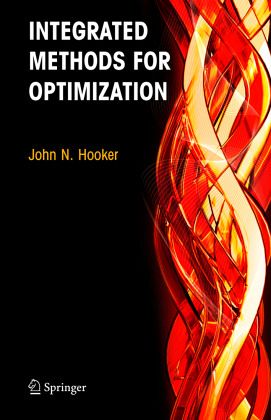
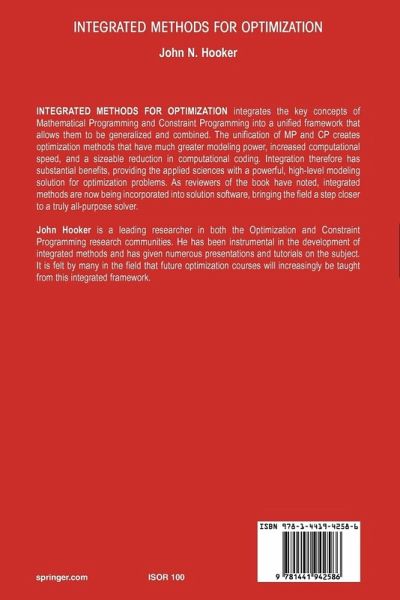
Integrated Methods for Optimization integrates the key concepts of Mathematical Programming and Constraint Programming into a unified framework that allows them to be generalized and combined. The unification of MP and CP creates optimization methods that have much greater modeling power, increased computational speed, and a sizeable reduction computational coding. Hence the benefits of this integration are substantial, providing the Applied Sciences with a powerful, high-level modeling solution for optimization problems. As reviewers of the book have noted, this integration along with…mehr
Integrated Methods for Optimization integrates the key concepts of Mathematical Programming and Constraint Programming into a unified framework that allows them to be generalized and combined. The unification of MP and CP creates optimization methods that have much greater modeling power, increased computational speed, and a sizeable reduction computational coding. Hence the benefits of this integration are substantial, providing the Applied Sciences with a powerful, high-level modeling solution for optimization problems. As reviewers of the book have noted, this integration along with constraint programming being incorporated into a number of programming languages, brings the field a step closer to being able to simply state a problem and having the computer solve it.
John Hooker is a leading researcher in both the Optimization and Constraint Programming research communities. He has been an instrumental principal for this integration, and over the years, he has givennumerous presentations and tutorials on the integration of these two areas. It is felt by many in the field that the future Optimization courses will increasingly be taught from this integrated framework.
Produktdetails
Produktdetails
International Series in Operations Research & Management Science 100
John Hooker is T. Jerome Holleran Professor of Business Ethics and Social Responsibility, and Professor of Operations Research, at Carnegie Mellon University. He is also part-time Visiting Professor at London School of Economics, 2009-2011. He holds doctoral degrees in philosophy and management science. His research interests include operations research, business ethics, and cross-cultural issues. He teaches courses in these fields at the undergraduate, postgraduate, and executive levels, and he has published over 130 articles and seven books. He is founding editor-in-chief of the Journal of Business Ethics Education and an area editor for INFORMS Journal on Computing. He is founding director of the Center for International Corporate Responsibility at Carnegie Mellon. He was recently named an INFORMS Fellow for outstanding contributions to operations research and the management sciences. His recent book Integrated Methods for Optimization reflects his primary research interests in operations research. He developed the ethics curriculum, including course materials, used in CMU's Tepper School of Business, and he has co-organized four conferences on international corporate responsibility. His book Working across Cultures is used as a text in cross-cultural business courses at several universities. He has lived and worked in Australia, China, Denmark, India, Qatar, Turkey, the United States, and Zimbabwe, and has extensive experience in Germany, Mexico, and the United Kingdom. He has led professional workshops in several countries. He was head of Carnegie Mellon's undergraduate Business Administration Program 1996-2001. He reorganized the program, led the design of its curriculum, and received a distinguished service award from the Tepper School for his contributions. In 2009 he received an Award for Sustained Teaching Excellence in the program.
Inhaltsangabe
Preface.- Introduction.- Search.- The solution process.- Branching search.- Constraint-directed search.- Local search.- Bibliographic notes.- Inference.- Completeness.- Inference duality.- Linear inequalities.- General inequality constraints.- Propositional logic.- 0-1 linear inequalities.- Integer linear inequalities.- The element constraint.- The all-different constraint.- The cardinality and Nvalues constraints.- The circuit constraint.- The stretch constraint.- Disjunctive scheduling.- Cumulative scheduling.- Bibliographic notes.- Relaxation.- Relaxation duality.- Linear inequalities.- Semicontinuous piecewise linear functions.- 0-1 linear inequalities.- Integer linear inequalities.- Lagrangean and surrogate relaxations.- Disjunctions of linear systems.- Disjunctions of nonlinear systems.- MILP modeling.- Propositional Logic.- The element constraint.- The all-different constraint.- The cardinality constraint.- The circuit constraint.- Disjunctive scheduling.- Cumulative scheduling.- Bibliographic notes.- Dictionary of constraints.- References.- Index.
Preface.- Introduction.- Search.- The solution process.- Branching search.- Constraint-directed search.- Local search.- Bibliographic notes.- Inference.- Completeness.- Inference duality.- Linear inequalities.- General inequality constraints.- Propositional logic.- 0-1 linear inequalities.- Integer linear inequalities.- The element constraint.- The all-different constraint.- The cardinality and Nvalues constraints.- The circuit constraint.- The stretch constraint.- Disjunctive scheduling.- Cumulative scheduling.- Bibliographic notes.- Relaxation.- Relaxation duality.- Linear inequalities.- Semicontinuous piecewise linear functions.- 0-1 linear inequalities.- Integer linear inequalities.- Lagrangean and surrogate relaxations.- Disjunctions of linear systems.- Disjunctions of nonlinear systems.- MILP modeling.- Propositional Logic.- The element constraint.- The all-different constraint.- The cardinality constraint.- The circuit constraint.- Disjunctive scheduling.- Cumulative scheduling.- Bibliographic notes.- Dictionary of constraints.- References.- Index.
Rezensionen
From the reviews of the second edition: "The book amply illustrates the power of combining the strengths of constraint programming, mathematical programming, global optimization, and heuristics by detailing these approaches, by articulating the commonalties among them, and by applying them to a wide range of optimization problems. ... this book covers the field both broadly and with sufficient granularity to provide working software engineers and graduate students with both a firm theoretical grasp of optimization and the software techniques needed to solve real-world problems. I recommend the book without reservation." (Marlin Thomas, ACM Computing Reviews, July, 2012)
Es gelten unsere Allgemeinen Geschäftsbedingungen: www.buecher.de/agb
Impressum
www.buecher.de ist ein Internetauftritt der buecher.de internetstores GmbH
Geschäftsführung: Monica Sawhney | Roland Kölbl | Günter Hilger
Sitz der Gesellschaft: Batheyer Straße 115 - 117, 58099 Hagen
Postanschrift: Bürgermeister-Wegele-Str. 12, 86167 Augsburg
Amtsgericht Hagen HRB 13257
Steuernummer: 321/5800/1497
USt-IdNr: DE450055826