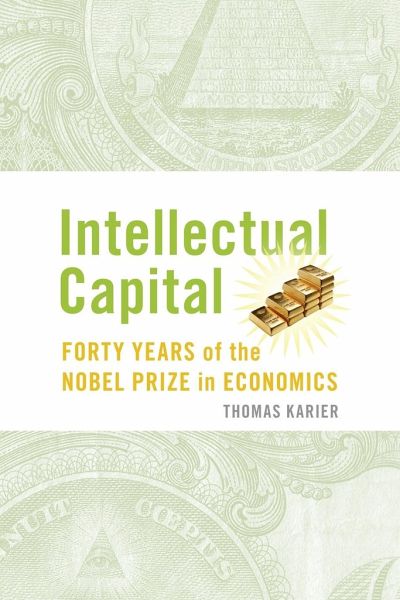
There is arguably no award more recognized in the academic and professional worlds than the Nobel Prize. The public pays attention to the prizes in the fields of economics, literature, and peace because their recipients are identified with particular ideas, concepts, or actions that often resonate with or sometimes surprise a global audience. The Nobel Prize in Economic Science established by the Bank of Sweden in 1969 has been granted to 64 individuals. Thomas Karier explores the core ideas of the economic theorists whose work led to their being awarded the Nobel in its first forty years. He…mehr
There is arguably no award more recognized in the academic and professional worlds than the Nobel Prize. The public pays attention to the prizes in the fields of economics, literature, and peace because their recipients are identified with particular ideas, concepts, or actions that often resonate with or sometimes surprise a global audience. The Nobel Prize in Economic Science established by the Bank of Sweden in 1969 has been granted to 64 individuals. Thomas Karier explores the core ideas of the economic theorists whose work led to their being awarded the Nobel in its first forty years. He also discusses the assumptions and values that underlie their economic theories, revealing different and controversial features of the content and methods of the discipline. The Nobelists include Keynesians, monetarists, financial economists, behaviorists, historians, statisticians, mathematicians, game theorists, and other innovators.
Thomas Karier is a Professor of Economics and a former associate dean at Eastern Washington University, Cheney, Washington, where he began teaching in 1981. He is also a research associate of the Jerome Levy Economics Institute at Bard College, New York. Professor Karier is the author of numerous scholarly and professional publications and two books: Beyond Competition (1993) and Great Experiments in American Economic Policy (1997). The topics of his research have ranged from wage policies, international competition, research and development expenditures, and welfare reform to the economic contributions of John Kenneth Galbraith. Professor Karier has conducted policy analysis for the Economic Policy Institute in Washington, DC, and the Washington State Institute for Public Policy in Olympia, Washington. Thomas Karier was appointed by the past two governors of Washington to represent the state on the Northwest Power and Conservation Council, which coordinates electric power planning and fish and wildlife recovery in the northwestern United States. He has written on energy and natural resource economics for the leading Washington state newspapers and commented on these subjects in the national media. Professor Karier received his Ph.D. from the University of California, Berkeley in 1985.
Inhaltsangabe
1. An economic prize 2. Free market economics 3. Micro: Chicago school 4. Stock market casino 5. More micro 6. A moral hazard 7. Keynesians 8. Classical revival 9. The inventors 10. Game geeks 11. General equilibrium 12. A world view 13. Numbers guys 14. History and institutions 15. Reshaping the prize.
1. An economic prize; 2. Free market economics; 3. Micro: Chicago school; 4. Stock market casino; 5. More micro; 6. A moral hazard; 7. Keynesians; 8. Classical revival; 9. The inventors; 10. Game geeks; 11. General equilibrium; 12. A world view; 13. Numbers guys; 14. History and institutions; 15. Reshaping the prize.
1. An economic prize 2. Free market economics 3. Micro: Chicago school 4. Stock market casino 5. More micro 6. A moral hazard 7. Keynesians 8. Classical revival 9. The inventors 10. Game geeks 11. General equilibrium 12. A world view 13. Numbers guys 14. History and institutions 15. Reshaping the prize.
1. An economic prize; 2. Free market economics; 3. Micro: Chicago school; 4. Stock market casino; 5. More micro; 6. A moral hazard; 7. Keynesians; 8. Classical revival; 9. The inventors; 10. Game geeks; 11. General equilibrium; 12. A world view; 13. Numbers guys; 14. History and institutions; 15. Reshaping the prize.
Rezensionen
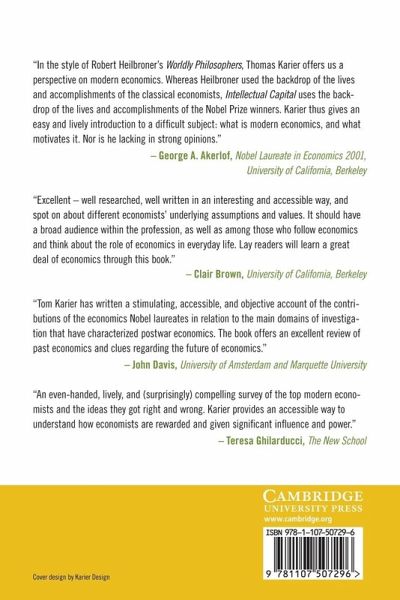
'In the style of Robert Heilbroner's Worldly Philosophers, Thomas Karier offers us a perspective on modern economics. Whereas Heilbroner used the backdrop of the lives and accomplishments of the classical economists, Intellectual Capital uses the backdrop of the lives and accomplishments of the Nobel Prize winners. Karier thus gives an easy and lively introduction to a difficult subject: what is modern economics, and what motivates it. Nor is he lacking in strong opinions.' George A. Akerlof, Nobel Laureate in Economics 2001, University of California, Berkeley
Es gelten unsere Allgemeinen Geschäftsbedingungen: www.buecher.de/agb
Impressum
www.buecher.de ist ein Internetauftritt der buecher.de internetstores GmbH
Geschäftsführung: Monica Sawhney | Roland Kölbl | Günter Hilger
Sitz der Gesellschaft: Batheyer Straße 115 - 117, 58099 Hagen
Postanschrift: Bürgermeister-Wegele-Str. 12, 86167 Augsburg
Amtsgericht Hagen HRB 13257
Steuernummer: 321/5800/1497
USt-IdNr: DE450055826