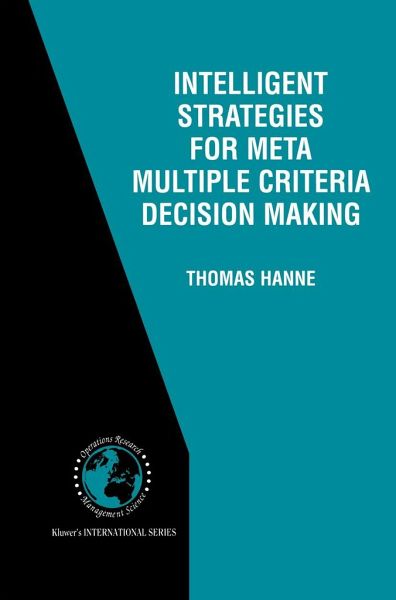
Multiple criteria decision-making research has developed rapidly and has become a main area of research for dealing with complex decision problems which require the consideration of multiple objectives or criteria. Over the past twenty years, numerous multiple criterion decision methods have been developed which are able to solve such problems. However, the selection of an appropriate method to solve a particular decision problem is today's problem for a decision support researcher and decision-maker. Intelligent Strategies for Meta Multiple Criteria Decision-Making deals centrally with the…mehr
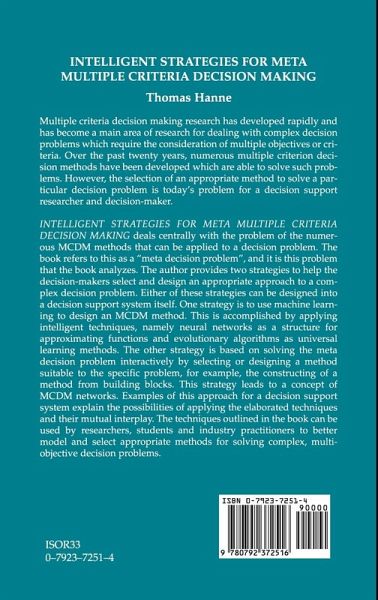
Multiple criteria decision-making research has developed rapidly and has become a main area of research for dealing with complex decision problems which require the consideration of multiple objectives or criteria. Over the past twenty years, numerous multiple criterion decision methods have been developed which are able to solve such problems. However, the selection of an appropriate method to solve a particular decision problem is today's problem for a decision support researcher and decision-maker. Intelligent Strategies for Meta Multiple Criteria Decision-Making deals centrally with the problem of the numerous MCDM methods that can be applied to a decision problem. The book refers to this as a `meta decision problem', and it is this problem that the book analyzes. The author provides two strategies to help the decision-makers select and design an appropriate approach to a complex decision problem. Either of these strategies can be designed into a decision support system itself. One strategy is to use machine learning to design an MCDM method. This is accomplished by applying intelligent techniques, namely neural networks as a structure for approximating functions and evolutionary algorithms as universal learning methods. The other strategy is based on solving the meta decision problem interactively by selecting or designing a method suitable to the specific problem, for example, the constructing of a method from building blocks. This strategy leads to a concept of MCDM networks. Examples of this approach for a decision support system explain the possibilities of applying the elaborated techniques and their mutual interplay. The techniques outlined in the book can be used by researchers, students, and industry practitioners to better model and select appropriate methods for solving complex, multi-objective decision problems.
Produktdetails
Produktdetails
International Series in Operations Research & Management Science 33
Thomas Hanne hat Diplomabschlüsse in Wirtschaftswissenschaften und Informatik und einen Doktortitel in Wirtschaftswissenschaften. Von 1999 bis 2007 arbeitete er am Fraunhofer-Institut für Techno- und Wirtschaftsmathematik (ITWM) als Wissenschaftler. Seitdem ist er Professor für Wirtschaftsinformatik an der Fachhochschule Nordwestschweiz und seit 2012 Leiter des Kompetenzzentrums Systems Engineering. Thomas Hanne ist Autor von etwa 180 Zeitschriften- und Konferenzartikeln und Herausgeber mehrerer Zeitschriften und Sonderausgaben. Seine aktuellen Forschungsinteressen umfassen multikriterielle Entscheidungsanalysen, evolutionäre Algorithmen, Metaheuristiken, Optimierung, Simulation, Logistik und Supply Chain Management. Rolf Dornberger ist Leiter des Instituts für Wirtschaftsinformatik, Hochschule für Wirtschaft, Fachhochschule Nordwestschweiz FHNW (seit 2007) und Leiter der Kompetenzzentren New Trends & Innovation (seit 2013) und Technology, Organization & People (seit 2014) und war Leiter des Kompetenzzentrums Systems Engineering (2006 - 2010). 2002 wurde er zum ausserordentlichen Professor und 2003 zum ordentlichen Professor für Wirtschaftsinformatik an der Fachhochschule Nordwestschweiz FHNW bzw. an deren Vorgängerin, der Fachhochschule Solothurn, ernannt. Darüber hinaus war er Lehrbeauftragter und Gastprofessor an der Universität Stuttgart und an der Zürcher Hochschule für Angewandte Wissenschaften. Bevor er an die Hochschule zurückkehrte, arbeitete er in der Industrie in verschiedenen Managementpositionen als Berater, IT-Verantwortlicher und leitender Forscher in verschiedenen Ingenieur-, Technologie- und IT-Unternehmen im Bereich Energieerzeugungssysteme und IT-Lösungen für die Luftfahrtbranche. Er besitzt einen Doktortitel (1998) und einen Diplomabschluss in Luft- und Raumfahrttechnik (1994). Zu seinen derzeitigen Forschungsinteressen gehören Computational Intelligence, Optimierung,Innovations- und Technologiemanagement sowie neue Trends und Innovationen.
Inhaltsangabe
1. Introduction.- 1. MCDM problems.- 2. Solutions of MCDM problems.- 3. Decision processes and the application of MCDM methods.- 4. Concepts of 'correct' decision making in MCDM methods.- 5. Summary and conclusions.- 2. The Meta Decision Problem in MCDM.- 1. Methodological criticism in MCDM.- 2. The met a decision problem in MCDM.- 3. Summary and conclusions.- 3. Neural Networks and Evolutionary Learning For MCDM.- 1. Neural networks and MCDM.- 2. Evolutionary learning.- 3. Summary and conclusions.- 4. On the Combination of MCDM Methods.- 1. Introduction.- 2. Properties of MCDM methods.- 3. Properties of specific MCDM methods.- 4. Properties of neurons and neural networks.- 5. The combination of algorithms.- 6. Neural MCDM networks.- 7. Termination and runtime of the algorithm.- 8. Summary and conclusions.- 5. Loops - An Object Oriented DSS for Solving Meta Decision Problems.- 1. Preliminary remarks.- 2. Method integration, openness, and object oriented implementation.- 3. A class concept for LOOPS.- 4. Problem solving and learning from an object oriented point of view.- 5. MADM methods in LOOPS.- 6. Neural networks in LOOPS.- 7. Neural MCDM networks in LOOPS.- 8. Evolutionary algorithms in LOOPS.- 9. An extended interactive framework.- 10. Summary and conclusions.- 6. Examples of the Application of Loops.- 1. Some remarks on the application of LOOPS.- 2. The learning of utility functions.- 3. Stock selection.- 4. Stock price prediction and the learning of time series.- 5. Stock analysis and long-term prediction.- 6. Method learning.- 7. Meta learning.- 8. An integrated proposal for the application of LOOPS.- 9. Summary and conclusions.- 7. Critical Resume and Outlook.- References.- Appendices.- A- Some basic concepts of MCDM theory.- 1. Relations.- 2. Efficiencyconcepts and scalarizing theorems.- 3. Utility concepts and other axiomatics 166 B- Some selected MCDM methods.- 1. Simple additive weighting.- 2. Achievement levels.- 3. Reference point approaches.- 4. The outranking method PROMETHEE 171 C- Neural networks.- 1. Introduction to neural networks.- 2. Neural networks for intelligent decision support 178 D- Evolutionary algorithms.- 1. Introduction to evolutionary algorithms.- 2. The generalization of evolutionary algorithms 186 E- List of symbols 189 F- List of abbreviations.
1. Introduction.- 1. MCDM problems.- 2. Solutions of MCDM problems.- 3. Decision processes and the application of MCDM methods.- 4. Concepts of 'correct' decision making in MCDM methods.- 5. Summary and conclusions.- 2. The Meta Decision Problem in MCDM.- 1. Methodological criticism in MCDM.- 2. The met a decision problem in MCDM.- 3. Summary and conclusions.- 3. Neural Networks and Evolutionary Learning For MCDM.- 1. Neural networks and MCDM.- 2. Evolutionary learning.- 3. Summary and conclusions.- 4. On the Combination of MCDM Methods.- 1. Introduction.- 2. Properties of MCDM methods.- 3. Properties of specific MCDM methods.- 4. Properties of neurons and neural networks.- 5. The combination of algorithms.- 6. Neural MCDM networks.- 7. Termination and runtime of the algorithm.- 8. Summary and conclusions.- 5. Loops - An Object Oriented DSS for Solving Meta Decision Problems.- 1. Preliminary remarks.- 2. Method integration, openness, and object oriented implementation.- 3. A class concept for LOOPS.- 4. Problem solving and learning from an object oriented point of view.- 5. MADM methods in LOOPS.- 6. Neural networks in LOOPS.- 7. Neural MCDM networks in LOOPS.- 8. Evolutionary algorithms in LOOPS.- 9. An extended interactive framework.- 10. Summary and conclusions.- 6. Examples of the Application of Loops.- 1. Some remarks on the application of LOOPS.- 2. The learning of utility functions.- 3. Stock selection.- 4. Stock price prediction and the learning of time series.- 5. Stock analysis and long-term prediction.- 6. Method learning.- 7. Meta learning.- 8. An integrated proposal for the application of LOOPS.- 9. Summary and conclusions.- 7. Critical Resume and Outlook.- References.- Appendices.- A- Some basic concepts of MCDM theory.- 1. Relations.- 2. Efficiencyconcepts and scalarizing theorems.- 3. Utility concepts and other axiomatics 166 B- Some selected MCDM methods.- 1. Simple additive weighting.- 2. Achievement levels.- 3. Reference point approaches.- 4. The outranking method PROMETHEE 171 C- Neural networks.- 1. Introduction to neural networks.- 2. Neural networks for intelligent decision support 178 D- Evolutionary algorithms.- 1. Introduction to evolutionary algorithms.- 2. The generalization of evolutionary algorithms 186 E- List of symbols 189 F- List of abbreviations.
Es gelten unsere Allgemeinen Geschäftsbedingungen: www.buecher.de/agb
Impressum
www.buecher.de ist ein Internetauftritt der buecher.de internetstores GmbH
Geschäftsführung: Monica Sawhney | Roland Kölbl | Günter Hilger
Sitz der Gesellschaft: Batheyer Straße 115 - 117, 58099 Hagen
Postanschrift: Bürgermeister-Wegele-Str. 12, 86167 Augsburg
Amtsgericht Hagen HRB 13257
Steuernummer: 321/5800/1497
USt-IdNr: DE450055826