
Andere Kunden interessierten sich auch für
 Interactions entre les bactéries et Batrachochytrium dendrobatidis16,99 €
 Wechselwirkungen zwischen Bakterien und Batrachochytrium dendrobatidis23,90 €
 Interakcje mi¿dzy bakteriami a Batrachochytrium dendrobatidis16,99 €
 Interações entre bactérias e Batrachochytrium dendrobatidis16,99 €
 Interazioni tra batteri e Batrachochytrium dendrobatidis16,99 €
 Effect of Mineral-Organic-Microorganism Interactions on Soil and Freshwater Environments116,99 €
 Effect of Mineral-Organic-Microorganism Interactions on Soil and Freshwater Environments113,99 €
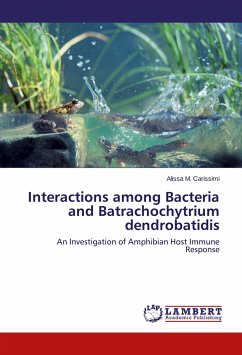
Pathogenic threats to biodiversity contribute significantly to community and species level extinctions, and for amphibians the chytrid fungus, Batrachochytrium dendrobatidis (Bd) is their greatest threat. The host-pathogen dynamics between amphibians and Bd are not fully understood; however, recent studies have shown that the microbial community composition on amphibian epidermal tissues can promote resistance to the disease. Antidermatophyte bacteria can inhibit fungi that require keratin from the epidermis for growth. Two species, Janthinobacterium lividum and Pseudomonas fluorescens, have been found on Bd resistant amphibians. In a series of three individual experiments, Bd susceptible amphibians (i.e. Lithobates shpenocephalus) were exposed to these bacteria both before and after experimental infection by Bd. J. lividum and P. fluorescens mounted a strong immune response, and therefore, can be used to prevent Bd induced mortality. Conversely, neither bacteria proved effectivewhen applied to those frogs with prior Bd exposure. These results can be used to address other aspects of amphibian immunity when Bd and bacteria induce changes of their epidermal community structure.