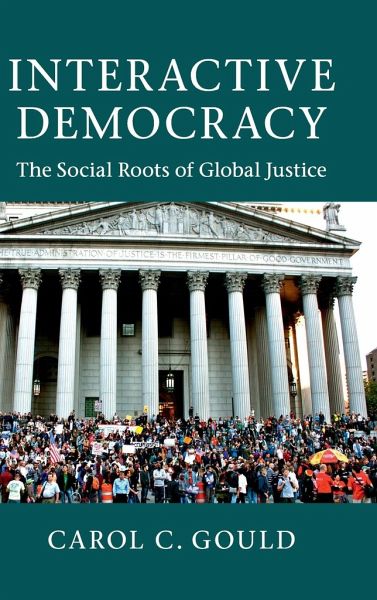
How can we confront the problems of diminished democracy, pervasive economic inequality, and persistent global poverty? Is it possible to fulfill the dual aims of deepening democratic participation and achieving economic justice, not only locally but also globally? Carol C. Gould proposes an integrative and interactive approach to the core values of democracy, justice, and human rights, looking beyond traditional politics to the social conditions that would enable us to realize these aims. Her innovative philosophical framework sheds new light on social movements across borders, the prospects…mehr
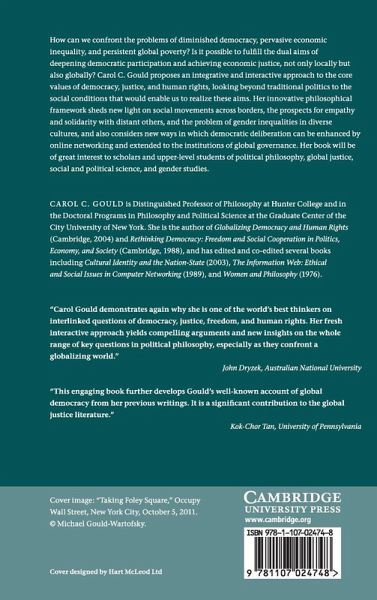
How can we confront the problems of diminished democracy, pervasive economic inequality, and persistent global poverty? Is it possible to fulfill the dual aims of deepening democratic participation and achieving economic justice, not only locally but also globally? Carol C. Gould proposes an integrative and interactive approach to the core values of democracy, justice, and human rights, looking beyond traditional politics to the social conditions that would enable us to realize these aims. Her innovative philosophical framework sheds new light on social movements across borders, the prospects for empathy and solidarity with distant others, and the problem of gender inequalities in diverse cultures, and also considers new ways in which democratic deliberation can be enhanced by online networking and extended to the institutions of global governance. Her book will be of great interest to scholars and upper-level students of political philosophy, global justice, social and political science, and gender studies.
Carol C. Gould is Distinguished Professor of Philosophy at Hunter College and in the Doctoral Programs in Philosophy and Political Science at the Graduate Center of the City University of New York. She is the author of Globalizing Democracy and Human Rights (Cambridge, 2004) and Rethinking Democracy: Freedom and Social Cooperation in Politics, Economy, and Society (Cambridge, 1988), and has edited and co-edited several books including Cultural Identity and the Nation-State (2003), The Information Web: Ethical and Social Issues in Computer Networking (1989) and Women and Philosophy (1976).
Inhaltsangabe
Introduction Part I. A Theoretical Framework: 1. A human rights approach to global justice: elements of theory and practice 2. A social ontology of human rights 3. Interpreting freedom dynamically: beyond liberty and autonomy to positive freedom 4. Is there a human right to democracy? Part II. The Social Roots of Global Justice: 5. Transnational solidarities 6. Does global justice presuppose global solidarity? 7. Recognition and care in global justice 8. Gender equality, culture, and the interpretation of human rights 9. The sociality of free speech: the case of humor across cultures 10. Violence, power-with, and the human right to democracy Part III. Interactive Democracy - Transnational, Regional, Global: 11. Diversity, democracy, and dialogue in a human rights framework 12. What is emancipatory networking? 13. Structuring transnational democracy: participation, self-determination, and new forms of representation 14. Democratic management and international labor rights 15. Regional vs global democracy: possibilities and limitations Works cited Index.
Es gelten unsere Allgemeinen Geschäftsbedingungen: www.buecher.de/agb
Impressum
www.buecher.de ist ein Internetauftritt der buecher.de internetstores GmbH
Geschäftsführung: Monica Sawhney | Roland Kölbl | Günter Hilger
Sitz der Gesellschaft: Batheyer Straße 115 - 117, 58099 Hagen
Postanschrift: Bürgermeister-Wegele-Str. 12, 86167 Augsburg
Amtsgericht Hagen HRB 13257
Steuernummer: 321/5800/1497
USt-IdNr: DE450055826