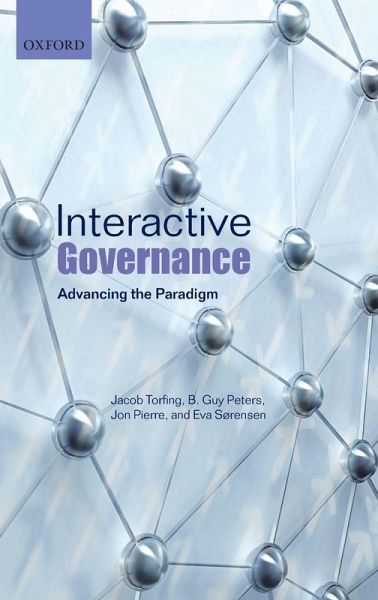
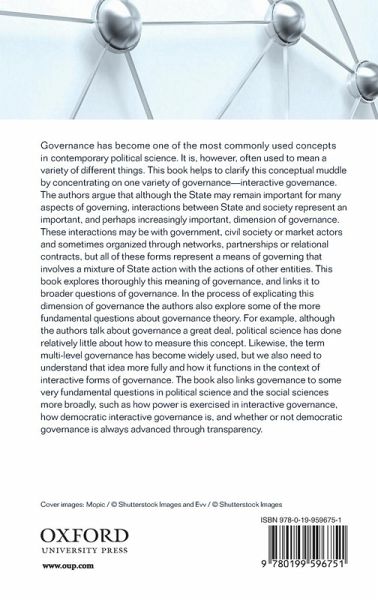
Governance has become one of the most commonly used concepts in contemporary political science. It is, however, often used to mean a variety of different things. This book helps to clarify this conceptual muddle by concentrating on one variety of governance-interactive governance.
Governance has become one of the most commonly used concepts in contemporary political science. It is, however, often used to mean a variety of different things. This book helps to clarify this conceptual muddle by concentrating on one variety of governance-interactive governance.
Jacob Torfing teaches political science, political theory and public administration. He is the author of Collaborative Innovation in the Public Sector (Georgetown University Press, 2016). He is Professor in Politics and Institutions at Roskilde University in Denmark and Professor II at Nord University in Norway. B. Guy Peters is an honorary professor at the City University of Hong Kong. He is author or editor of over 60 books and is currently founding co-editor of the European Political Science Review. He is Maurice Falk Professor of American Government at the University of Pittsburgh and also Distinguished Professor of Comparative Governance at the Zeppelin University in Germany. Jon Pierre holds adjunct professorships at the University of Pittsburgh and University of Nordland in Norway. He has published extensively on theories of governance, public administration and urban politics. He is co-author (with Guy Peters) of Governance, Politics and the State (Palgrave, 2000) and Governing Complex Societies (Palgrave, 2005) and editor of Debating Governance (Oxford University Press). He is Professor of Political Science at the University of Gothenburg. Eva Sørensen is Professor of Public Administration and Democracy at Roskilde University, and Professor II at Nord University. She is a long time student of public sector reform in Western liberal democracies. Her main focus has been on how interactive forms of governance that bring public and private actors in to close collaboration has affected the capacity of the public sector to provide effective, innovative, and democratic governance. In recent years her interest has turned towards the question of what the surge of interactive governance implies for political leadership. She is the author of Interactive Political Leadership (OUP, forthcoming).
Inhaltsangabe
Introduction 1: The Governance Debate and the Rise of Interactive Governance 2: Governance in other Disciplines: One Approach or Many? 3: Power and Politics In Interactive Governance 4: Measuring Governance 5: Horizontal, Vertical, and Diagonal Governance 6: Institutionalizing Interactive Governance 7: Metagovernance: The Art of Governing Interactive Governance 8: New Roles and Role Dilemmas in Interactive Governance 9: Assessing and Improving Effective Interactive Governance 10: Assessing And Improving The Democratic Quality of Interactive Governance 11: Transparency and Governance 12: Conclusions References
Introduction 1: The Governance Debate and the Rise of Interactive Governance 2: Governance in other Disciplines: One Approach or Many? 3: Power and Politics In Interactive Governance 4: Measuring Governance 5: Horizontal, Vertical, and Diagonal Governance 6: Institutionalizing Interactive Governance 7: Metagovernance: The Art of Governing Interactive Governance 8: New Roles and Role Dilemmas in Interactive Governance 9: Assessing and Improving Effective Interactive Governance 10: Assessing And Improving The Democratic Quality of Interactive Governance 11: Transparency and Governance 12: Conclusions References
Es gelten unsere Allgemeinen Geschäftsbedingungen: www.buecher.de/agb
Impressum
www.buecher.de ist ein Internetauftritt der buecher.de internetstores GmbH
Geschäftsführung: Monica Sawhney | Roland Kölbl | Günter Hilger
Sitz der Gesellschaft: Batheyer Straße 115 - 117, 58099 Hagen
Postanschrift: Bürgermeister-Wegele-Str. 12, 86167 Augsburg
Amtsgericht Hagen HRB 13257
Steuernummer: 321/5800/1497
USt-IdNr: DE450055826