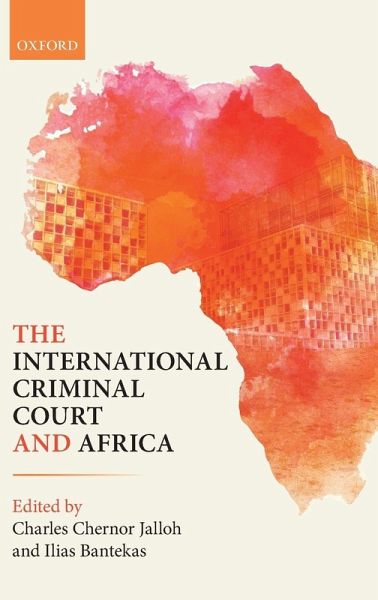
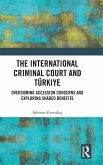
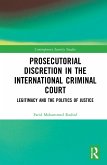
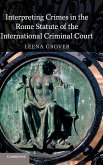
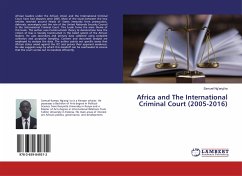
Africa has been at the forefront of contemporary global efforts towards ensuring greater accountability for international crimes. But the continent's early embrace of international criminal justice seems to be taking a new turn with the recent resistance from some African states claiming that the emerging system of international criminal law represents a new form of imperialism masquerading as international rule of law. This book analyses the relationship and tensions between the International Criminal Court (ICC) and Africa. It traces the origins of the confrontation between African…mehr
Africa has been at the forefront of contemporary global efforts towards ensuring greater accountability for international crimes. But the continent's early embrace of international criminal justice seems to be taking a new turn with the recent resistance from some African states claiming that the emerging system of international criminal law represents a new form of imperialism masquerading as international rule of law. This book analyses the relationship and tensions between the International Criminal Court (ICC) and Africa. It traces the origins of the confrontation between African governments, both acting individually and within the framework of the African Union, and the permanent Hague-based ICC. Leading commentators offer valuable insights on the core legal and political issues that have confused the relationship between the two sides and expose the uneasy interaction between international law and international politics. They offer suggestions on how best to continue the fight against impunity, using national, ICC, and regional justice mechanisms, while taking into principled account the views and interests of African States.
Charles Chernor Jalloh is Full Professor of International Law at Florida International University (FIU), Miami, USA and a member of the United Nations International Law Commission. He has practiced law in the Canadian Department of Justice, the International Criminal Tribunal for Rwanda, the Special Court for Sierra Leone (SCSL), where he was duty counsel in the trial of former Liberian President Charles Taylor and, as a visiting professional, in the International Criminal Court (ICC). Ilias Bantekas is Full Professor of international law at Brunel University School of Law and Director of the University of London LLB Program in Athens. He has held visiting appointments, among others, at Harvard, School of Oriental and African Studies (UoL), Miami and Cleveland-State, and has advised governments and international organisations, such as the UNDP, the European Union and the Council of Europe, as well as international law firms and non-governmental organisations.
Inhaltsangabe
* 1: Martin Mennecke: The African Union and Universal Jurisdiction * 2: Manisuli Ssenyonjo: The Implementation of the Proprio Motu Authority of the Prosecutor in Africa * 3: Benson Olugbuo: Operationalizing the Complementarity Principle: The Case for a Differentiated Standard * 4: Ilias Bantekas: Sequencing Peace and Justice in Post-Conflict Africa: The ICC Perspective * 5: Gino Naldi and Konstantinos Magliveras: The International Criminal Court and the African Union: A Problematic Relationship * 6: Paolo Gaeta and Patryk I. Labuda: Trying Sitting Heads of State: The African Union versus the ICC in the Al Bashir and Kenyatta Cases * 7: Dire D. Tladi: Presence of the Accused, Right or Duty? The Art of Interpretation in a Tense Political Climate * 8: Charles Chernor Jalloh: The African Union, the Security Council and the International Criminal Court * 9: Manisuli Ssenyonja: State Withdrawals from the Rome Statute of the International Criminal Court: South Africa, Burundi, and The Gambia * 10: Kebreab Isaac Weldesellasie: The Development of Criminal Law and Criminal Justice in Africa from pre-Colonial Rule to Present Day * 11: Olympia Bekou: National Implementation of the ICC Statute to Prosecute International Crimes in Africa * 12: Charles Chernor Jalloh: The Place of the African Criminal Court in the Prosecution of Serious Crimes in Africa * 13: Efthymios Papastavridis: Who Will Prosecute Piracy in Africa? * 14: Pacifique Manirakiza: Complementing the ICC Efforts to Curb the Impunity of International Crimes in Africa: The Role and Contribution of Community-Based Mechanisms * Conclusion
* 1: Martin Mennecke: The African Union and Universal Jurisdiction * 2: Manisuli Ssenyonjo: The Implementation of the Proprio Motu Authority of the Prosecutor in Africa * 3: Benson Olugbuo: Operationalizing the Complementarity Principle: The Case for a Differentiated Standard * 4: Ilias Bantekas: Sequencing Peace and Justice in Post-Conflict Africa: The ICC Perspective * 5: Gino Naldi and Konstantinos Magliveras: The International Criminal Court and the African Union: A Problematic Relationship * 6: Paolo Gaeta and Patryk I. Labuda: Trying Sitting Heads of State: The African Union versus the ICC in the Al Bashir and Kenyatta Cases * 7: Dire D. Tladi: Presence of the Accused, Right or Duty? The Art of Interpretation in a Tense Political Climate * 8: Charles Chernor Jalloh: The African Union, the Security Council and the International Criminal Court * 9: Manisuli Ssenyonja: State Withdrawals from the Rome Statute of the International Criminal Court: South Africa, Burundi, and The Gambia * 10: Kebreab Isaac Weldesellasie: The Development of Criminal Law and Criminal Justice in Africa from pre-Colonial Rule to Present Day * 11: Olympia Bekou: National Implementation of the ICC Statute to Prosecute International Crimes in Africa * 12: Charles Chernor Jalloh: The Place of the African Criminal Court in the Prosecution of Serious Crimes in Africa * 13: Efthymios Papastavridis: Who Will Prosecute Piracy in Africa? * 14: Pacifique Manirakiza: Complementing the ICC Efforts to Curb the Impunity of International Crimes in Africa: The Role and Contribution of Community-Based Mechanisms * Conclusion
Es gelten unsere Allgemeinen Geschäftsbedingungen: www.buecher.de/agb
Impressum
www.buecher.de ist ein Internetauftritt der buecher.de internetstores GmbH
Geschäftsführung: Monica Sawhney | Roland Kölbl | Günter Hilger
Sitz der Gesellschaft: Batheyer Straße 115 - 117, 58099 Hagen
Postanschrift: Bürgermeister-Wegele-Str. 12, 86167 Augsburg
Amtsgericht Hagen HRB 13257
Steuernummer: 321/5800/1497
USt-IdNr: DE450055826