International commitments may sit uneasily with national pressures in the best of times. This age of economic uncertainty brings these tensions into sharper relief. This volume draws together thirteen analyses of this tension in a wide array of contexts, including each of the three main pillars of the World Trade Organization, international investment law and arbitration, and the international financial institutions. The essays feature internationally recognised experts addressing topical examples of international economic law obligations clashing with domestic political interests. For…mehr
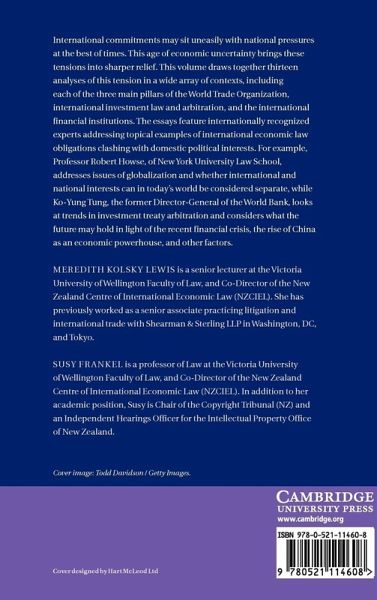
International commitments may sit uneasily with national pressures in the best of times. This age of economic uncertainty brings these tensions into sharper relief. This volume draws together thirteen analyses of this tension in a wide array of contexts, including each of the three main pillars of the World Trade Organization, international investment law and arbitration, and the international financial institutions. The essays feature internationally recognised experts addressing topical examples of international economic law obligations clashing with domestic political interests. For example, Professor Robert Howse, of New York University Law School, addresses issues of globalization and whether international and national interests can in today's world be considered separate, while Ko-Yung Tung, the former Director-General of the World Bank, looks at trends in investment treaty arbitration and considers what the future may hold in light of the recent financial crisis, the rise of China as an economic powerhouse, and other factors.
Susy Frankel is a Professor of Law at the Victoria University of Wellington Faculty of Law and Co-Director of the New Zealand Centre of International Economic Law (NZCIEL). In addition to her academic position, Susy is Chair of the Copyright Tribunal (NZ) and an Independent Hearings Officer for the Intellectual Property Office of New Zealand.
Inhaltsangabe
Part I. International Economic Law: Conceptions of Convergence and Divergence: 1. The end of the globalization debate - continued Robert Howse; 2. Global economic institutions and the autonomy of development policy: a pluralist approach Yuka Fukunaga; 3. Fragmentation, openness, and hegemony: adjudication and the WTO Jason Beckett; Part II. WTO Treaty Interpretation: Implications and Consequences: 4. Demanding perfection: private food standards and the SPS Agreement Tracey Epps; 5. Eroding national autonomy from the TRIPS Agreement Susy Frankel; 6. The WTO and RTAs: a 'bottom-up' interpretation of RTAs' autonomy over WTO law Alberta Fabbricotti; 7. 'Gambling' with sovereignty: complying with international obligations or upholding national autonomy Henning Grosse Ruse-Kahn; Part III. Responding to International Economic Law Commitments: 8. Safety standards and indigenous products: what role for traditional knowledge? Meredith Kolsky Lewis; 9. The GATS and temporary migration policy Rafael Leal-Arcas; 10. A different approach to the external trade requirement of GATT Article XXIV: assessing 'other regulations of commerce' in the context of EC enlargement and its heightened regulatory standards Pinar Artiran; Part IV. Transformations in International Economic Law: 11. Foreign investors vs. sovereign states: towards a global framework, BIT by BIT Ko-Yung Tung; 12. What about the people? How GATS Mode 4 transforms national regulation of temporary migration for remittances in poor countries Jane Kelsey; 13. Reconceptualising international investment law: bringing the public interest into private business Kate Miles.
Es gelten unsere Allgemeinen Geschäftsbedingungen: www.buecher.de/agb
Impressum
www.buecher.de ist ein Internetauftritt der buecher.de internetstores GmbH
Geschäftsführung: Monica Sawhney | Roland Kölbl | Günter Hilger
Sitz der Gesellschaft: Batheyer Straße 115 - 117, 58099 Hagen
Postanschrift: Bürgermeister-Wegele-Str. 12, 86167 Augsburg
Amtsgericht Hagen HRB 13257
Steuernummer: 321/5800/1497
USt-IdNr: DE450055826